Apparition Hill Medjugorje — climbing Podbrdo
Međugorje and Apparition Hill Private Tour From Dubrovnik
What is Apparition Hill in Medjugorje and how do you climb it?
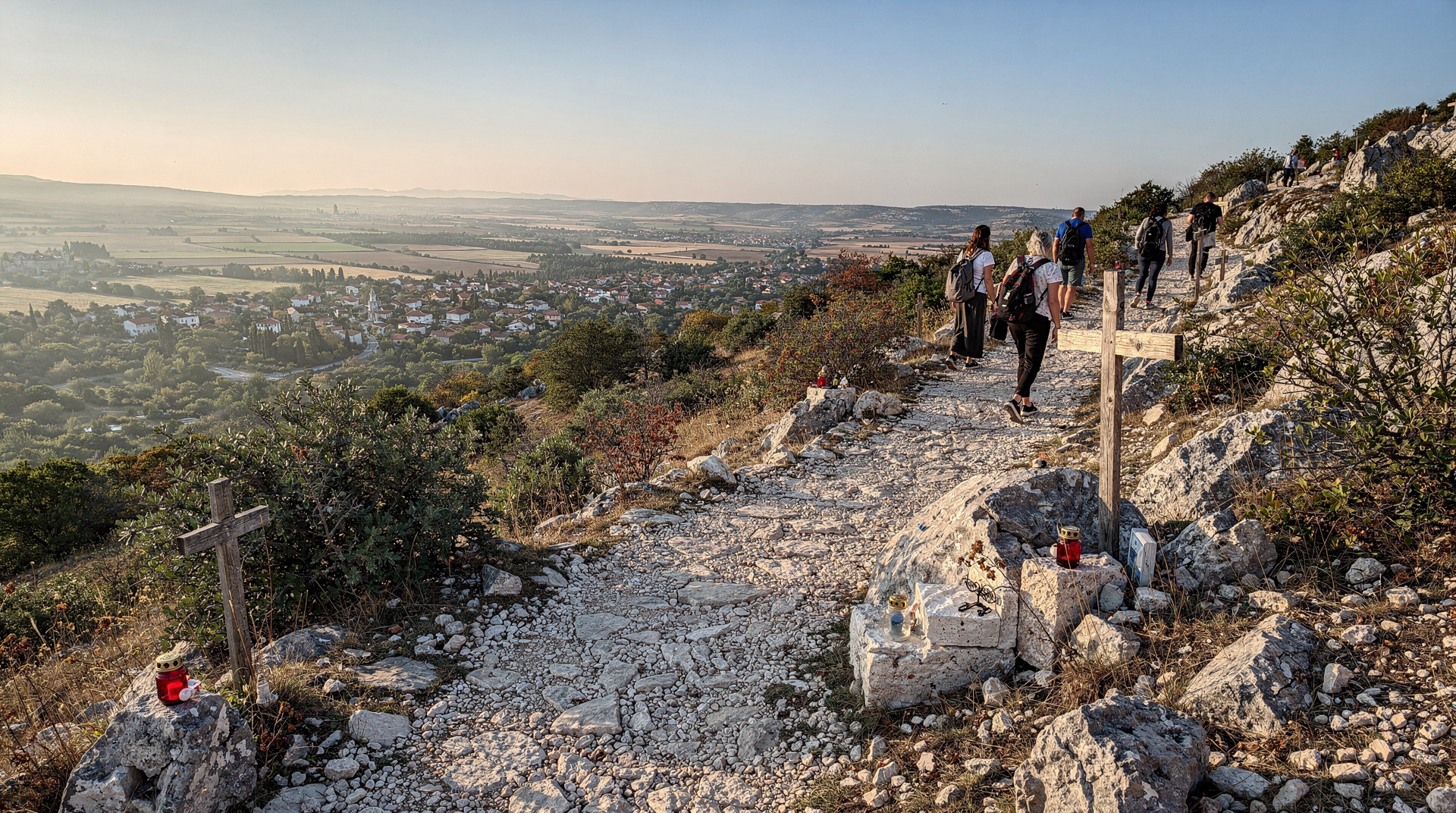
Apparition Hill (Podbrdo) is the rocky hillock outside Medjugorje where six young people first reported seeing the Virgin Mary on 24 June 1981. The climb takes 20–30 minutes on rough limestone; sturdy shoes are essential. A bronze statue of the Virgin marks the first apparition site partway up.
| At a glance | |
|---|---|
| Where | Podbrdo hillock on the edge of Medjugorje village, Herzegovina |
| Cost | Free and open access at any time |
| Time needed | 1-1.5 hours round trip including time at the statue |
| Getting there | On foot from the village centre; most pilgrims arrive by organised coach or from Mostar/Dubrovnik day tours |
| Best time | Early morning or late afternoon; avoid midday heat June-August |
The hill does not look like much from the road. Podbrdo — Apparition Hill in Medjugorje — rises perhaps 150 metres above the surrounding tobacco fields on its roughest flank. In late afternoon it glows pale gold. On a summer morning it is already full of people before the heat builds, many of them walking barefoot over the limestone as an act of penance.
Since 1981, when six young people from the village said they saw a luminous figure here, Podbrdo has become one of the most visited pilgrimage sites in the world. Whatever your own beliefs, climbing it is a quietly remarkable experience — not because of the geology, but because of who you will meet on the way.
The first apparition, June 1981
On the evening of 24 June 1981, Ivanka Ivanković and Mirjana Dragičević were walking near Podbrdo when, they later said, a figure of light appeared on the hillside. The following day, four more young people accompanied them — Vicka Ivanković, Ivan Dragičević, Marija Pavlović and Jakov Čolo — and all six reported seeing the Virgin Mary and hearing her speak.
The message they described was consistent with mainstream Marian apparition tradition: a call to prayer, peace, fasting and conversion. Local Communist authorities were alarmed and briefly detained the visionaries and the Franciscan priests who supported them. The crowds that continued to gather on the hillside could not be stopped.
The word spread through Yugoslavia and then internationally. Within a decade Medjugorje had received millions of visitors. The apparitions are considered ongoing by several of the original visionaries, who say they continue to receive messages.
For a broader overview of Medjugorje as a site and the Church’s position on it, see the Medjugorje pilgrimage guide.
The path up Podbrdo
The path to Apparition Hill begins at the edge of the village, signposted from the church and from the main road. The trailhead has a small car park, a water tap, and a bench.
The first section is a well-worn track through scrubby vegetation before the limestone begins in earnest. The rock here is light grey to white, broken into slabs and loose chips that shift underfoot. In dry weather it is grippy; after rain it becomes treacherous. Flat-soled sandals or flip-flops are a genuine risk — they can tear on the sharp edges and provide no grip on the incline.
The bronze statue
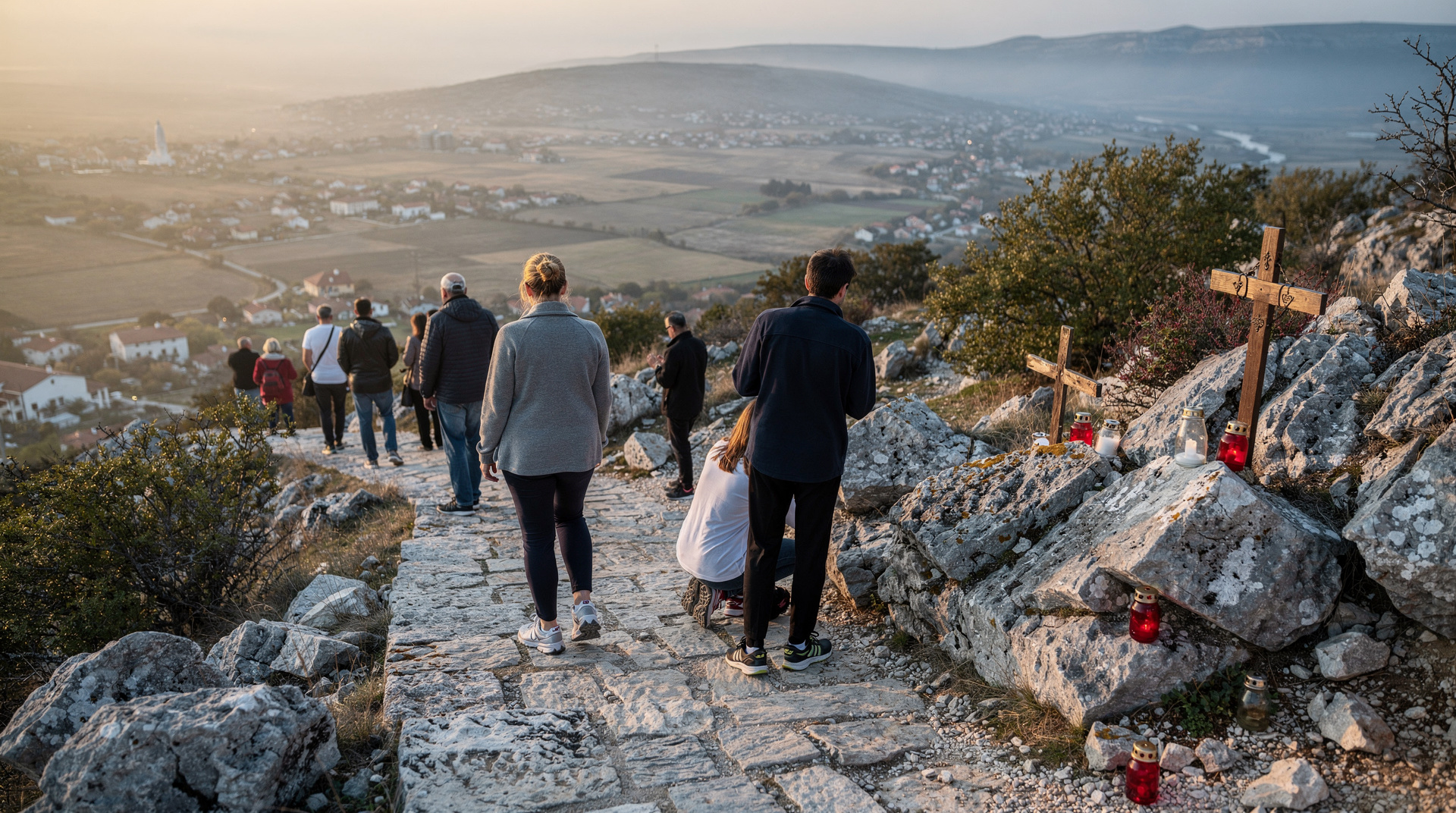
About halfway up — roughly 15 minutes at a steady pace — a life-size bronze statue of the Virgin Mary marks the spot the visionaries identified as the first apparition site. This is the focal point for most pilgrims. Groups gather here to pray the rosary, sometimes in organised processions of fifty or a hundred people led by a priest or leader; sometimes in small family groups, heads bowed and quiet.
The area around the statue is smoothed by millions of feet and hands. Rosaries, flowers, photographs and laminated prayers are left at its base. On major feast days the crowd here can be dense.
The summit
The path continues above the statue for another 10–15 minutes to the summit of Podbrdo, where a small cross marks the highest point. The view from the top is striking in its ordinariness — flat fields of tobacco and vegetables, the church spire below, distant ridges of Herzegovina, the mountains of Montenegro on a clear day. The scale of what a small village set in this unremarkable landscape has attracted to itself becomes clear from up here.
Book a guided Medjugorje and Apparition Hill private tour from Dubrovnik for an organised experience that includes transport and local commentary.
The mysteries of the rosary — stations on the path
The path up Podbrdo is marked with a series of bronze relief plaques depicting the Joyful, Sorrowful and Glorious Mysteries of the Rosary — the 15 traditional prayer sequences of Catholic Marian devotion. Groups pray one mystery at each station as they ascend, making the climb itself a continuous act of prayer rather than simply a hike to a viewpoint.
Individual visitors may or may not choose to engage with the stations. They are present, visible, and mark a spiritual rhythm to the ascent that is distinct from secular hill-walking.
Cross Mountain (Križevac) — the second pilgrimage hill
While Podbrdo is the site of the apparitions, Cross Mountain (Križevac, 520 m) is physically larger and more demanding. The 4 km path to the summit is stone-paved and marked with 14 Stations of the Cross in bronze relief. The climb takes 45–60 minutes.
The large concrete cross at the summit — built in 1934, 47 years before the apparitions — has become a secondary symbol of Medjugorje. It is visible for kilometres. Sunrise climbs to Križevac are a tradition among pilgrims; the path is steep in the final section and a torch is necessary if you start before light.
If time is limited, Podbrdo is the more historically significant site for pilgrims; Križevac is better for those who want a more physical challenge and a wider view.
Practical advice for Apparition Hill
Shoes: Non-negotiable — wear closed, rubber-soled shoes. The limestone cuts through thin soles and sandal straps. Many pilgrims go barefoot as an intentional act of penance, but this is not recommended for casual visitors.
Water: Bring at least half a litre per person. The climb is not long but the sun reflection from white limestone is intense in summer. The water tap at the trailhead is the last water before the top.
Crowds: The anniversary of the first apparition (24–25 June) and major Marian feast days bring very large crowds — hundreds of organised pilgrim groups. A quiet weekday in May, September or October is a different experience entirely.
Time: Allow 1–1.5 hours for the round trip including time at the bronze statue. Add another hour if you want to sit quietly and watch the pilgrims.
Combined with the church: Most visitors combine Apparition Hill with a visit to St James’s Parish Church (a short walk away) and, if time allows, the Old Bridge in Mostar. The 30 km distance makes Mostar a natural companion stop.
Who climbs Apparition Hill
On any given morning in summer you might share the path with a group of elderly Croatian women with rosaries, a Brazilian family photographing each station, a German priest in clerical collar, a pair of Irish students in hiking boots, a South Korean nun in full habit, and a retired couple from the United States who have been making this pilgrimage annually for twenty years. The congregation of Medjugorje is one of the most international gatherings in the Balkans.
For the non-believing visitor, this mix of humanity — its devotion, its quiet intensity, its sheer geographical diversity — is genuinely moving on its own terms, separate from any question of whether apparitions occur.
Frequently asked questions about Apparition Hill
Do I need permission to climb Apparition Hill?
No. The hill is freely accessible to all visitors. The path is managed by the Medjugorje parish but open without charge or reservation.
Is Apparition Hill the same as the Blue Cross?
The Blue Cross is a landmark slightly below the bronze statue site, where a blue metal cross marks a particular location significant in the visionaries’ accounts of the early apparitions. It is on the main path and visible as you approach the bronze statue.
Can I climb Apparition Hill at night?
Yes, though it requires a torch (the path is not lit) and awareness that the loose limestone is harder to see in low light. Night climbs are particularly popular around the June anniversary and during organised retreat weeks.
How does Apparition Hill compare to other Marian apparition sites?
Medjugorje is in a different category from approved Marian shrines like Lourdes (France) or Fatima (Portugal) — those have received full Church approval; Medjugorje has not. In terms of visitor numbers, Medjugorje now exceeds both. The atmosphere on Podbrdo is more informal and less institutionalised than at either of the major European shrines — which some visitors prefer.
Planning the climb around the rest of your day
Podbrdo works best as a slow morning or late-afternoon stop rather than something squeezed between coach departures. If you are driving yourself, the driving in Bosnia guide covers road conditions and parking habits, and visitors crossing from the coast will find the border logistics in the driving from Croatia to Bosnia guide. Those without a car can look at getting around Bosnia for the realistic options.
Travellers based in Mostar can let someone else handle the logistics with a private day combining the hill with the Old Bridge town, while those staying in the capital have a full-day pilgrimage tour that starts in Sarajevo.
Think about the weather before you commit to a start time. The hill offers almost no shade, so a clear summer day asks more of you than the route suggests. The best time to visit Bosnia page explains how the seasons shape a trip to Herzegovina, and it helps to match your visit to the quieter months if you want space to pause at the statue.
What to expect at the statue and on the summit
Pilgrims move at very different speeds. Some stop at every station and pray at length; others climb steadily in silence. Let faster walkers pass, step aside on the narrow sections, and do not be surprised if a group is singing or reciting prayers in a language you do not know. Nobody expects you to join in, and nobody will mind if you simply stand and watch for a few minutes.
At the summit, most people take a moment before heading down. The descent over loose limestone is where most slips happen, so take it slower than you took the climb, keep your hands free and watch each step. If you are visiting with children or older relatives, the Bosnia with kids guide has general advice on pacing family days in Herzegovina.
Setting Podbrdo in a wider Herzegovina trip
Many visitors fold Medjugorje into a longer route through the region. The Medjugorje destination page gathers the village’s sites in one place, while the Herzegovina weekend itinerary shows how a pilgrimage stop can sit alongside Mostar and the surrounding villages. For a more personal, sceptical account of the same village, the blog post a sceptic’s visit to Medjugorje is worth reading before you go.
Photography and etiquette on the hill
Photography is generally permitted throughout Podbrdo, including at the bronze statue, but pilgrims should be mindful of groups actively praying — stepping into the middle of a rosary procession for a photo is poor etiquette. Drone photography is not appropriate on an active pilgrimage site. Speaking quietly, especially near the statue, is appreciated even by non-religious visitors simply passing through.
Modest dress (shoulders and knees covered) is customary though not strictly enforced on the open hillside — it becomes more relevant if you plan to enter St James’s Parish Church afterwards, where the dress code is observed more carefully.
Combining Podbrdo with the rest of Medjugorje
Most itineraries treat Apparition Hill as one stop among several: St James’s Parish Church, the Blue Cross, the Risen Christ statue (known for a resin “weeping” phenomenon on its knee) and, for the more energetic, Cross Mountain. A full day covering all of Medjugorje’s sites, done unhurried, runs six to eight hours including breaks.
Those combining Medjugorje with a wider Herzegovina trip often continue to Blagaj Tekke or the Kravice Waterfalls, both roughly 30-45 minutes away, for a change of pace from the pilgrimage atmosphere. The is Medjugorje worth it guide covers the broader question of whether the site suits your trip. For those arriving from the coast, the Mostar from Dubrovnik guide outlines routes that often include a Medjugorje stop.
Top experiences
Bookable activities with verified prices and instant confirmation on GetYourGuide.