Medjugorje pilgrimage guide
Međugorje with Apparition Hill and Mostar private tour
Is Medjugorje worth visiting?
For devout Catholics seeking a place of prayer and apparition, yes — the atmosphere is powerful. For secular travellers expecting a traditional Herzegovinian village, expect a commercialised pilgrimage town. Go knowing which experience you want.
Every year, more than a million people travel to a small village in Herzegovina that most maps barely show. Medjugorje is not a conventional tourist attraction — it is one of the most visited pilgrimage sites in the world. Whether you are a devout Catholic, a curious traveller, or somewhere in between, understanding what Medjugorje actually is before you arrive will make all the difference.
At a glance
| Where | Western Herzegovina, about 25km south-west of Mostar |
| Cost | Hills and church are free to enter; guided tours from Mostar around 25-45 EUR, from Dubrovnik around 40-65 EUR |
| Time needed | Half-day (3-4 hours) for Apparition Hill and the church; full day to add Križevac |
| Getting there | Taxi/car from Mostar (~30-40 min), organised tour from Mostar or Dubrovnik |
| Best time | May, September or October for a quieter visit; avoid 24-25 June and Easter unless you want the crowds |
What Medjugorje is — and what it is not
The village of Medjugorje sits in the flat karst plateau of western Herzegovina, about 25 km south-west of Mostar. Until June 1981 it was an ordinary farming community of a few hundred souls growing tobacco and tending vines.
On 24 June 1981, six young people — Vicka Ivanković, Ivan Dragičević, Marija Pavlović, Mirjana Dragičević, Ivanka Ivanković and Jakov Čolo — said they saw a luminous figure on the hillside of Podbrdo, which they identified as the Virgin Mary. The following days brought more visions, more witnesses, and the attention of authorities who initially tried to suppress the gatherings. They failed. Word spread through Yugoslavia and then beyond, and within a few years Medjugorje had become a global phenomenon.
Today the town functions almost entirely as a pilgrimage infrastructure: hotels, hostels, souvenir shops, restaurants and prayer halls ring St James’s Parish Church (Župna crkva sv. Jakova), the red-brick building that anchors daily religious life. Organised Masses take place in multiple languages every day. Confession is available in dozens of languages, around the clock during busy seasons.
For practising Catholics, especially those with a Marian devotion, Medjugorje can be profoundly moving. For travellers expecting a picturesque Herzegovinian village with old stone houses, olive groves and local wine, be honest with yourself: this is not that place. The commercial strip along the main road can feel jarring. What gives the site its character is the people who come to it — elderly Croatian pilgrims, Brazilian families, Irish youth groups, Korean nuns — and the genuine intensity of their faith.
The Church’s position — an honest summary
The Catholic Church has not issued a full doctrinal approval of the Medjugorje apparitions, which remain technically “ongoing.” In 2024, a Vatican commission released a positive assessment acknowledging the spiritual fruits of Medjugorje pilgrimages, while distinguishing between the earliest apparitions (viewed more favourably) and the long-running daily messages (more cautiously). The local diocesan bishop has historically been sceptical. Pope Francis has permitted official pilgrimages since 2019.
The short version: you are allowed to visit and pray there as a Catholic. The Church has not said the apparitions are supernatural. It has said the site produces good outcomes for the faith of those who visit.
Apparition Hill (Podbrdo)
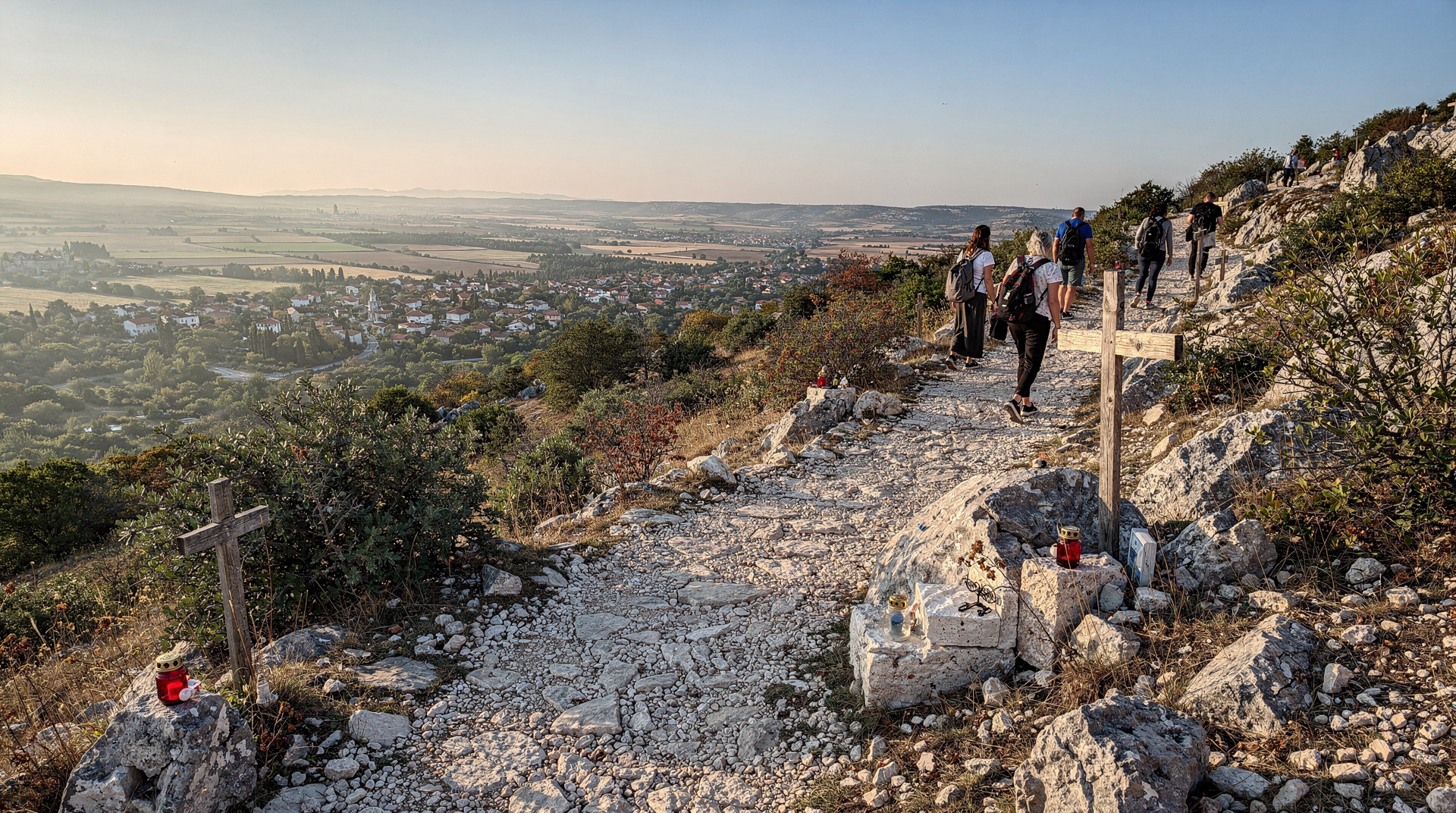
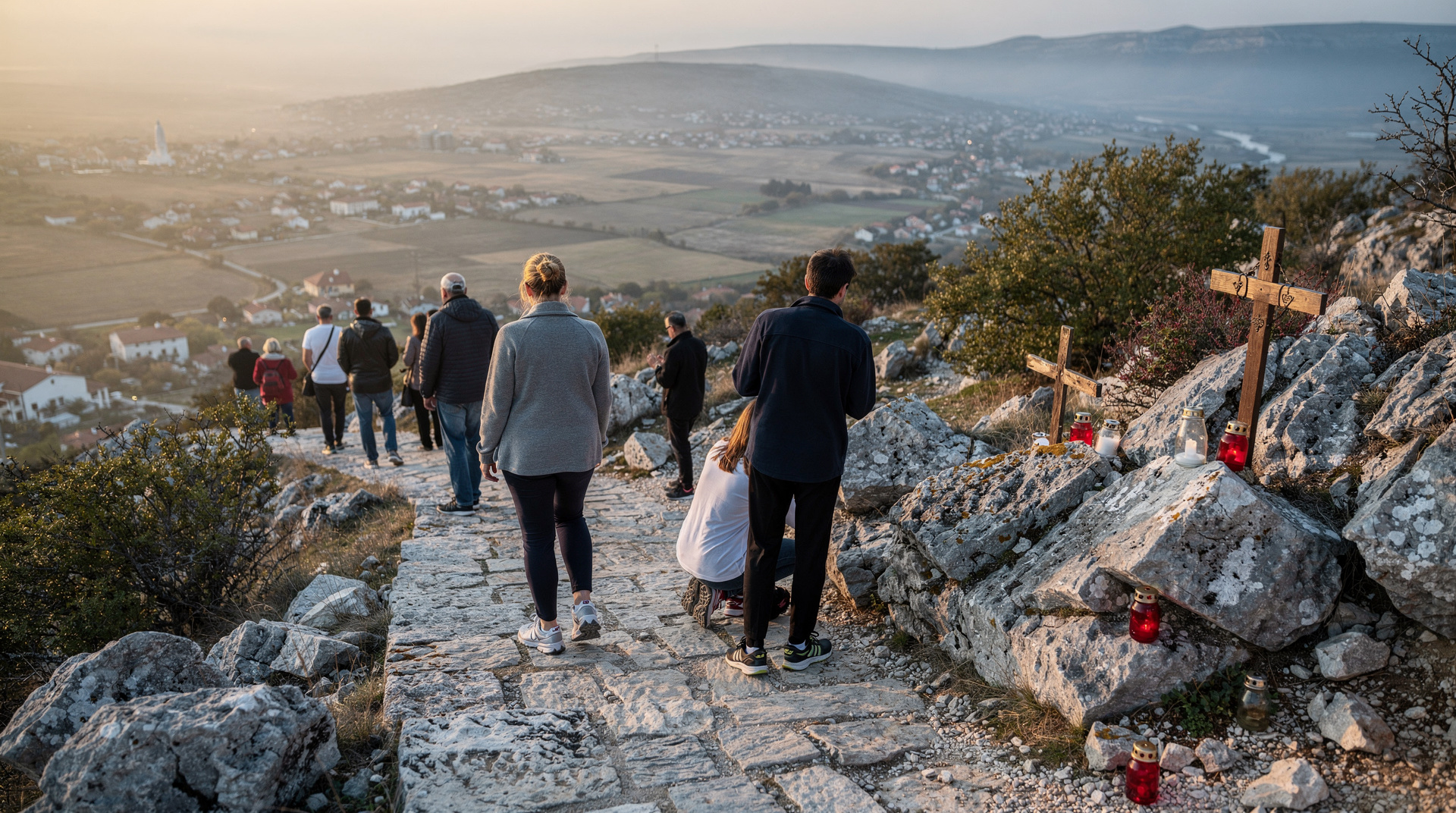
The climb up Podbrdo — the hill where the first apparition occurred — is the central act of most pilgrimages. The path begins just outside the village and rises steeply over loose limestone rock for about 150 metres of elevation gain. Allow 20–30 minutes each way.
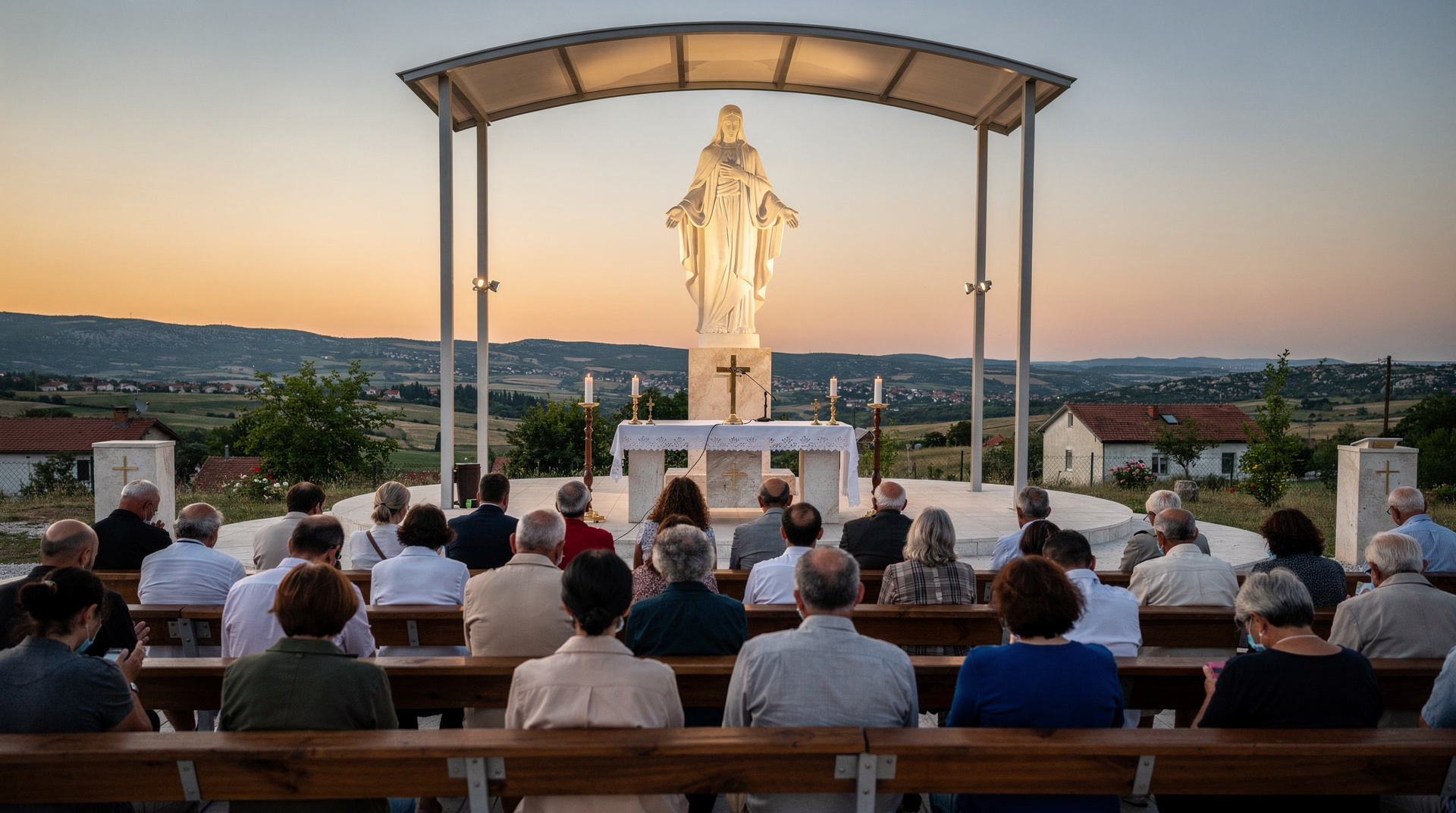
Partway up, a bronze statue of the Virgin Mary marks the primary apparition site and is the focal point for outdoor prayer groups. At the top, a small concrete cross overlooks the valley. Pilgrims often kneel, pray the rosary and leave flowers, rosaries and small photographs.
Wear sturdy, closed shoes — the limestone is rough enough to cut through sandals. The path is manageable for most fitness levels but is not suitable for pushchairs. An early morning ascent, before the heat and before the crowds, is the most atmospheric option.
Join a guided Medjugorje and Apparition Hill private tour from Mostar, which combines the pilgrimage with a visit to Stari Most and the old town — useful if you want local context alongside the spiritual site.
There is no rail link and the coach schedules are built around pilgrimage groups rather than individuals, which leaves the two-hour road from Split awkward to cover alone: a private transfer from Split to Medjugorje sets its own departure and crosses the border once.
Cross Mountain (Križevac)
Križevac, the limestone ridge that towers over the village to the west, is the second major pilgrimage route. The 4 km path to the summit (520 m) is stone-paved and marked by 14 Stations of the Cross in bronze relief. The climb takes 45–60 minutes for a fit adult; allow longer if stopping at each station.
At the summit stands a large concrete cross erected by the parish in 1934, before the apparitions, to mark the 1 900th anniversary of the Crucifixion. The view across the Herzegovina plateau — flat scrubland dissolving into distant mountains — is striking even on secular terms.
Sunrise walks up Križevac are a tradition, particularly on Fridays. Bring a torch if you start before dawn, and a windproof layer — the summit can be cold even in summer.
St James’s Parish Church
The church itself, built in the 1960s in a style that leans more toward mid-century concrete than Baroque splendour, is the hub of Medjugorje’s daily programme. English Mass is generally celebrated at 10:00 and 18:00 in high season; check the parish website for current schedules. Confession is available in a long row of confessionals in multiple languages — the queues on pilgrimage feast days can stretch 200 metres.
Behind the church, a life-size bronze statue of the Risen Christ has become known for the moisture that appears on its right knee, which pilgrims interpret as miraculous. Scientists have suggested capillary action through porous metal. Either way, there is always a queue to touch it.
Who should visit Medjugorje
Go if: You are a practising Catholic, have a devotion to the Rosary or to Marian apparitions, travel with a pilgrimage group, or are genuinely curious about what draws millions of people from every continent to this spot in the Herzegovinian scrubland.
Think twice if: You are looking for traditional Bosnian heritage, wine culture or scenic landscapes. There are far better places in Herzegovina for those — Blagaj, Trebinje and Počitelj offer more to the secular traveller.
Honest note on commercialisation: The main street is lined with shops selling rosaries, icons, crucifixes, bottled “holy water” and Medjugorje wine (the local Žilavka is actually decent). The commercial pressure can feel at odds with the spiritual purpose. Staying in a private room or guesthouse slightly off the main strip reduces the souvenir-shop atmosphere considerably.
Practical logistics
Getting there from Mostar: Roughly 30 km, 30–40 minutes by car or taxi (expect 25–35 BAM/13–18 EUR one way). Local buses run a few times daily. Organised group tours from Mostar are the simplest option and include transfers.
Getting there from Dubrovnik: Around 100 km, 1h30 by car. Organised day tours from Dubrovnik run year-round — they typically include transport, a guide and time for both Apparition Hill and the church.
Book a small-group pilgrimage day tour from Dubrovnik to Medjugorje for a straightforward experience with a local guide who knows both the spiritual and practical sides.
Accommodation: Medjugorje has hundreds of beds — from simple rooms in family guesthouses (30–50 EUR/night) to newer hotels (70–120 EUR/night). Booking several months ahead is essential for the June anniversary and Easter week.
What to wear: The church has a dress code. Shorts and sleeveless tops are not acceptable inside St James’s — carry a scarf or wrap. On the hills, the concern is footwear, not clothing.
Currency: Bosnian Convertible Marks (BAM/KM), pegged to the euro at 1 EUR = 1.95583 BAM. Most shops and guesthouses accept euros, but you will get a slightly worse rate. There are ATMs in the village.
What to pack and practical etiquette
Beyond footwear for the hills, the church dress code is worth taking seriously: shoulders and knees covered for both men and women, no shorts inside St James’s. A lightweight scarf doubles as a head covering if needed and as sun protection on Križevac. Bring small BAM notes for donations at the hill shrines and for the konobas that line the main street — cards are not universally accepted away from hotels.
If you want religious context beyond the Catholic tradition, Herzegovina and wider Bosnia offer a genuinely mixed religious landscape. The Sarajevo faiths guide covers the mosques, churches and synagogue that sit side by side in the capital, and Blagaj Tekke — a Sufi dervish monastery less than an hour away — offers a striking contrast within the same region.
Combining Medjugorje with the wider region
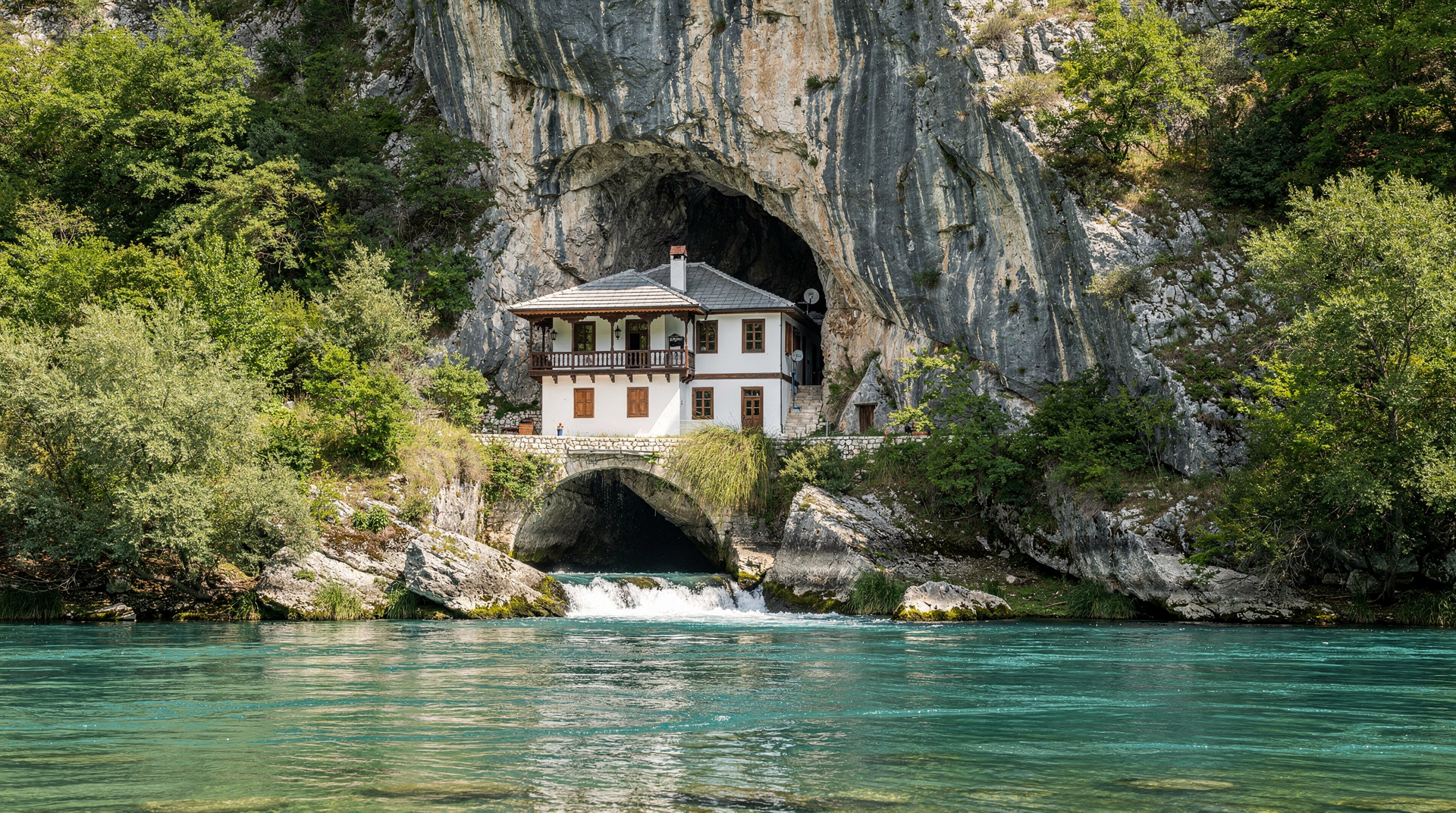
Medjugorje works well as a half-day or full-day stop within a broader Herzegovina itinerary. The most natural pairing is with Mostar — the two are 30 km apart, and most tour operators offer combined visits. Add Kravice Waterfalls for a half-day in nature, or Blagaj for a striking dervish monastery at the source of the Buna river — a completely different religious tradition within 40 km. Travellers building a longer Herzegovina loop should also see the Herzegovina day trip guide for how Medjugorje fits alongside Počitelj and Trebinje.
For travellers combining Bosnia with Dubrovnik or Split, Medjugorje fits naturally as a stop on the way to or from Mostar. See our Mostar from Dubrovnik guide for logistics on that crossing.
Frequently asked questions about Medjugorje
The apparition site receives visitors of all backgrounds. Below are the questions we hear most often.
Is Medjugorje safe?
Yes. It is one of Bosnia’s most visited and well-serviced destinations. The town is oriented around pilgrims and is extremely safe. The usual sensible precautions apply (watch your bag in crowds), but crime is negligible.
Do I need a guide?
Not strictly. Both Podbrdo and Križevac are well-marked and freely accessible. However, a guide adds context — both spiritual (the history of the apparitions, the visionaries’ stories) and regional (the Herzegovinian landscape, local history). For first-time visitors, a guided tour is worth it.
How much does it cost to visit?
Entry to the hills and the church is free. Guided tours from Mostar typically cost 25–45 EUR per person. From Dubrovnik, expect 40–65 EUR including transport. On-site accommodation ranges from 30 EUR (private room) to 120 EUR+ (hotel).
What is the best way to visit as part of a day trip?
From Mostar, a half-day (3–4 hours) gives you time for Apparition Hill and the church. A full day allows Križevac as well. If combining with other Herzegovina sights, allow at least 2–3 hours on site. Most visitors find they need more time than they planned.
Top experiences
Bookable activities with verified prices and instant confirmation on GetYourGuide.