Andrićgrad — Višegrad's stone cultural quarter
Sarajevo: Visegrad, Šargan Eight Railway & Küstendorf Tour
What is Andrićgrad?
Andrićgrad is a stone-built cultural and tourism complex on the bank of the Drina river at Višegrad, opened in 2014. It was conceived by Bosnian Serb filmmaker Emir Kusturica as a homage to the Nobel Prize-winning author Ivo Andric, and contains a cinema, gallery spaces, a church, cafes and souvenir shops built in a mixture of Ottoman and European architectural styles.
| At a glance | |
|---|---|
| Where | West bank of the Drina, next to Višegrad old town |
| Cost | Lanes and exterior free; Ivo Andric Institute around 3-5 BAM |
| Time needed | 1-2 hours for the complex; half a day combined with the bridge |
| Getting there | Car (about 1h45 from Sarajevo) or bus (2h+); walkable from Višegrad town centre |
| Best time | Spring or autumn for light on the Drina; September for the Andric Days festival |
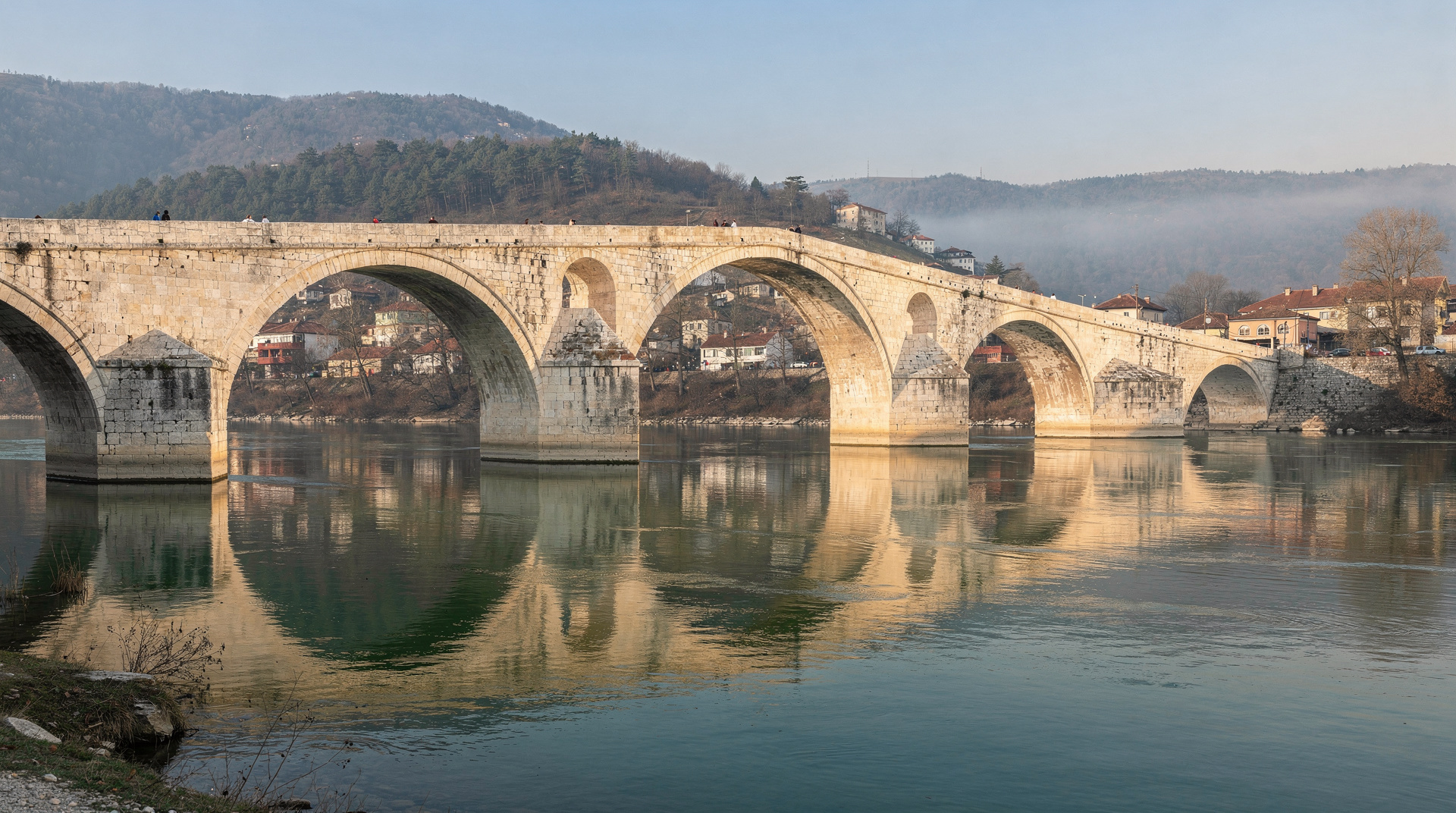
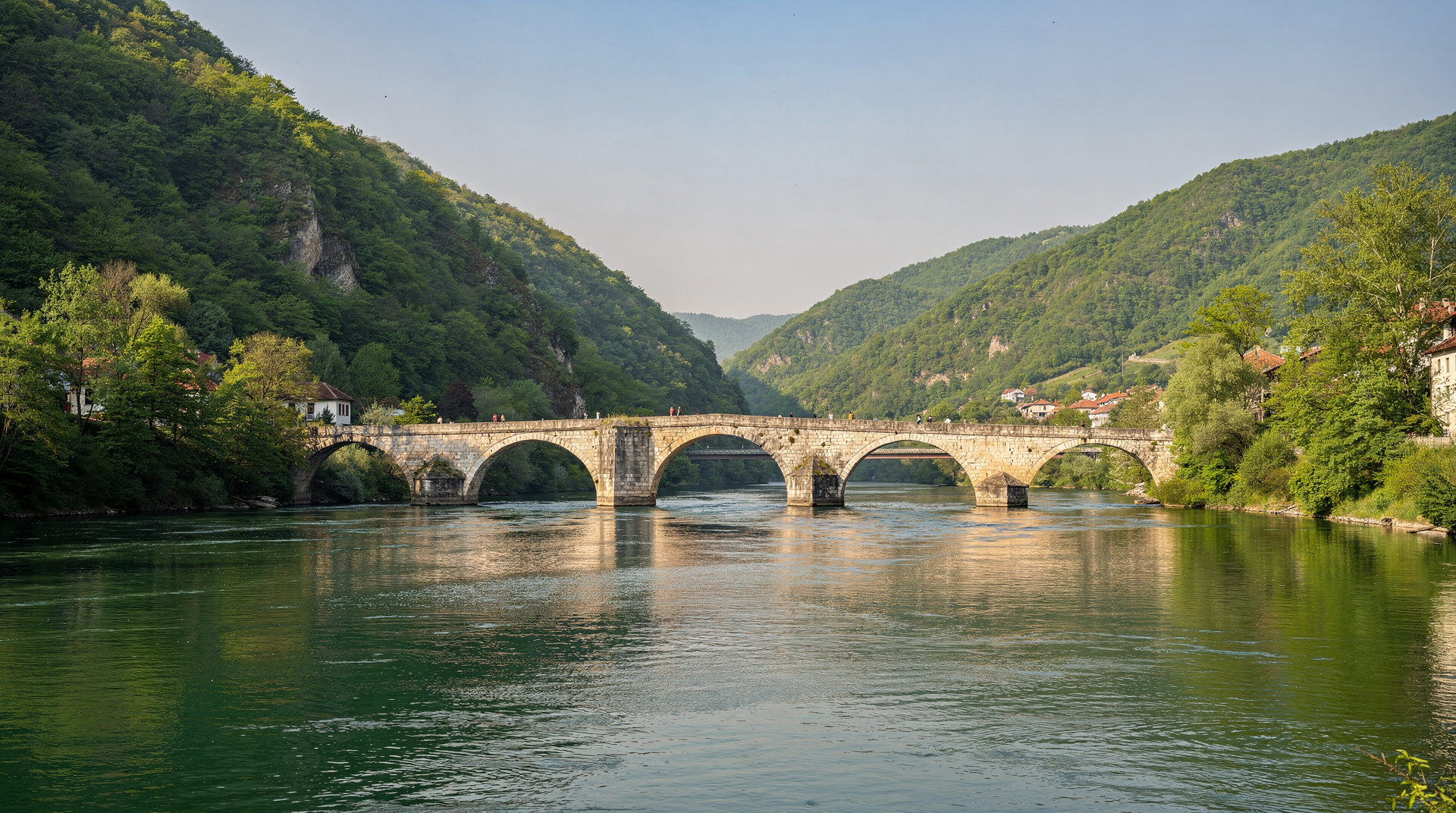
Andrićgrad divides opinion. To some visitors it is an impressive cultural project that brings Ivo Andric’s fictional world to life in stone; to others it is a politicised theme park that obscures more than it reveals. Both reactions contain truth. What is certain is that the complex looks striking, the setting on the Drina is beautiful and it makes a logical companion to the Mehmed Paša Sokolović Bridge just along the riverbank.
What is Andrićgrad?
Andrićgrad (in English sometimes called Andric Town or Kamengrad, Stone Town) is a new-built complex of stone buildings on a narrow peninsula formed by the confluence of the Rzav river and the Drina, directly adjacent to Višegrad’s old town. The complex includes a cinema, the Ivo Andric Institute with a small museum, a church, a tower, cafes, restaurants and souvenir shops. All the buildings are constructed from local stone in a variety of historical styles — Ottoman elements mixed with Central European baroque and Romanesque details.
The project was conceived and designed by director Emir Kusturica, whose films (When Father Was Away on Business, Underground, Time of the Gypsies) established him as one of the major European filmmakers of the late 20th century. Kusturica has stated that Andrićgrad is his tribute to Ivo Andric and to the novel The Bridge on the Drina. The first section opened during the 2012 film festival; the full complex was largely complete by 2014.
The Ivo Andric connection
Ivo Andric (1892-1975) is Bosnia’s most famous writer and the only Nobel Prize laureate produced by the former Yugoslavia. He won the prize in 1961, primarily for the Višegrad trilogy: The Bridge on the Drina (1945), Bosnian Chronicle (1945) and The Woman from Sarajevo (1945).
Andric was born in Travnik (see the Travnik guide) and moved to Višegrad as a child, living there until he left for gymnasium in Sarajevo. He never returned to Višegrad for any significant period; his adult life was spent in Sarajevo, Zagreb, Vienna, Berlin and finally Belgrade, where he died. The Višegrad bridge entered his imagination as a child and became the organising symbol of his greatest novel, but his personal relationship with the town was limited to his early years.
Andric’s legacy is complicated by his stated positions on Bosnian national identity and the Serbian character of Bosnia — positions cited by Radovan Karadzic, who was later convicted of genocide, as intellectual justification for the war. This does not diminish the literary quality of the novels, but it means that Andric is not a neutral figure in the context of post-war Bosnia, and Andrićgrad’s enthusiastic promotion of his legacy has been criticised by Bosniak intellectuals and human rights organisations.
Visitors who want to understand this complexity before or during their visit can read English-language academic essays on Andric and the wars; the topic is not addressed within Andrićgrad itself.
The Ivo Andric Institute
The Institute is the centrepiece of the complex and houses an exhibition on Andric’s life, work and times. Displays cover his biography, the writing of the Višegrad novels, the Nobel Prize ceremony and his diplomatic career (Andric worked as a Yugoslav diplomat in the 1930s and 1940s). There are original manuscript pages, photographs and personal effects. The exhibition is well-presented and informative about the literary context.
The institute also hosts the annual Andric Days cultural festival, usually in September, with readings, theatre performances and film screenings. If you happen to visit during the festival, the town is considerably more animated.
Admission to the institute museum is modest — around 3-5 BAM.
Architecture and atmosphere
The stone lanes of Andrićgrad are pleasant to walk regardless of the politics. The buildings use local limestone and have been constructed with reasonable craft — not the slick concrete of a standard new development but something that at least gestures towards traditional masonry. The tower at the north end gives views over the Drina and the Mehmed Paša Sokolović Bridge.
The Church of the Holy Trinity is small and richly decorated in the Serbian Orthodox style, with gilded iconostasis and frescoes. It is open to visitors.
The cafes and restaurants are positioned along the Drina side with views of the river. Food is Bosnian-Herzegovinian: grilled meats, burek, fresh fish from the Drina. Prices are moderate — a main course runs 12-20 BAM.
The Sarajevo to Višegrad, Šargan Eight railway and Küstendorf tour is the most comprehensive day-trip option from Sarajevo, covering Višegrad, Andrićgrad and the narrow-gauge railway at Mokra Gora in a single day.
Combining Andrićgrad with the bridge
The two sites are a short walk apart — perhaps 5 minutes along the riverbank. A logical sequence is to start at the bridge in the morning (when the light is better for photography), walk into the old town for coffee, then visit Andrićgrad before lunch.
The full Višegrad visit — bridge, old town, Andrićgrad — can be done in three to four hours. For a proper day trip from Sarajevo with additional time for lunch and the Šargan Eight railway, allow eight to nine hours in total. The Višegrad day trip guide gives a full day-by-day itinerary.
Travellers without a car who would rather not manage bus connections can join a guided day trip from Sarajevo that visits Višegrad, Andrićgrad and the Drvengrad wooden village. A guided format also means someone else handles the driving on the winding Drina valley roads, leaving you free to look at the scenery.
Practical information
Location: On the west bank of the Drina, adjacent to Višegrad town centre. GPS: approximately 43.782°N, 19.292°E.
Opening hours: The complex is generally open daily. Individual venues (cinema, institute) have their own hours. Check locally on arrival.
Admission: The lanes and external areas are free. The Ivo Andric Institute charges approximately 3-5 BAM. The cinema charges per screening.
Getting there: Višegrad is reached from Sarajevo by car (about 1h45) or bus (2h+). The day trip guide covers transport options from Sarajevo.
Best time: Spring and autumn for the best light on the Drina. Summer weekends bring more visitors but the complex is rarely crowded by comparison with Mostar.
For context on Ottoman heritage across Bosnia as a whole, see the Ottoman heritage guide, and for the broader eastern Bosnia region, the guide to Višegrad’s bridge gives the full story of the Mehmed Paša Sokolović Bridge.
The politics behind the stone
Andrićgrad is impossible to separate entirely from Republika Srpska politics, and understanding this makes the visit more interesting rather than less. The complex was substantially funded by the Republika Srpska government and opened with political fanfare emphasising a Serb-centred reading of Bosnian and Yugoslav history. Kusturica himself has been an outspoken supporter of Republika Srpska’s political establishment. Bosniak commentary on the project has ranged from indifferent to openly critical, particularly given Višegrad’s own history: the town saw some of the worst ethnic-cleansing violence against Bosniaks during the 1992-95 war, a history that Andrićgrad’s celebratory framing does not address.
None of this is visible on the surface of a visit — there are no explanatory panels covering the war years in the town — but it’s useful context for travellers who want to understand what they’re looking at rather than take the stone lanes at face value. For deeper background on the war’s impact on this part of eastern Bosnia, the Bosnia history for travelers guide and the Yugoslav wars explained guide both give useful framing before or after a Višegrad visit.
Beyond Andrićgrad: what else Višegrad offers
Višegrad itself, beyond the bridge and Andrićgrad, is a modest working town rather than a tourism-oriented destination — which some visitors find refreshing after busier stops like Mostar or Sarajevo’s Baščaršija. A short walk along the Drina away from the two main sites reveals ordinary cafes, a small daily market and river views without the crowds. Those continuing east or wanting a broader itinerary across eastern Bosnia can pair Višegrad with other Ottoman-heritage towns; the guide to Ottoman heritage in Bosnia suggests a route.
How to pace your visit
Andrićgrad rewards a slow, unhurried walk rather than a checklist. Start at the lanes without a fixed plan, let the layout of squares and narrow passages reveal itself, and only then decide which venues deserve your time. The Institute is the obvious priority for anyone who has read the novels; the church and the tower suit those who like architecture and views. If you have just come from a busier stop such as Mostar or the lanes of Baščaršija, the quiet here can feel almost surprising.
Bring a camera and a bit of curiosity about how the buildings were assembled. Look at how different styles sit side by side on a single street, and notice which details feel borrowed from Ottoman towns and which from Central Europe. Comparing them with a genuinely old townscape, such as the one described in the Ottoman heritage guide, is one of the most instructive things you can do here.
Reading Andric before you go
The visit is richer if you arrive with at least a little of the literature in your head. The Bridge on the Drina is the natural starting point, and many travellers read it on the road between Sarajevo and the Drina valley. It gives the bridge a human history that no plaque can match, and it helps you understand why the stone town was named the way it was. For the wider backdrop to the novel, the Bosnia history for travelers guide and the Višegrad bridge guide are good companions.
If you prefer to approach the writer through a city, the Travnik Ottoman town guide covers the place where he was born, and the guide to Sarajevo’s meeting of cultures explores the multi-faith world that shaped so much of his fiction. Reading a few pages in either place makes the Institute exhibition feel like part of a larger journey rather than an isolated stop.
Eating and resting by the river
After the lanes, the cafe terraces are the best place to sit and take in the river. Order slowly, watch the light change on the water and use the break to digest what you have seen. If you want to eat more adventurously, the Bosnian food guide and the burek and pita guide explain what to look for on a menu, and the Bosnian coffee culture guide will help you make the most of a coffee break in an Ottoman-influenced setting.
Because the complex is compact, there is no need to plan meals around it. A relaxed lunch on the Drina side, followed by a stroll back into town, is a perfectly good way to close the visit. Travellers who prefer something lighter can simply take a coffee and watch the river go by.
Fitting Višegrad into a wider route
Višegrad works best as part of a longer journey across eastern Bosnia and beyond. Many visitors slot it between Sarajevo and the Serbian border, while others treat it as a standalone excursion. The best day trips from Sarajevo guide places it alongside other options, and the Višegrad destination page collects the town’s main sights in one place.
If you are building a longer trip, the Bosnia 7-day itinerary and the Bosnia war history itinerary both show how a stop in the Drina valley can fit alongside Sarajevo and the south. For getting around without a car, the guide to getting around Bosnia and the driving in Bosnia guide lay out the practical trade-offs, and the Sarajevo airport guide helps if you are connecting from a flight.
Respectful travel in a sensitive place
Višegrad carries a heavy recent history, and it is worth approaching the town with that in mind. Speak quietly about politics in public spaces, ask before photographing people, and avoid turning the visit into a debate with locals about the war. If the subject interests you, the Srebrenica genocide memorial guide offers a sober look at another site in the same region, and the Sarajevo faiths guide shows how the country’s religious communities have lived side by side.
Most visitors leave with mixed feelings, and that is entirely normal. The stone town is attractive, the river is beautiful, and the story behind both is more complicated than any single visit can resolve. Giving yourself room to reflect, rather than rushing on to the next stop, is the best way to take something lasting from it.
Frequently asked questions about Andrićgrad — Višegrad's stone cultural quarter
Who created Andrićgrad?
Is Andrićgrad worth visiting?
What is the connection between Andrićgrad and Ivo Andric?
What can you do at Andrićgrad?
How long does Andrićgrad take?
Top experiences
Bookable activities with verified prices and instant confirmation on GetYourGuide.