Ottoman heritage in Bosnia & Herzegovina
Sarajevo: Mostar, Konjic, Blagaj Tekke, Pocitelj & Waterfall
What are the main Ottoman sites in Bosnia & Herzegovina?
Bosnia's most important Ottoman sites are Baščaršija and the Gazi Husrev-beg Mosque in Sarajevo, Stari Most (Old Bridge) in Mostar, the Mehmed Pasa Sokolovic Bridge at Višegrad, the Tekija dervish monastery at Blagaj, the hilltop fortress village of Počitelj and the old town of Travnik. Most date from the 16th century.
For four centuries, Bosnia & Herzegovina was part of the Ottoman Empire. That period — from the conquest of 1463 to the Austrian occupation of 1878 — left a physical imprint on the country that no subsequent power has erased. Ottoman mosques, bridges, bazaars, fortresses, caravanserais and dervish lodges survive across the country in a density unmatched anywhere else in the Balkans outside Turkey itself. This guide maps the most important sites and explains how to visit them.
At a glance
| Where | Spread nationwide: Sarajevo, Mostar, Počitelj, Blagaj, Travnik, Jajce and Višegrad are the core stops |
| Cost | Most sites are free to enter or charge a small fee (around 2-5 BAM for mosques) |
| Time needed | A day for Sarajevo’s Baščaršija alone; around 7-10 days to cover the full trail at a relaxed pace |
| Getting there | Rental car is most flexible; buses and the Sarajevo-Mostar train cover the main towns; organised day tours fill the gaps |
| Best time | Late spring or early autumn — mild weather, thinner crowds at Mostar and Počitelj |
Historical background
The Ottoman conquest of Bosnia began in earnest after the fall of Constantinople in 1453. Mehmed II sent forces into central Bosnia; the last Bosnian king, Stjepan Tomasevic, was captured and executed in 1463. Herzegovina held out longer — it was incorporated by 1482 — and the Ottomans pushed further to take parts of Croatia and Hungary, making Bosnia a frontier province.
The Ottomans were not simply occupiers. They built cities. The empire’s method of urban development — the foundation of a waqf (religious endowment) around a mosque, with income-generating markets, caravanserais and public baths supporting the religious institution — created entirely new towns. Sarajevo was founded on this model in the 1460s by the governor Isa-Beg Isakovic. Mostar grew around an Ottoman bridge and fort. Travnik became a provincial capital.
Conversion to Islam was gradual and voluntary by the standards of the time — Bosnia had a complex pre-Ottoman religious landscape (the Bosnian Church, Catholicism and Orthodoxy all had adherents) and many Bosnian nobles converted to preserve their landholdings. By the 17th century, Bosnia had a large Muslim majority in the towns, though Orthodox and Catholic communities continued in rural areas and smaller towns.
Sarajevo: the Ottoman city
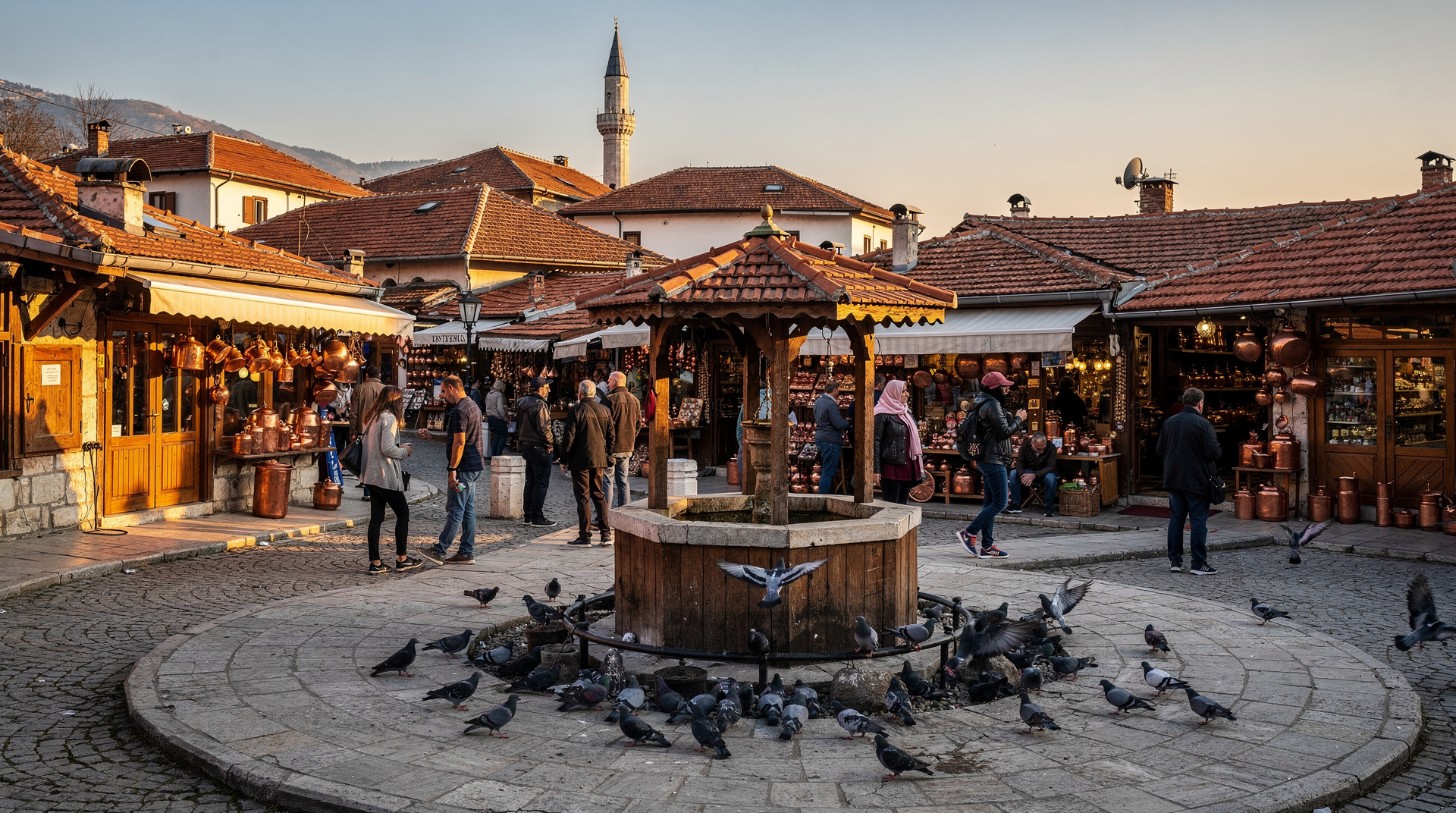
Baščaršija, Sarajevo’s Ottoman bazaar, is the best place to start any Ottoman itinerary in Bosnia. Founded in the 1460s by Isa-Beg Isakovic, it retains its original layout: a grid of specialised craft streets — coppersmiths, jewellers, shoemakers — radiating from the Sebilj wooden fountain. The Gazi Husrev-beg Mosque (1531), the largest Ottoman mosque in the Balkans, anchors the northern edge of the bazaar. The Bezistan (covered market hall) and the Morića Han (caravanserai) survive from the 16th century.
For a full treatment of Sarajevo’s Ottoman core, see the Baščaršija guide and the Sarajevo mosques guide.
A full-day tour from Sarajevo covering Mostar, Konjic, Blagaj Tekke and Počitelj is the most efficient way to see the major Ottoman sites of Herzegovina in a single day.
Stari Most and Mostar’s old town
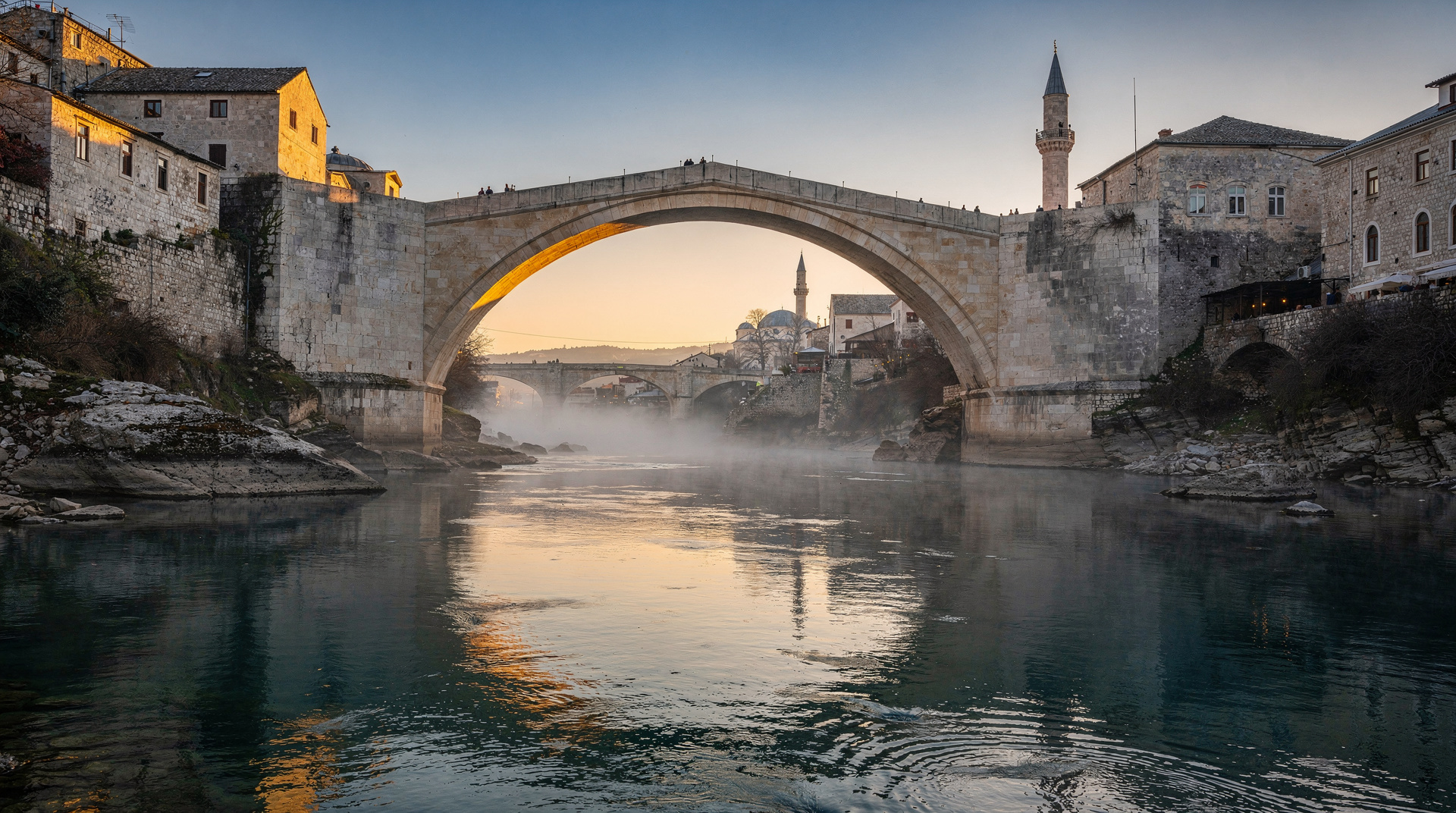
Stari Most (1566) is the most famous Ottoman monument in Bosnia — a single stone arch over the Neretva, designed by the imperial architect Mimar Hayruddin and built on commission from the governor. Destroyed in 1993 and rebuilt in 2004 using original techniques and stones, it is a UNESCO World Heritage Site.
The surrounding old town of Mostar preserves several other Ottoman structures: the Kriva Cuprija (Crooked Bridge, c.1558), the Koski Mehmed Pasha Mosque, the Kujundžiluk bazaar lane and numerous Ottoman houses. The old town’s ensemble is part of the UNESCO listing.
Full details in the Stari Most guide.
Počitelj: the hill fortress
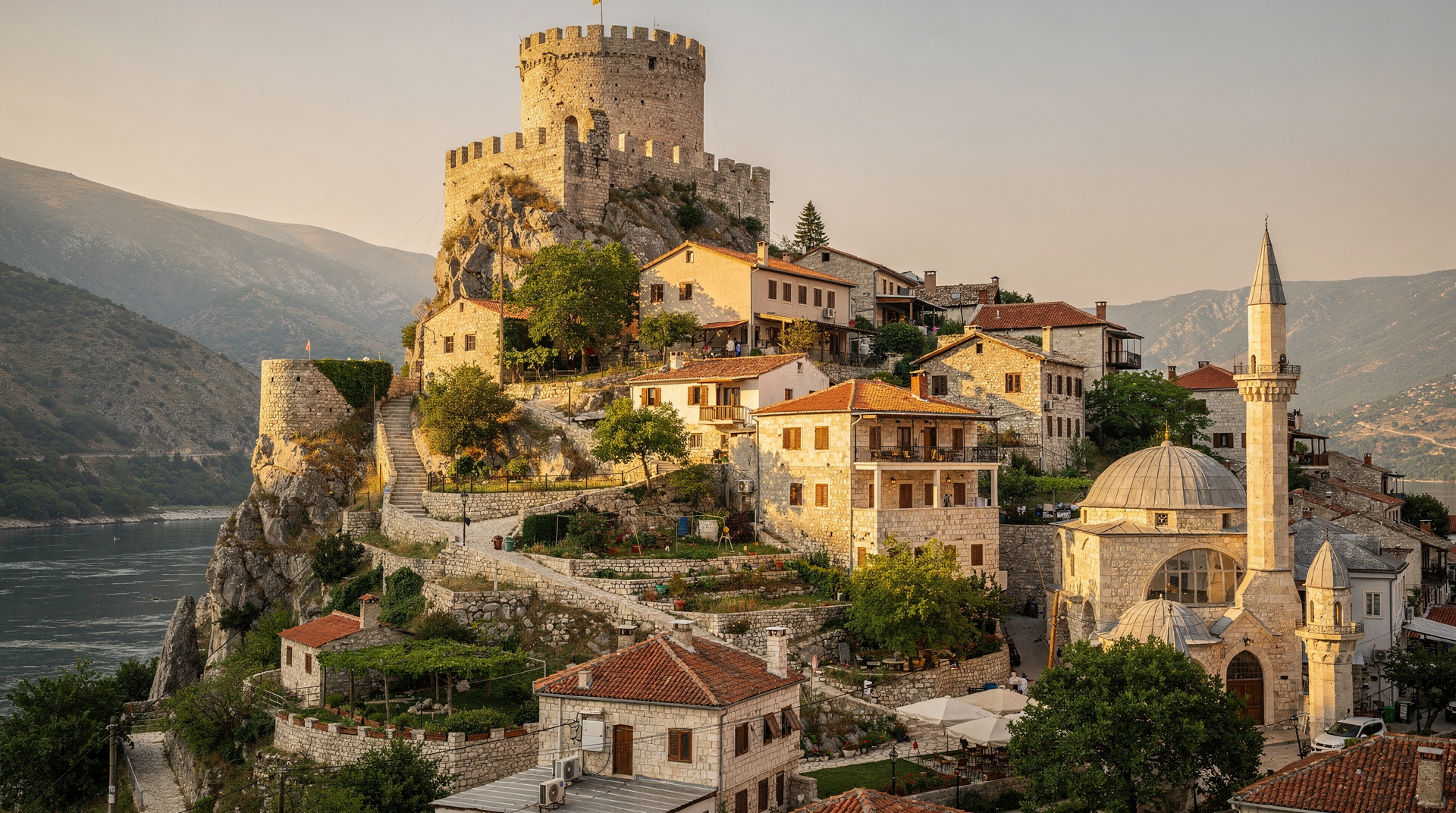
Počitelj is a small hilltop settlement on the Neretva about 30 km south of Mostar that represents the Ottoman fortified town in near-perfect form. A 15th-century fortress crowns the hill; below it cascade a mosque (Sisman Ibrahim Pasha, 1664), a hexagonal mausoleum (turbe), a madrasa (Islamic school), a hamam (bathhouse) and stone houses terraced into the hillside.
The village was heavily damaged during the Croatian-Bosniak War and has been partially restored. At peak times (July-August afternoons) it draws large coach groups from Mostar and Dubrovnik. Visit early in the day or in the shoulder season. Entry to the site is free; the mosque charges a small admission (2-3 BAM).
For practical details, see the Počitelj guide.
Blagaj Tekija: dervish monastery at the source
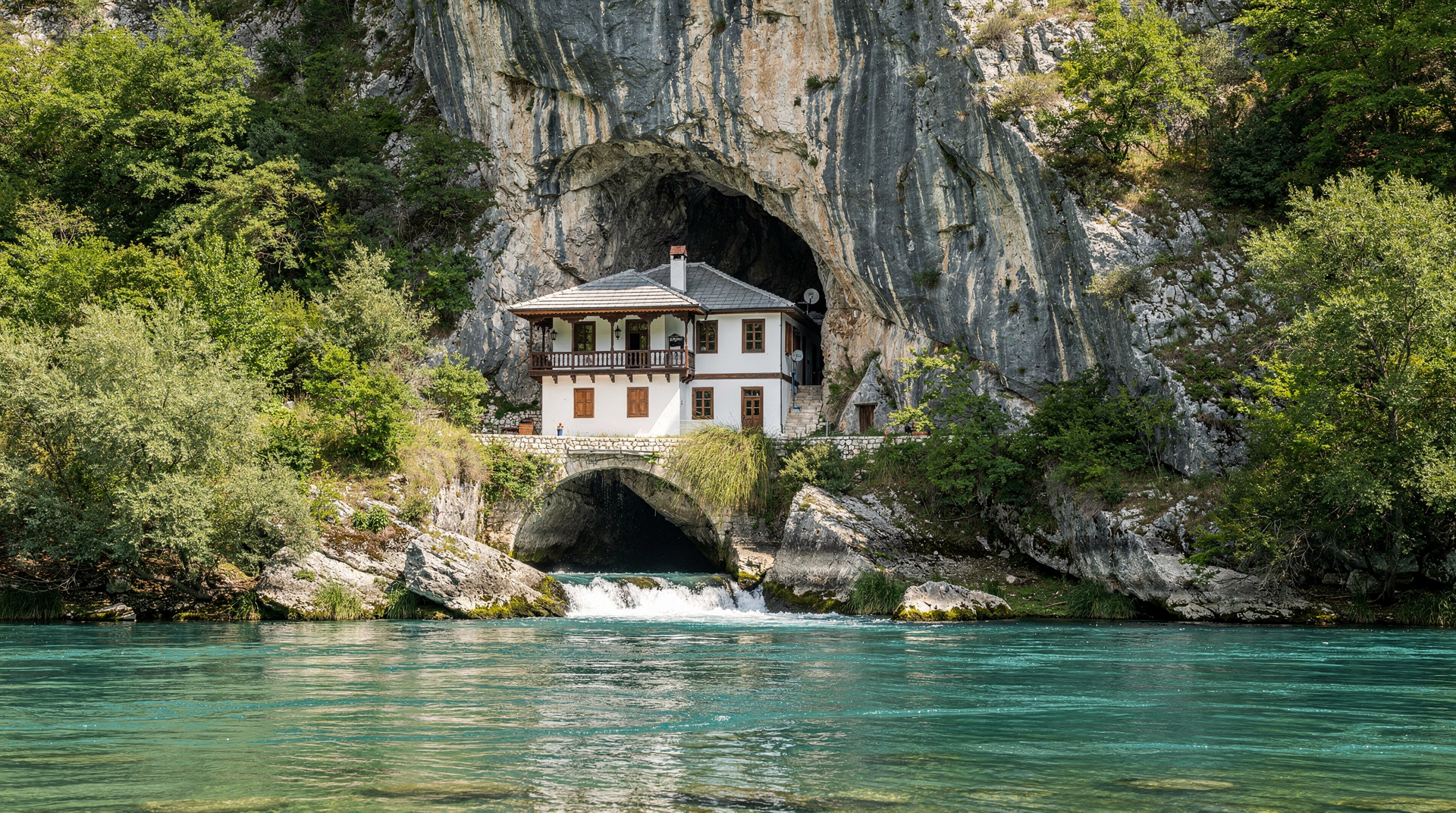
At the village of Blagaj, 12 km from Mostar, the Buna river emerges from a large cave at the base of a 200-metre cliff. At the cave mouth stands the Blagaj Tekija, a dervish lodge built in the 16th century and expanded in the Ottoman period. The building’s white plaster walls and wooden-latticed upper storey rise directly from the water, with the cliff face behind them — one of the most dramatic architectural settings in south-east Europe.
The tekija is still a working religious site. Visitors must remove shoes; women are provided a head covering. The interior is simple: wooden floors, a prayer hall and rooms used by visiting dervishes. The spring itself — the largest karst spring in Bosnia — produces around 43 cubic metres of water per second.
Entry is modest; a tea on the waterside terrace afterwards is recommended. Full details in the Blagaj Tekija guide.
Travnik: old capital of Bosnia
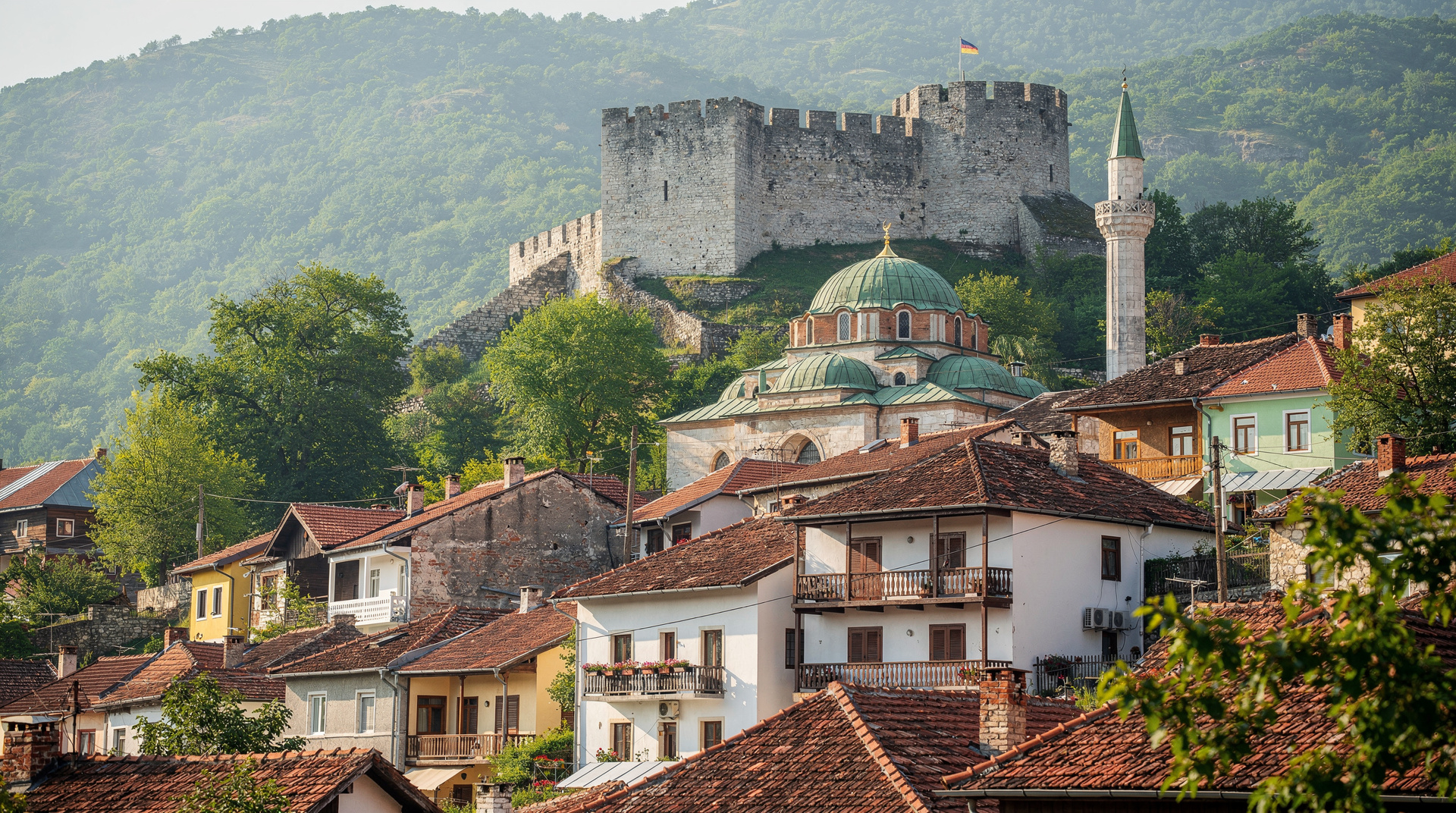
Travnik, 90 km north-west of Sarajevo, was the seat of the Ottoman governor (vizier) of Bosnia from 1699 to 1850, when the capital moved to Sarajevo. The town preserves its Ottoman character better than almost anywhere else in central Bosnia. The 15th-century fortress dominates the hill; below it are several mosques, old Ottoman houses, the original bazaar street and the famous Šarena džamija (Colourful Mosque) of 1757, with its exterior covered in painted floral ornament.
Travnik is also associated with Ivo Andric, who was born here in 1892 (the house is now a small museum). The Travnik guide covers the full site.
Višegrad: the bridge on the Drina
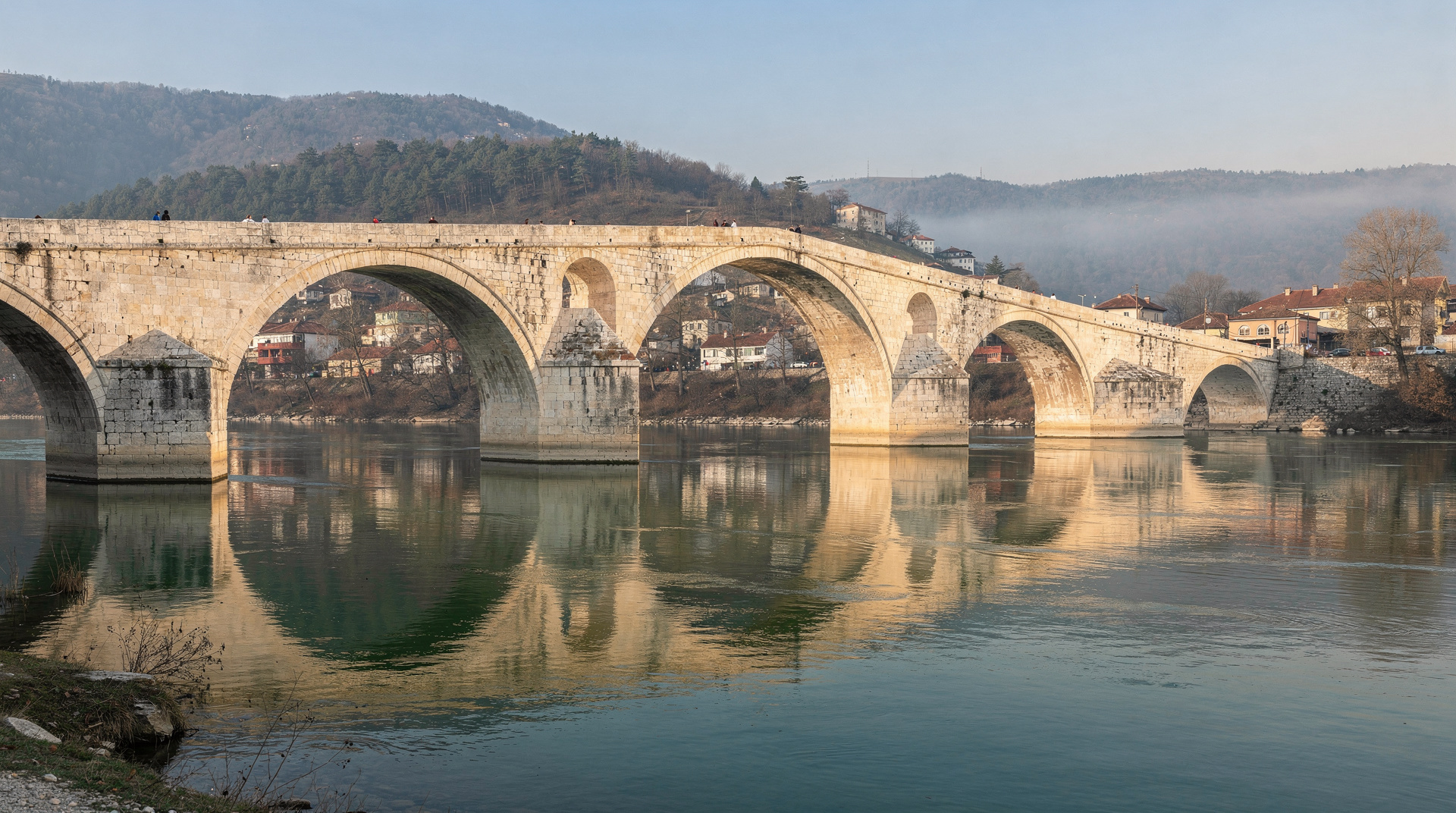
The Mehmed Paša Sokolović Bridge at Višegrad (1571-1577) is the other UNESCO-listed Ottoman bridge in Bosnia. Eleven stone arches cross the Drina — a larger, longer structure than Stari Most, designed by Mimar Sinan himself at the commission of Grand Vizier Mehmed Paša Sokolovic. The bridge inspired Ivo Andric’s Nobel Prize-winning novel.
Full historical context in the Višegrad bridge guide.
Jajce: the old royal capital
Jajce was the capital of the last Bosnian kingdom before the Ottoman conquest and later became an Ottoman administrative centre. The town retains a fortress (rebuilt extensively in the Ottoman period), several mosques and the Esma Sultana Mosque (1752) — Bosnia’s only Turkish baroque mosque. The famous Pliva waterfall drops through the lower town in a single 17-metre cascade that can be seen from the streets.
For more detail, see the Jajce fortress guide.
A practical Ottoman trail itinerary
A week of focused Ottoman heritage travel in Bosnia might run:
Day 1-2: Sarajevo — Baščaršija, Gazi Husrev-beg Mosque, Bezistan, Morića Han, Sarajevo Rose memorials. Day 3: Travnik — fortress, Šarena džamija, Ivo Andric birth house, old bazaar. Continue to Jajce. Day 4: Jajce — fortress, Esma Sultana Mosque, Pliva waterfall. Drive south. Day 5: Mostar — Stari Most, Kriva Cuprija, old town, Koski Mehmed Pasha Mosque. Day 6: Blagaj and Počitelj — Tekija in the morning, Počitelj in the afternoon. Day 7: Višegrad — Mehmed Paša Sokolović Bridge, Andrićgrad.
This requires a rental car; an alternative using organised tours from Sarajevo and Mostar is possible but involves more dead time. See the Bosnia travel guide for planning tools.
Budget and logistics
Most Ottoman sites charge minimal entry fees: mosques typically 2-5 BAM, Počitelj free. Guided tours add context — the Sarajevo old town tour covers the basics — but most sites can be self-guided with decent preparation.
Currency is BAM (Bosnian Convertible Mark): 1 EUR = 1.95583 BAM. The currency guide covers ATMs and card payments.
For the broader cultural picture — how Ottoman heritage sits alongside Austro-Hungarian, Communist and contemporary Bosnian culture — see the Sarajevo meeting of cultures guide.
Caravanserais, hamams and the waqf economy
Beyond mosques and bridges, the Ottoman legacy in Bosnia is an economic system as much as an architectural one. A waqf (vakuf) was a religious endowment: a wealthy patron would fund a mosque, then attach income-generating properties — a han (caravanserai for merchants), a bezistan (covered market), a hamam (bathhouse) or a row of shops — whose rents paid for the mosque’s upkeep, staff and charitable works. This is why so many Ottoman towns in Bosnia have a mosque standing directly beside a market: the two were built as one financial unit.
Sarajevo’s Morića Han is the best-preserved caravanserai in the country, still operating as a café and craft courtyard today. The Gazi Husrev-beg Hamam, restored and reopened as a working Turkish bath, lets visitors experience the Ottoman bathing ritual firsthand rather than just viewing a museum piece. Mostar and Travnik both retain smaller hans, though in less complete condition.
Andrićgrad and the Ottoman legacy in fiction
At Višegrad, alongside the historic bridge, stands Andrićgrad — a stone-built “town within a town” constructed in the 2010s as a tribute to Ivo Andrić, whose novel The Bridge on the Drina is set on the Mehmed Paša Sokolović Bridge. Andrićgrad is not an Ottoman-era structure itself but a modern recreation using historicist architecture, and it is worth an hour combined with the bridge visit. It houses a cinema, shops and a small museum on Andrić’s life. Details are in the Andrićgrad guide.
Best months for an Ottoman heritage trip
| Season | Weather | Crowds | Notes |
|---|---|---|---|
| Spring (Apr-May) | Mild, occasional rain | Moderate | Green Neretva valley, comfortable walking at Počitelj and Blagaj |
| Summer (Jun-Aug) | Hot, 30°C+ in Herzegovina | Heavy at Mostar/Počitelj | Visit Stari Most and Počitelj early morning; Sarajevo’s old town stays cooler in the evening |
| Autumn (Sep-Oct) | Mild, clear light | Thinning after September | Best light for photography at Blagaj and Travnik; see the Bosnia in autumn guide |
| Winter (Nov-Mar) | Cold, snow in Sarajevo | Very light | Mosque interiors and Baščaršija’s cafés are the draw; some rural sites (Lukomir road) can be inaccessible |
Pairing the Ottoman trail with the rest of Bosnia
The Ottoman layer is easier to understand when you see what came before and after it. The Bosnia history for travellers guide gives the wider timeline, and the Austro-Hungarian Sarajevo guide shows how the next empire built its own city beside the old bazaar. Walking from one into the other in Sarajevo is the clearest lesson in how the country’s layers fit together. The Sarajevo faiths guide adds the religious picture, with mosques, churches and synagogue close together.
If you want the trail to follow a route rather than a list, the Bosnia 7-day itinerary and the Sarajevo and Mostar in 3 days itinerary both pass through the main Ottoman towns. For a slower pace on the Herzegovina side, the Herzegovina weekend itinerary keeps Mostar, Blagaj and Počitelj close together.
Food belongs to the heritage too. Coffee served in a copper džezva, grilled meat and layered pastries all came with the Ottomans, and the Bosnian coffee culture guide and the burek and pita guide explain the habits behind what you will be eating between monuments. A stop for coffee in an old bazaar lane is often the best way to take in the surroundings.
Choosing your base and your transport
Sarajevo and Mostar make the most natural bases, because the other Ottoman stops are within reach of one or the other. The Sarajevo where to stay guide and the Mostar where to stay guide help you pick a neighbourhood, ideally one within walking distance of the old town so evenings among the lit-up monuments cost nothing extra. Drivers should read the driving in Bosnia guide before setting out, and anyone relying on public services will find the getting around Bosnia guide useful for linking the towns without a car.
Travellers coming from the coast can reach the Herzegovina end of the trail first: the Mostar from Dubrovnik guide and the Mostar from Split guide describe the approach, and the Trebinje destination page covers a quieter Herzegovinian town with its own Ottoman-era traces. Reading a short blog account of Mostar’s old bridge before you arrive makes the first view of the arch mean a little more.
Reading the Ottoman landscape town by town
Each stop on the trail shows a different side of the same system. Sarajevo is the planned market city, and the Sarajevo destination page is the best entry point for its wider context. Mostar is the bridge town, where the Mostar destination page and the Mostar war history guide explain why the rebuilt arch carries so much meaning. Počitelj and Blagaj, covered on their own Počitelj page and Blagaj page, show the fortress village and the dervish lodge. Travnik and Višegrad, on the Travnik page and the Višegrad page, show the provincial capital and the great bridge on the Drina.
If you cannot decide between the two big bases, the Sarajevo vs Mostar comparison lays out what each offers a heritage-minded visitor. Those short on time can follow the Mostar day trip from Sarajevo guide or the Herzegovina day trip guide, while the best day trips from Mostar shows how to stretch a stay on the Neretva.
Tours that cover the Ottoman sites
Guided options make sense where public transport is thin. Travellers starting from the coast can join a one-way tour from Dubrovnik to Sarajevo that stops at Mostar, Blagaj and Počitelj, which saves a separate return journey. Anyone based in Herzegovina can pick a full-day heritage tour through the old towns of Herzegovina and let someone else handle the driving and the parking.
Food, museums and the Ottoman table
Between monuments, the Sarajevo food tour guide and the Bosnian food guide show how Ottoman cooking still shapes daily meals. The museums of Sarajevo guide is useful on a rainy day, and the Herzegovina wine guide suits the slower evenings around Mostar. For a Travnik and Jajce pairing without a long itinerary, the Jajce and Travnik day trip guide keeps the two Ottoman-era towns together, and the Konjic day trip guide adds an old stone bridge town on the road between Sarajevo and Mostar.
Frequently asked questions about Ottoman heritage in Bosnia & Herzegovina
How long did Ottoman rule last in Bosnia?
Why is Bosnia's Ottoman heritage so well preserved?
What is a tekija and why is Blagaj famous?
Which Ottoman sites are UNESCO listed?
Is it possible to visit the main Ottoman sites in one trip?
What should I wear to visit an Ottoman mosque or tekija in Bosnia?
Are the Ottoman bridges of Bosnia still used for traffic?
Top experiences
Bookable activities with verified prices and instant confirmation on GetYourGuide.