Višegrad day trip guide from Sarajevo
From Sarajevo: Višegrad, Andrićgrad, Šargan Train, Drvengrad
Is Višegrad worth a day trip from Sarajevo?
Yes, for travellers interested in Ottoman heritage and Balkan culture. Višegrad has the stunning Mehmed Paša Sokolović Bridge (UNESCO), Andrićgrad — a stone town built by filmmaker Emir Kusturica — and access to the spectacular Šargan Eight railway through the Serbian mountains. The drive is 115 km and about 2 hours from Sarajevo through eastern Bosnia.
Eastern Bosnia is the least-visited part of the country, and Višegrad is one of its most rewarding destinations. The town sits at the point where the Drina river cuts between mountain ridges, and it has two extraordinary claims on the traveller’s attention: a UNESCO-listed Ottoman bridge that gave its name to a Nobel Prize-winning novel, and a bizarre, creative, controversial stone town built by a famous filmmaker on the riverbank beside it. Adding the spectacular Šargan Eight heritage railway across the Serbian border makes for one of the most culturally layered day trips in the entire Balkans.
At a glance
| Where | Višegrad, eastern Bosnia, on the Drina river near the Serbian border |
| Cost | Bridge and Andrićgrad free to enter; guided day tour typically covers transport and Andrićgrad extras; Šargan Eight ticket separate (see below) |
| Time needed | Half a day for the bridge and Andrićgrad; a full day if adding the Šargan Eight railway |
| Getting there | Self-drive around 2 hours on the E761, or an organised tour from Sarajevo |
| Best time | Late spring to early autumn; mountain roads can ice over in winter |
Getting from Sarajevo to Višegrad
Distance and journey time
Višegrad is 115 km east of Sarajevo — approximately 2 hours by car on the E761 road through Han Pijesak and Rogatica. The road is of good quality and the landscapes of eastern Bosnia — beech forests, limestone gorges, the Drina valley opening out as you descend — are beautiful and untouristed.
By organised tour
A guided tour from Sarajevo is the most practical and informative option. Tours typically combine Višegrad with Andrićgrad and either the Šargan Eight railway (crossing briefly into Serbia) or Drvengrad (Küstendorf), Kusturica’s earlier wooden village creation on the Serbian side.
From Sarajevo: Višegrad, Andrićgrad, Šargan Train and DrvengradFor a more extended exploration of the railway:
Sarajevo: Višegrad, Šargan Eight Railway and Küstendorf tourThe Mehmed Paša Sokolović Bridge
The bridge
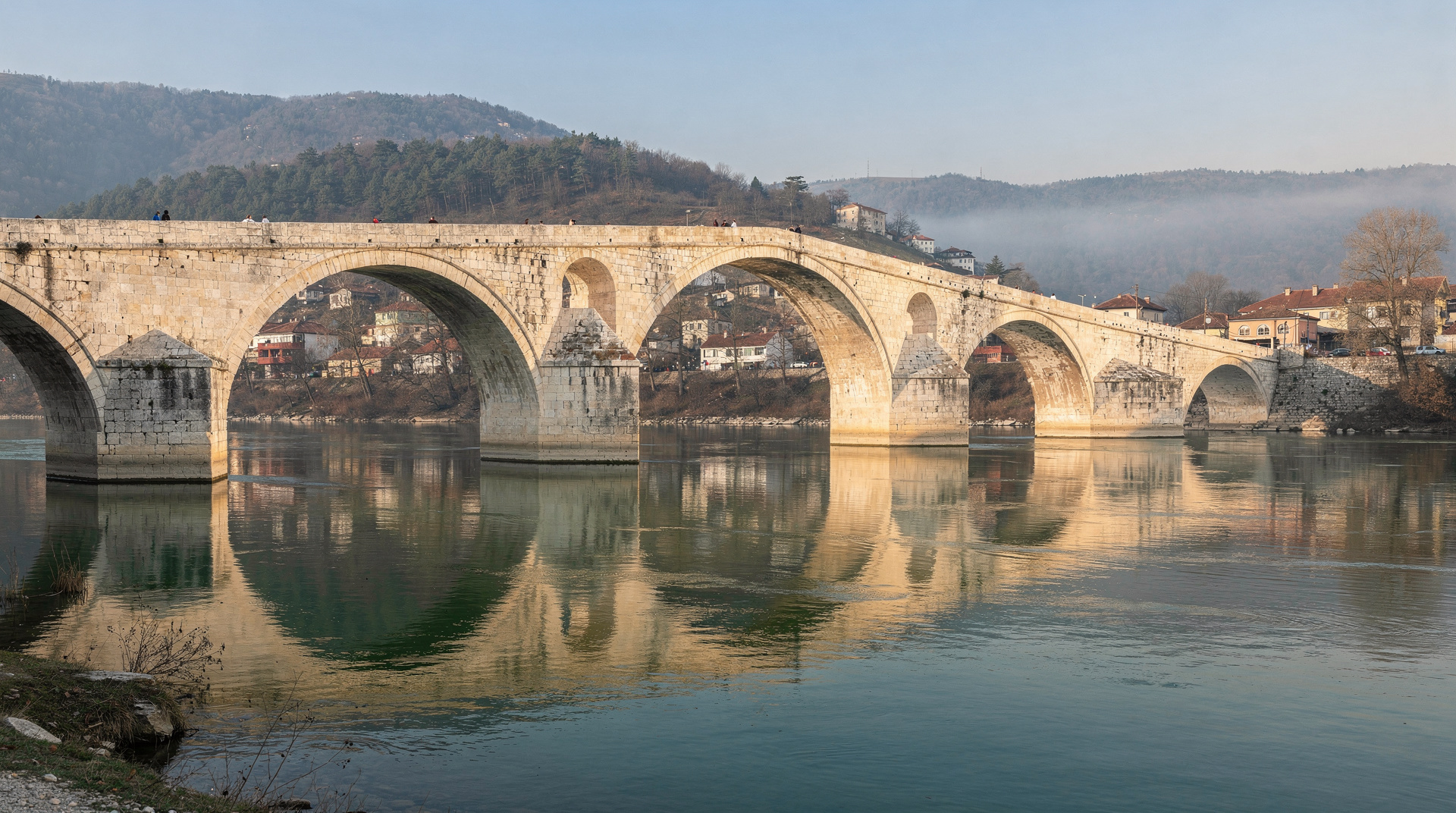
The Mehmed Paša Sokolović Bridge is one of the supreme achievements of Ottoman civil engineering — eleven semicircular arches of pale Drina limestone stretching 180 metres across the river, supported on slender piers, unchanged in its essential form since 1571. The bridge was built under the direction of the great Ottoman architect Mimar Sinan (designer of the Süleymaniye mosque in Istanbul and the Selimiye in Edirne) and commissioned by Grand Vizier Mehmed Paša Sokolović.
The Grand Vizier himself came from the village of Sokolovići near Višegrad — born a Bosnian Serb, taken to Istanbul as part of the devşirme system, he rose to become the most powerful man in the Ottoman Empire after the sultan. The bridge was his gift to his hometown. It is a UNESCO World Heritage Site, and its eleven arches have become one of the most recognisable images in Balkan architectural history.
Walk the full length of the bridge. Sit on the sofa — the stone seat built into the central parapet, used for centuries by Višegrad’s merchants and travellers to rest and watch the river. The Drina below is a deep blue-green, one of the most beautiful rivers in the Balkans.
Ivo Andrić and the Nobel Prize
The bridge gave its name to “The Bridge on the Drina” (Na Drini ćuprija), Ivo Andrić’s 1945 novel — a chronicle of Višegrad across four centuries, from the bridge’s construction to the First World War, told through the lives of the town’s Muslim, Serb and Jewish inhabitants. Andrić won the Nobel Prize for Literature in 1961. The bridge and the sofa (taş) at its centre are described in the novel with an exactness that makes reading the book before visiting the bridge a richly rewarding preparation.
Andrićgrad (Kamengrad)
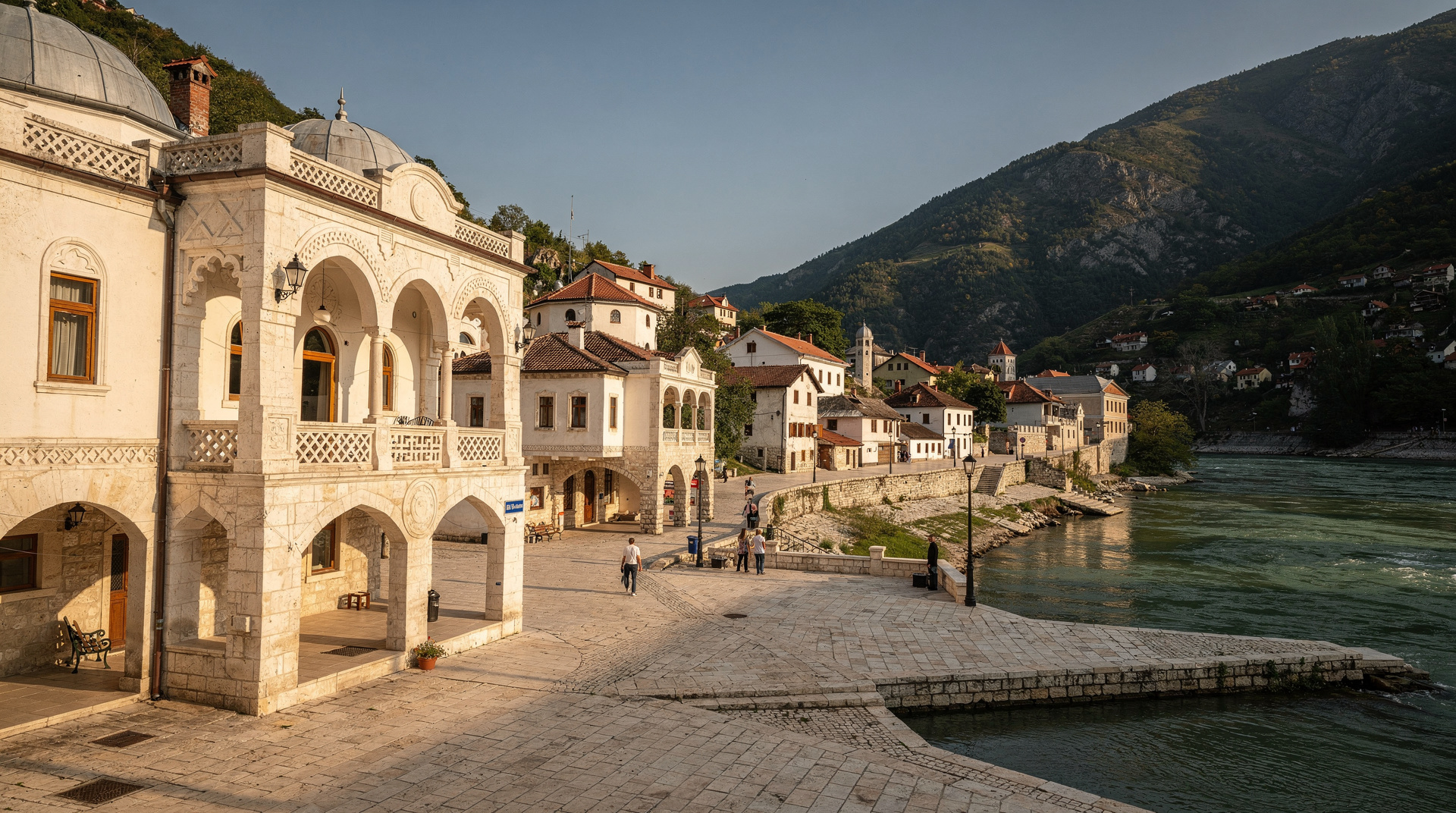
Built between 2012 and 2014 by Serbian filmmaker Emir Kusturica as a creative project and homage to Andrić, Andrićgrad is a compact stone town of cobbled lanes, arched gateways, a waterfront promenade and plazas. The architecture borrows from various Balkan historical styles — Byzantine, Ottoman, Serbian medieval — without being any single one of them. The effect is deliberately dreamlike: a town that looks ancient but is entirely invented.
Within Andrićgrad: a cinema that shows Kusturica’s films and other classics, a small orthodox church, a statue of Andrić, several restaurants and cafes, and a hotel. The Andrić Institute, a cultural centre dedicated to the writer’s legacy, operates from the town.
It is an odd place — part theme park, part genuine artistic statement. Opinions are divided. But the setting beside the Drina and the bridge, and the quality of some of the stonework, make it more than a curiosity.
The Šargan Eight railway
The Šargan Eight (Šarganska osmica) is a narrow-gauge heritage railway that climbs from Mokra Gora (Serbia) through a series of figure-eight loops — hence the name — gaining 300 metres of altitude in a landscape of pine forests and mountain ridges. The route was originally built by Austro-Hungarian engineers in the early 20th century and abandoned in 1974; it was restored as a tourist railway in 2004.
A ride on the Šargan Eight takes about 1.5-2 hours return from Mokra Gora station. The views over the Sargan valley and back towards Bosnia are extraordinary. Drvengrad (Küstendorf) — Kusturica’s earlier village creation, built for his film “Life is a Miracle” (2004) — is a short drive from Mokra Gora.
Border crossing note: Crossing into Serbia requires a valid passport. EU, UK, US, Canadian and Australian citizens cross without a visa (stays up to 90 days). The border crossing at Kotroman is straightforward but can have queues in summer. Your tour operator will handle all logistics.
Eastern Bosnia’s difficult history
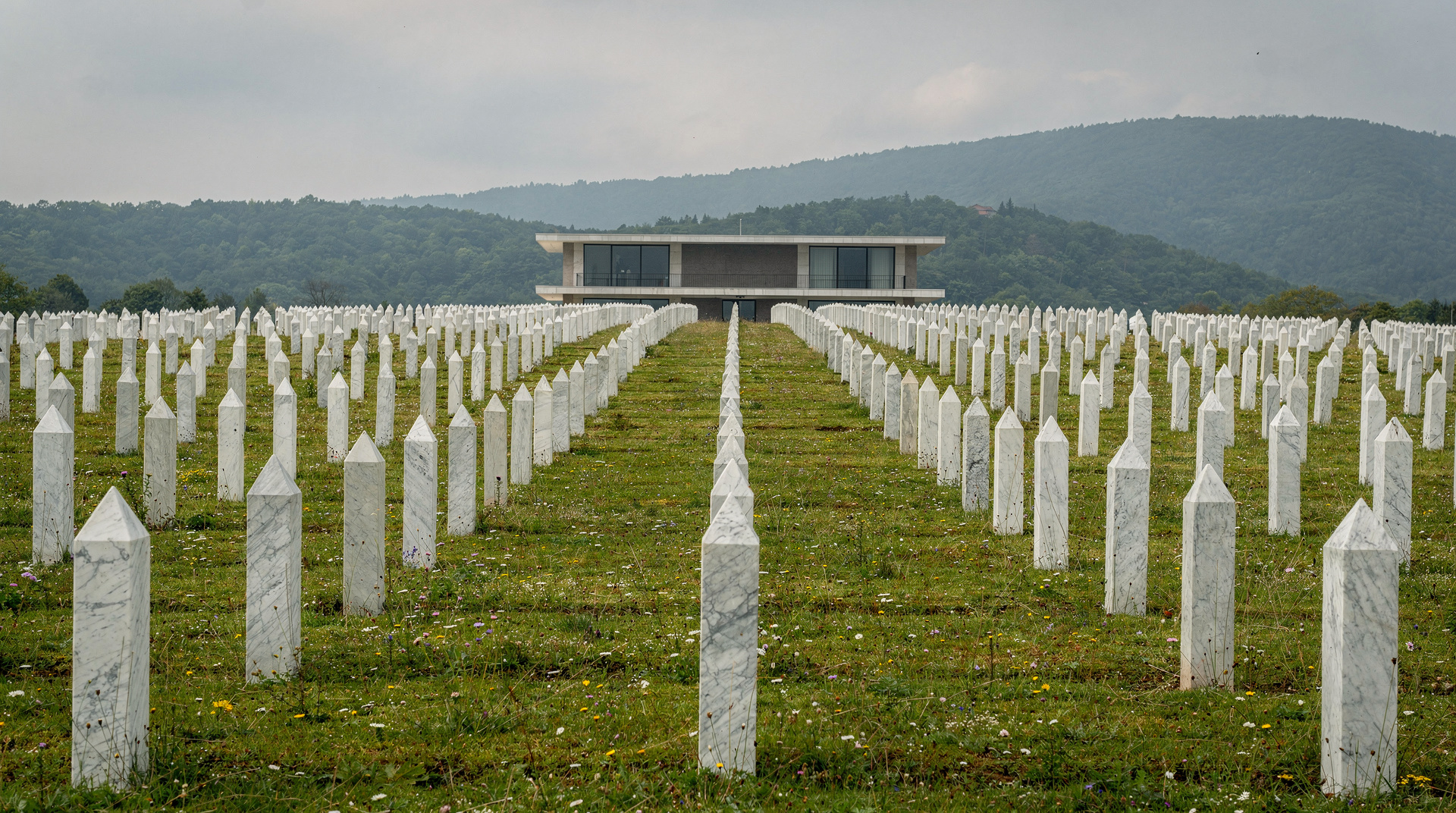
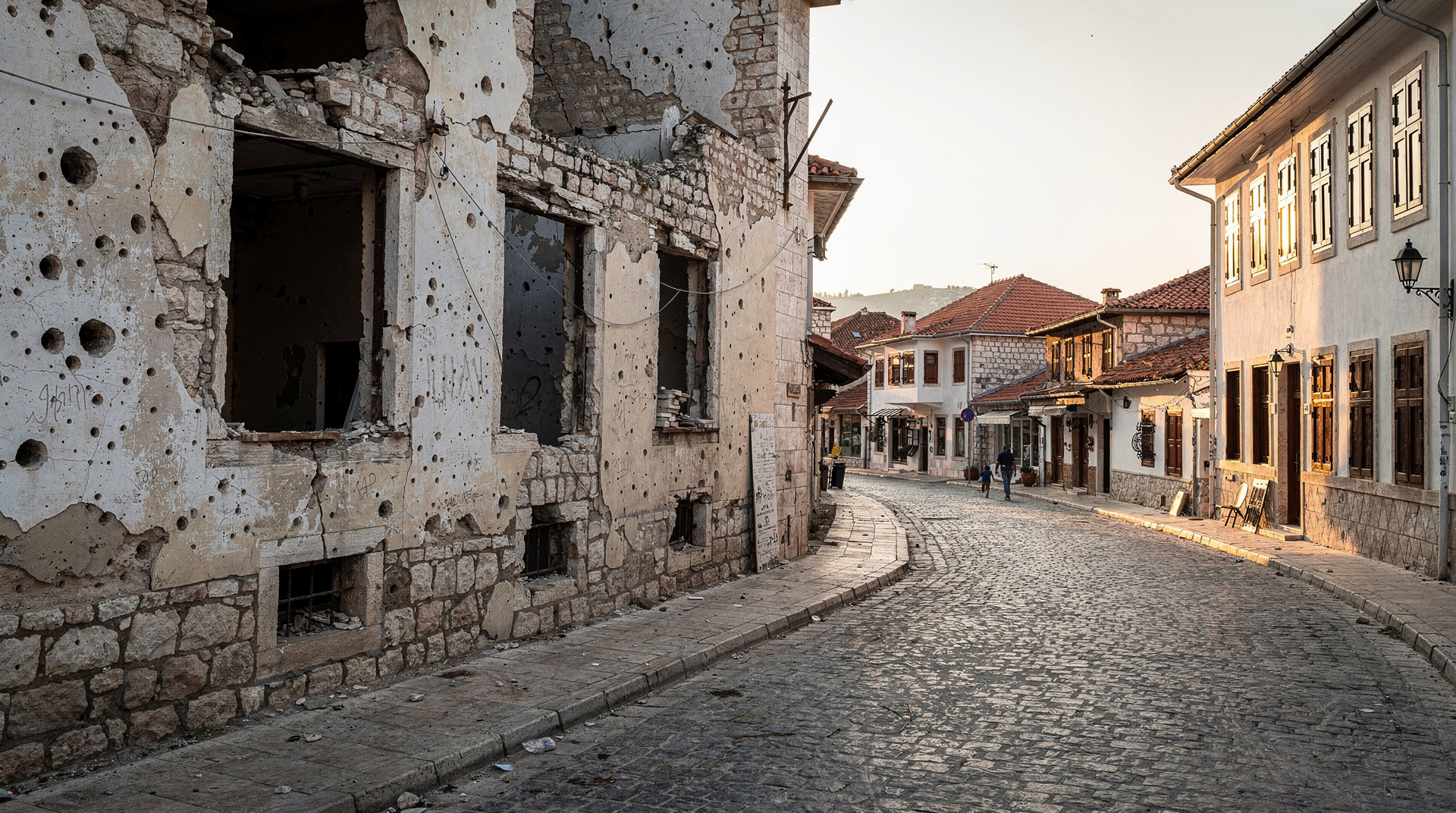
Visitors to Višegrad should be aware that the town was the site of systematic atrocities against Bosniak civilians in April-July 1992, early in the Bosnian War. The perpetrators used the Drina river as a means of disposal. This history coexists uncomfortably with the Ottoman bridge tourism and the Andrićgrad development. There is a small memorial to the victims in the town. The Yugoslav wars guide provides context.
Practical information
- Distance from Sarajevo: 115 km, approximately 2 hours
- Best season: May-October; mountain roads can be icy in winter
- Entry fees: Bridge free; Andrićgrad free to enter (cinema and restaurants charge separately)
- Šargan Eight railway ticket: Approximately 1,000 Serbian dinars (about 8-9 EUR) for the round trip
- Currency: Serbia uses the Serbian dinar, not BAM or EUR; exchange or use a card
- Passport: Required for the Serbian border crossing
See the best day trips from Sarajevo guide for how Višegrad fits into a wider itinerary, and the Visegrad Bridge on the Drina guide for deeper history of the bridge itself.
How to pace the day in Višegrad
The temptation on a day trip is to rush from the car park to the bridge, take a photograph and leave. Resist it. The town rewards slow looking, and the two sights sit so close together that you lose very little by lingering. Start with the bridge while the light is still soft and the crowds, such as they are, have not arrived. Walk it once without stopping, then walk it again slowly, pausing at the sofa and looking down at the piers where the Drina folds around the stone.
From there, drift across to Andrićgrad for a coffee or a meal. Treat it as a place to sit, not a checklist. The riverside promenade is the best part, because it lets you see the bridge from a different angle than the one printed on every postcard. If you have read Andrić’s novel, this is the moment to reread a passage on the spot. Our Visegrad Bridge on the Drina guide and the dedicated Andrićgrad guide go deeper on each, and the Višegrad destination page gathers the essentials in one place.
What to read and watch before you go
Višegrad is a destination that repays preparation. A little background turns a pleasant riverside stroll into something much richer. Three kinds of reading help:
- The novel itself. Andrić’s book is structured around the bridge, and each chapter feels like a different layer of the town’s story. Even a few chapters on the bus or in the car will change how you see the stonework.
- Ottoman context. The bridge makes more sense if you understand the empire that built it and the world of viziers, caravans and river crossings. The Ottoman heritage in Bosnia guide is a good primer, and the Bosnia history for travellers guide places it in the longer sweep of the country’s past.
- Recent history. Because of what happened here in 1992, it is worth understanding the war before you arrive. The Yugoslav wars explained guide is the place to start, and the Srebrenica day trip guide covers another eastern town where that history is central.
Who this trip suits
Višegrad is not for everyone, and saying so honestly is part of how this site works. It suits travellers who enjoy architecture, literature and quiet places more than ticking off headline attractions. It suits people who have already seen Sarajevo’s centre and want something that feels different. It suits those happy to spend a good part of the day in a car or on a coach, because the journey is part of the point: you watch the landscape shift from the Sarajevo basin to forested ridges and then to the open Drina valley.
It suits less well anyone travelling with very small children who dislike long drives, or visitors who want a packed, action-heavy day. For those travellers, the family activities guide and the Bosnia with kids guide point to easier options. If you prefer water, rivers and adventure over stone and history, the rafting in Bosnia guide shows another side of the country’s rivers.
Combining Višegrad with other plans
Because Višegrad lies off the main tourist axis, it fits best as a standalone excursion rather than a stop on the way to somewhere else. Still, it can slot into a wider trip in sensible ways:
- As one of several excursions from the capital, alongside the options in the best day trips from Sarajevo guide.
- As a counterweight in a longer route that mixes heritage and history, such as the Bosnia war history itinerary or the Sarajevo 4-day deep dive.
- As part of a full country loop, for example the Bosnia 7-day itinerary, if you are willing to trade one of the better-known stops for something quieter.
If you are still deciding how long to spend in the country overall, the how many days in Bosnia guide helps you weigh up where an eastern excursion deserves a slot. For a wider read on the country’s heritage towns, the Travnik Ottoman town guide offers a comparison with a very different Ottoman setting.
Respect and etiquette in a town with a hard past
A few simple habits make the visit better for you and more respectful to those who live here. Photograph the bridge and the stone town freely, but be thoughtful about photographing local people without asking. Speak quietly near the memorial. Avoid treating the town’s recent history as a topic for casual conversation with strangers; if locals choose to talk about it, listen. Spend something in a local café or restaurant, so that the visit supports the town rather than just passing through it.
It also helps to hold two ideas at once. The bridge is a shared heritage, admired across communities and the wider world. The town also carries real pain. Neither cancels the other, and a good visit makes room for both. The Bosnia travel guide offers broader advice on travelling thoughtfully through a country with a layered past.
Planning around Višegrad
If you are self-driving rather than joining a tour, budget time to get comfortable with local road rules — the driving in Bosnia guide covers what to expect on the E761 and other secondary roads. Cash matters too: within Bosnia the convertible mark (BAM) is used everywhere, and the money and currency guide explains where to exchange and what cards are accepted. Travellers deciding when to come should check the best time to visit Bosnia guide, since eastern Bosnia’s mountain roads are best avoided in deep winter.
For those extending the trip east of Sarajevo, Višegrad pairs naturally with a stop at Srebrenica, another eastern Bosnia destination with a heavy but essential history. Public buses from Sarajevo do exist but are infrequent; check the buses in Bosnia guide before relying on them for a day trip.
Frequently asked questions about Višegrad day trip guide from Sarajevo
What is the Mehmed Paša Sokolović Bridge in Višegrad?
What is Andrićgrad (Kamengrad)?
Can I combine Višegrad with the Šargan Eight railway?
How do I get from Sarajevo to Višegrad?
Is Višegrad safe to visit given its war history?
Do I need currency other than Bosnian marks for a Višegrad day trip?
Is Višegrad worth it without the Sargan Eight railway?
Top experiences
Bookable activities with verified prices and instant confirmation on GetYourGuide.