Višegrad — the bridge on the Drina
From Sarajevo: Višegrad, Andrićgrad, Šargan Train, Drvengrad
What is the Mehmed Paša Sokolović Bridge at Višegrad?
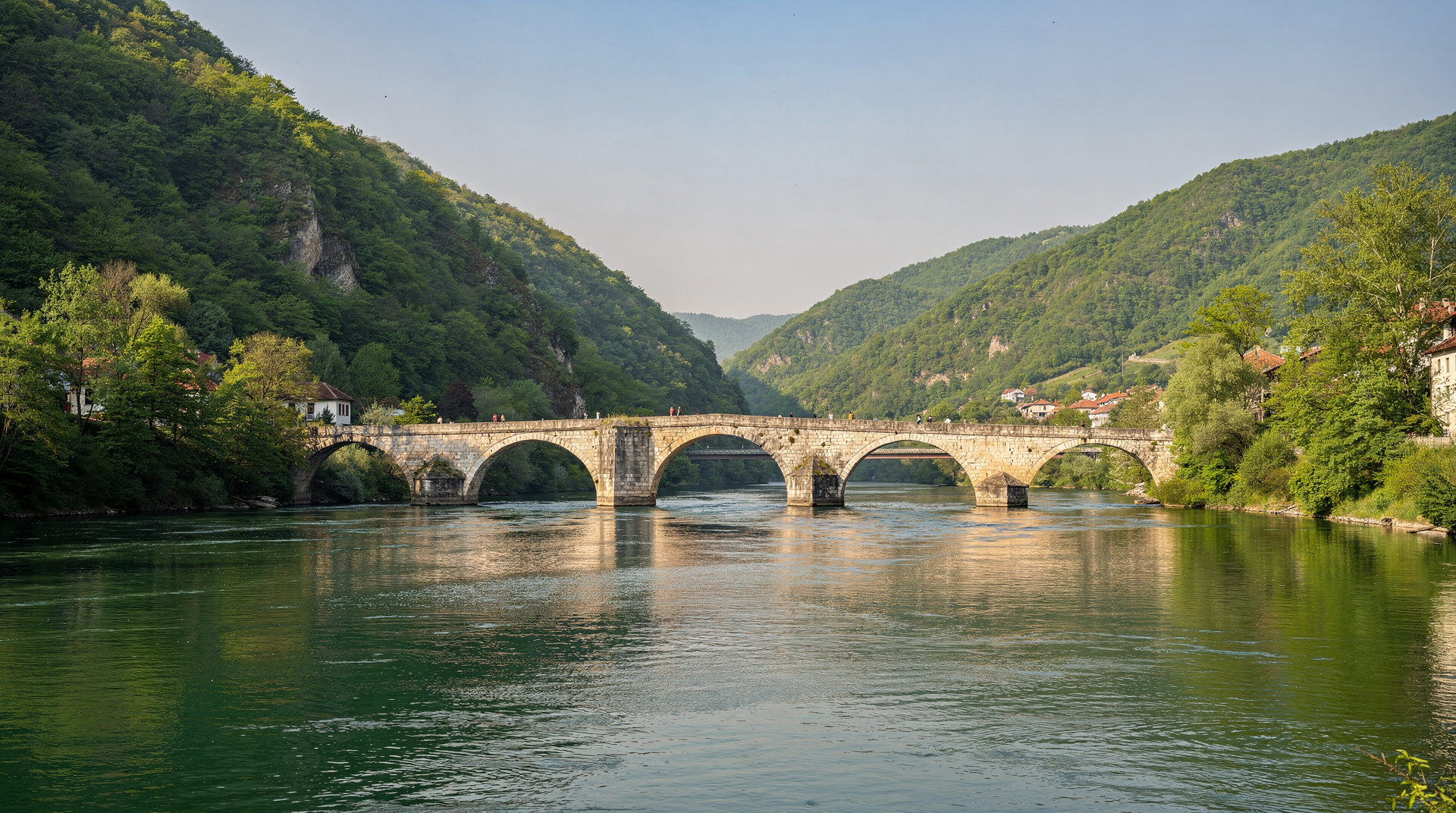
The Mehmed Paša Sokolović Bridge is an 11-arch Ottoman stone bridge over the Drina river at Višegrad, eastern Bosnia, built between 1571 and 1577 and inscribed on the UNESCO World Heritage List in 2007. It is one of the finest examples of Ottoman bridge engineering in the Balkans and inspired Ivo Andric's Nobel Prize-winning novel The Bridge on the Drina.
In a country full of remarkable Ottoman monuments, the bridge at Višegrad is exceptional. Eleven stone arches stride across the emerald Drina river, each span precisely calculated, the stonework still tight after 450 years. It is larger, older and arguably more architecturally significant than Mostar’s Stari Most, yet it receives a fraction of the visitors. Višegrad rewards those who make the two-hour detour from Sarajevo.
| At a glance | |
|---|---|
| Where | Višegrad, eastern Bosnia, around 100 km from Sarajevo |
| Cost | Free to walk the bridge; Andrićgrad has a small charge for some museum spaces |
| Time needed | Half a day for the bridge and Andrićgrad; a full day if adding the Šargan Eight railway |
| Getting there | Self-drive (around 1h45-2h from Sarajevo) or a guided day tour with transfer |
| Best time | May to October, with late spring giving the most scenic water levels |
The bridge: architecture and engineering
The Mehmed Paša Sokolović Bridge spans the Drina at a point where the river is wide, fast and turbulent — a location that defeated earlier attempts at bridge-building. The structure is 179 metres long and 6.2 metres wide, with 11 semicircular stone arches of varying spans (the largest is 11.45 metres) resting on twelve piers. The piers taper to wedge-shaped cutwaters upstream and downstream that deflect flood debris and reduce hydraulic pressure.
The architect was Mimar Sinan, the greatest builder of the Ottoman Empire, who was then in his 70s and had already designed the Süleymaniye Mosque in Istanbul and hundreds of other buildings across the empire. Sinan addressed the engineering problem of the unstable riverbed by founding the piers on wooden pile grids driven into the gravel. The approach ramps at each end are stone-paved, and small sofa-like projections — stone benches built into the railing at each pier — allowed travellers to rest and watch the river.
The bridge is built from local limestone, a pale grey stone that has weathered to a warm cream over the centuries. It has been repaired many times — most recently and significantly after flood damage in the 20th century — but the core structure is original. UNESCO inscribed it on the World Heritage List in 2007 as an outstanding example of the mastery of Ottoman bridge engineering.
The commissioner: Mehmed Paša Sokolovic
The bridge was commissioned by Mehmed Paša Sokolovic, Grand Vizier of the Ottoman Empire from 1565 to 1579 — arguably the most powerful man in the empire after the sultan. What makes this biography remarkable is that Sokolovic was born Bajica Sokolovic around 1505 in the village of Sokolovici, just a few kilometres from Višegrad, to a Serbian Orthodox Christian family. He was taken in the Ottoman devshirme levy (the practice of conscripting Christian boys for state service), converted to Islam, educated in Istanbul and rose through the military and administrative ranks to the highest office in the empire.
His decision to build a major bridge at his birthplace was both a pious act (building infrastructure was considered meritorious in Islam) and a personal statement of origin. He simultaneously commissioned his cousin, Makarije Sokolovic, to serve as the Serbian Orthodox Patriarch — one of the stranger dual-family stories in Ottoman history.
Sokolovic was assassinated in 1579, stabbed by a dervish petitioner in Istanbul. His bridge outlasted him by more than four centuries.
The Bridge on the Drina: Ivo Andric’s novel
Any serious visitor to Višegrad should read, or at least know, Ivo Andric’s novel Na Drini cuprija (The Bridge on the Drina), published in 1945 and cited when Andric was awarded the Nobel Prize for Literature in 1961. The novel spans four centuries, from the bridge’s construction to the outbreak of World War I, following the people who live near, work on and die by the bridge.
Andric was born in Travnik in 1892 (see the Travnik Ottoman town guide) but spent his early years in Višegrad. The bridge is not merely the setting of the novel; it is the protagonist — stable, patient, witness to everything. The recurring image of people gathering on the bridge’s stone sofas (the built-in benches) to talk, gossip and conduct business is historically accurate; the bridge was genuinely the social centre of the town for centuries.
The novel deals honestly with the violence of history, including Ottoman punishments and the degradations of late 19th-century Austro-Hungarian occupation. It is not a comfortable read but it is a great one.
Visiting the bridge
The bridge is in the centre of Višegrad town, easily walkable from the main street. There is no admission charge to walk the bridge or stand on it. The stone surface is in good condition and the railings (low, in the Ottoman style) are original.
The best photographs are taken from the east bank looking west in morning light, or from the river level — a small beach area below the east approach gives a low angle on the arches with the Drina in the foreground. The water of the Drina here is a distinctive dark emerald-green, fed by mountain rivers and reservoir water from the Perucac dam upstream.
A day tour from Sarajevo to Višegrad and Andrićgrad combines the bridge with the Andrićgrad cultural complex and often continues to the Šargan Eight railway across the Serbian border, making for a full day in the Drina canyon landscape.
How to spend your time on the bridge
Resist the urge to treat the bridge as a photo stop. The pleasure of Višegrad is slowness: walk the full length once without stopping, then return and sit on one of the stone benches at the piers, the same ones Andrić describes. Watch the current pull around the cutwaters and you will understand why the builders gave so much attention to the foundations. Locals cross at all hours, so the bridge still works as a living part of the town rather than a museum piece, which is exactly what sets it apart from the more staged experience at Stari Most.
If you have read the novel, bring a few passages with you. Standing at the widest part of the roadway, where the story places its gatherings, is a more affecting way to meet the text than any plaque. If you have not, even the opening chapters make the site far more legible. Pair the walk with the stone-built streets of Andrićgrad afterwards, and treat the two as one continuous visit rather than separate stops.
Višegrad as part of a wider eastern Bosnia route
The town sits on the edge of a part of the country that most visitors never see. Many travellers reach it from Sarajevo, but it also fits neatly into a longer loop. Those building a trip around the Ottoman legacy can link it with Počitelj and Blagaj in Herzegovina, then return north through Mostar. Those interested in the recent past can pair it with the Srebrenica day trip guide, keeping in mind that the two together make a heavy emotional day and deserve separate days if time allows.
For a first-time visitor, the Bosnia 7-day itinerary and the Bosnia war history itinerary show how an eastern detour can be slotted in without wrecking the rest of the plan. If you are still deciding how long to give the country overall, the how many days in Bosnia guide helps weigh Višegrad against the other candidates. The Višegrad destination page gathers everything the site covers about the town in one place.
Getting around once you are there
The centre of Višegrad is compact, and the bridge, the riverbank and the main street are all reachable on foot. A car is useful mainly for getting to the town and for exploring the canyon scenery along the Drina afterwards. If you are weighing self-drive against public transport, the driving in Bosnia guide covers road conditions and habits, while the buses in Bosnia guide explains how the intercity network behaves. For general planning across the country, the getting around Bosnia guide is a good starting point, and renters should read the car rental guide before booking.
Bring water, a hat in summer and comfortable shoes for the worn stone. Light layers help in the shoulder seasons, when the air by the river can feel cooler than elsewhere in town. Take your time over a coffee afterwards; the Bosnian coffee culture guide explains the ritual if you want to do it properly, and the Bosnian food guide will help you order sensibly at a local restaurant.
Reading the site with the right context
The bridge is more rewarding when you hold three layers in mind at once: the engineering of the sixteenth century, the literary afterlife created by Andrić, and the painful events of 1992. None cancels the others. Visitors who want the longer story of how the Ottoman period shaped the country will find it in the Ottoman heritage guide, while the Yugoslav wars explained guide sets out the political background to the war. Those who want a human-scale account of the town in a different period can read the Bosnia history for travelers overview before they travel.
Practical respect goes a long way here: keep voices low near memorials or places where locals gather quietly, ask before photographing people, and do not treat the river as a backdrop for jokes. Plenty of residents are proud of the bridge and glad to talk about it, and a courteous question usually opens a conversation.
The dark history: 1992
Visitors to Višegrad should be aware that the town was the scene of some of the most severe war crimes committed during the 1992-1995 war. In the spring and summer of 1992, Bosniak civilians were killed en masse — shot and thrown into the Drina from the bridge itself, or burned alive in houses. The crimes were committed primarily by the Serb paramilitary group Beli Orlovi (White Eagles) and local Serb forces under the command of Milan Lukic. Lukic was convicted by the ICTY in 2009 and sentenced to life imprisonment.
The bridge features in survivor testimonies: bodies were thrown from it into the Drina. The current tourist promotion of the town, particularly around Andrićgrad, largely avoids this history. Visitors who want to understand the full context of what happened in Višegrad in 1992 will find information in the war history guide for Bosnia and in the trial records of the ICTY.
This does not mean Višegrad should not be visited — the bridge and the landscape are genuinely extraordinary — but honesty about the location’s full history is part of responsible travel in this region.
Višegrad bridge vs Stari Most: which to prioritise
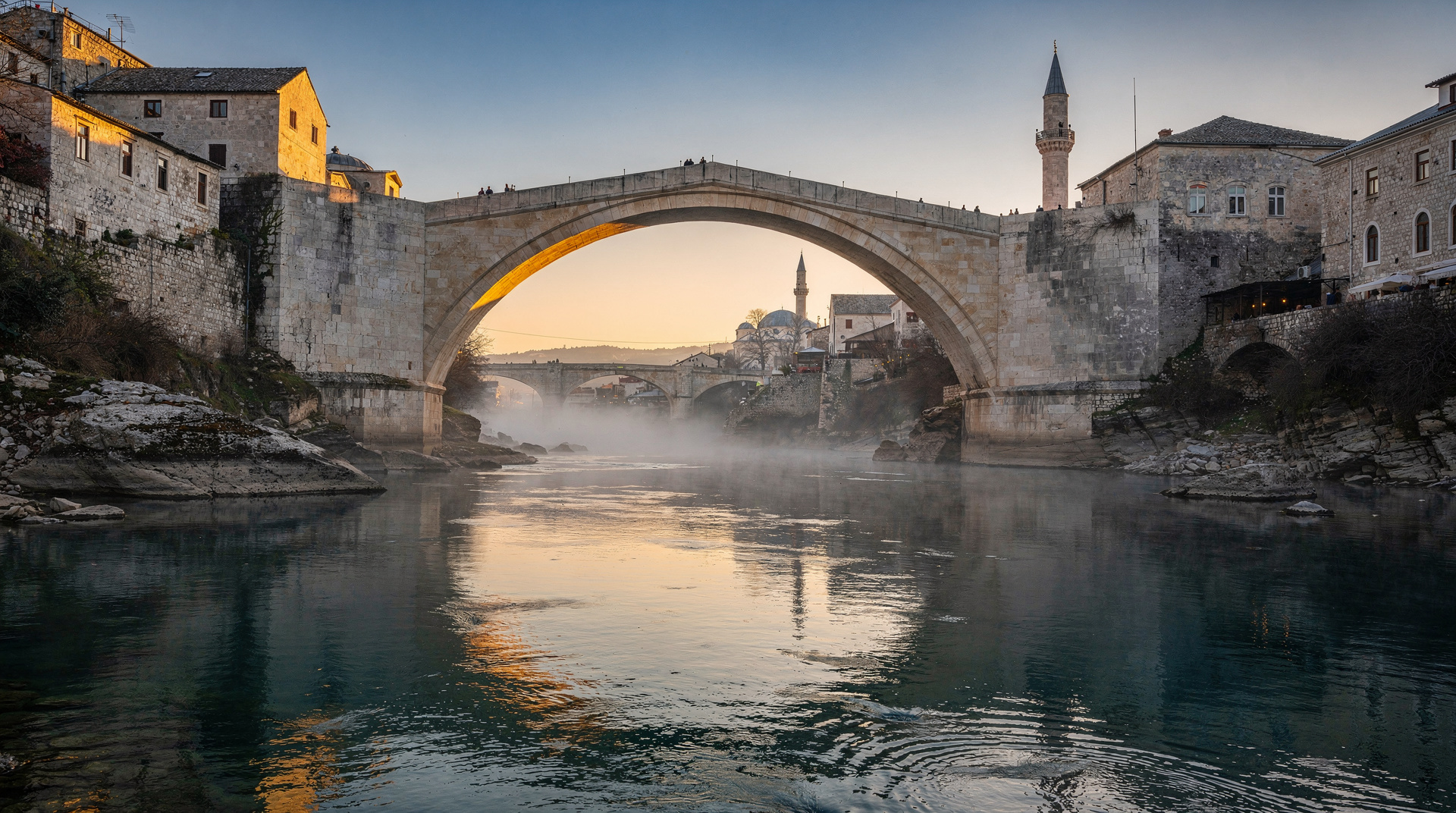
Visitors with limited time often ask whether Višegrad or Stari Most in Mostar deserves priority. Both are UNESCO-listed Ottoman masterpieces, but they offer different experiences.
| Višegrad bridge | Stari Most (Mostar) | |
|---|---|---|
| Built | 1571-1577 | Completed 1566, rebuilt 2004 after wartime destruction |
| Architect | Mimar Sinan | Mimar Hajruddin |
| Crowds | Light | Heavy, especially midday |
| Signature activity | Reading/knowing Andric’s novel, quiet riverside views | Watching or doing the bridge dive |
| Distance from Sarajevo | About 100 km, 1h45-2h | About 130 km, 2-2.5h |
Ideally, see both on a longer Bosnia trip — they tell complementary stories about Ottoman engineering and, in very different ways, about the country’s 20th-century history. The Ottoman heritage guide puts both bridges into a single narrative alongside Baščaršija and Počitelj, and the Bosnia history for travelers guide gives useful background before visiting either site. For the Mostar side of the comparison, a guided walk through the old town and across the rebuilt bridge gives helpful context on what you are looking at. If you only have time for a short eastern Bosnia detour, see the Višegrad day trip guide for a full itinerary built around the bridge.
Practical information
Distance from Sarajevo: About 100 km, 1h45-2h by car. The road follows the Prača valley — scenic and reasonably fast.
By bus: Buses from Sarajevo to Višegrad run several times daily from the East Sarajevo bus terminal (Lukavica). Journey time approximately 2h. The service is not frequent enough for a comfortable day trip without a car or organised tour.
Entry: Walking the bridge is free. Parking in Višegrad town is easy and cheap.
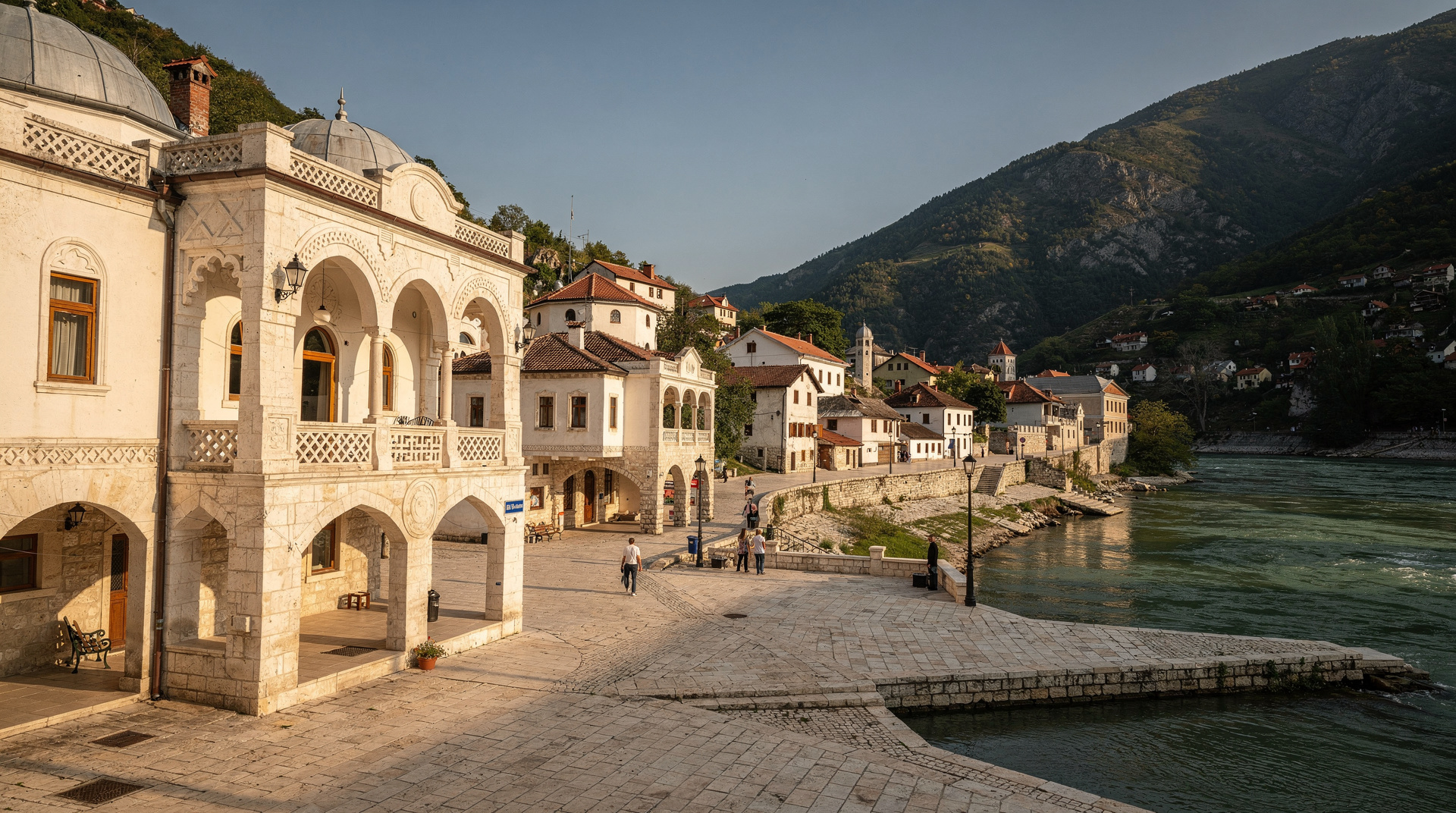
Combining with Andrićgrad: The cultural complex is 5 minutes’ walk from the bridge. See the Andrićgrad guide for what to expect.
The Šargan Eight railway: A popular add-on from Višegrad is to cross into Serbia at Mokra Gora and ride the restored narrow-gauge railway (approximately 1h round trip, departures roughly every 2h in summer). This is included in some organised day tours from Sarajevo. If you would rather not organise the border crossing and the railway timings yourself, a guided day out combining Višegrad, the Šargan Eight railway and the film-set village nearby handles the logistics for you.
When to visit: May-October. The Drina’s water level is typically at its most scenic in late spring. Summer brings some local tourism (Bosnians visit the thermal baths at Vilina Vlas). The town is very quiet in winter.
For the broader context of Ottoman architecture across Bosnia, see the Ottoman heritage guide, which places the Višegrad bridge alongside Stari Most, Baščaršija and Počitelj in a single historical narrative.
Frequently asked questions about Višegrad — the bridge on the Drina
Who built the Mehmed Paša Sokolović Bridge?
Why is the bridge on the UNESCO World Heritage List?
What is the connection between the bridge and Ivo Andric?
Is Višegrad safe to visit given its war history?
How far is Višegrad from Sarajevo?
What else is there to see in Višegrad?
How does the Višegrad bridge compare to Mostar's Stari Most?
Is there an entry fee to visit the bridge?
Top experiences
Bookable activities with verified prices and instant confirmation on GetYourGuide.