Where to stay in Mostar — best areas and honest hotel guide
Mostar: Private Walking Tour with Local Guide
What is the best area to stay in Mostar?
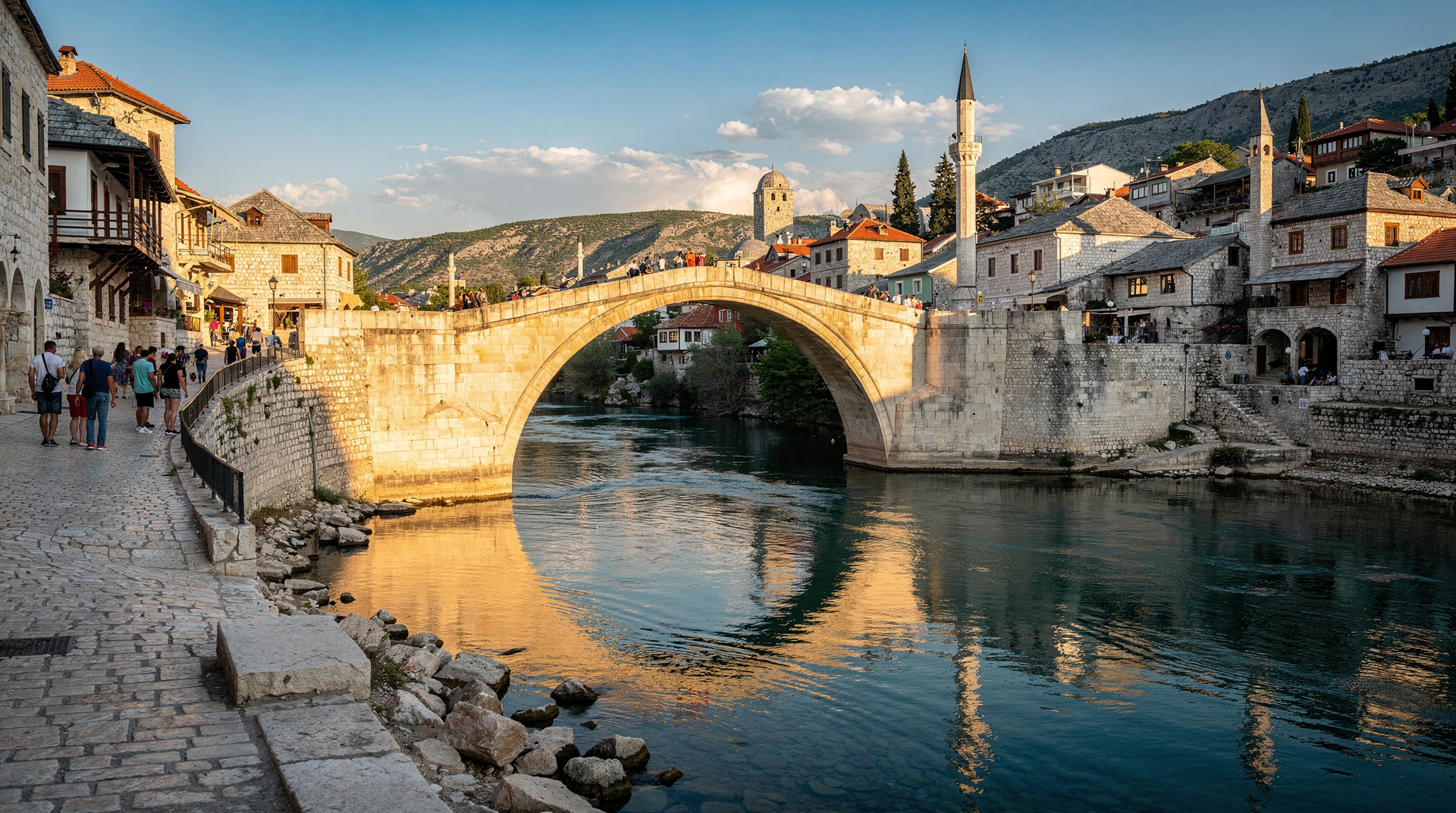
The old town (near Stari Most) is the most atmospheric choice but fills with day-trip crowds by midday. Stay on the east bank (Bosniak quarter) for authentic character and proximity to the bridge, or just back from the old town on the west side for quieter nights. Bulevar (the modern main boulevard) suits mid-range hotel preferences.
| Where | Old town east bank (closest to the bridge), west bank, or Bulevar (modern, parking) |
| Cost | Roughly 50–90 BAM/night budget, 100–200 BAM mid-range, 150–280 BAM boutique heritage |
| Time needed | 1 night minimum; 2 nights recommended with a day trip |
| Getting there | 15-minute walk from the bus/train station; see getting around Bosnia |
| Best time to book | Well ahead for July–August and for Muslibegović House year-round |
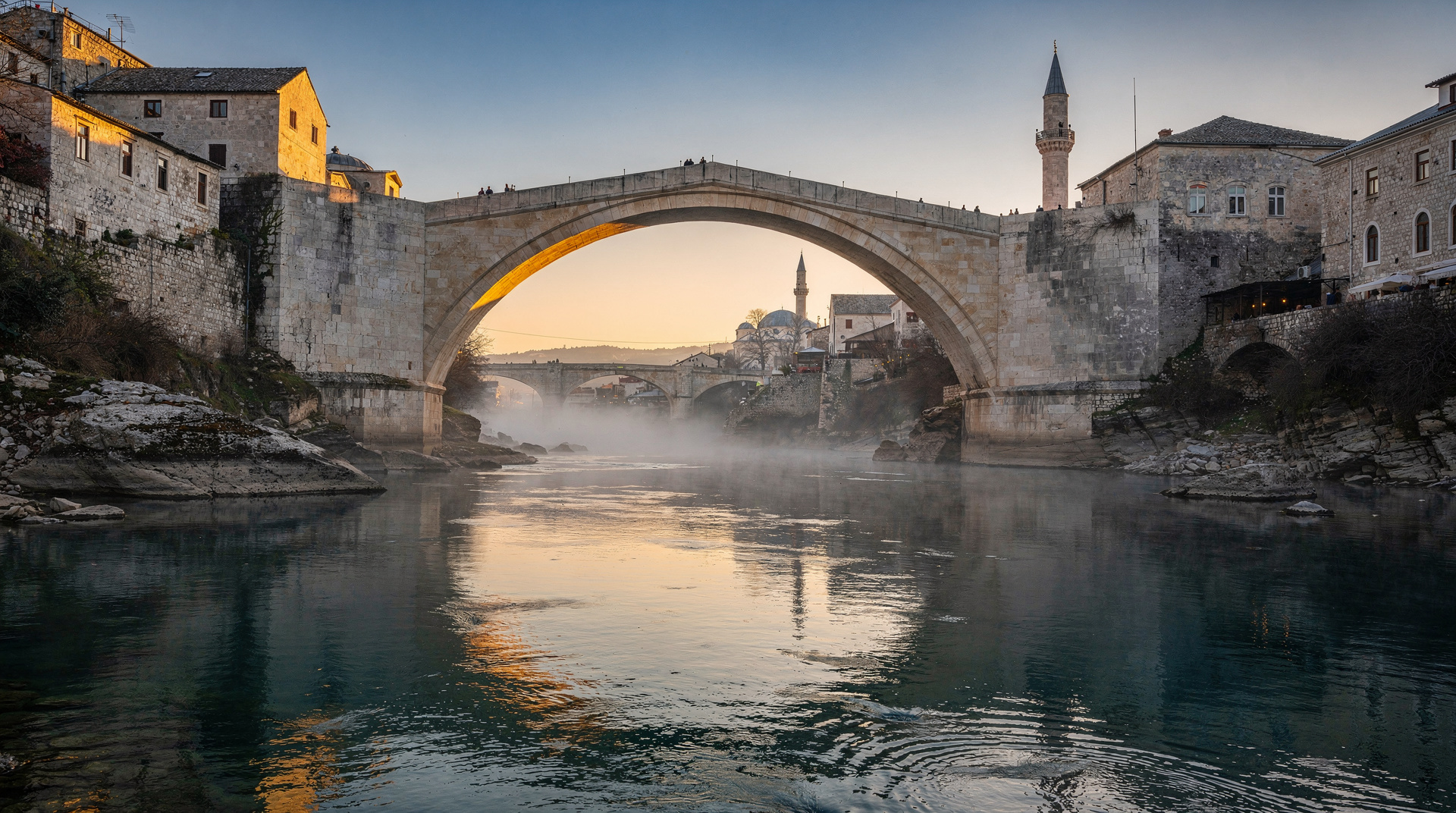
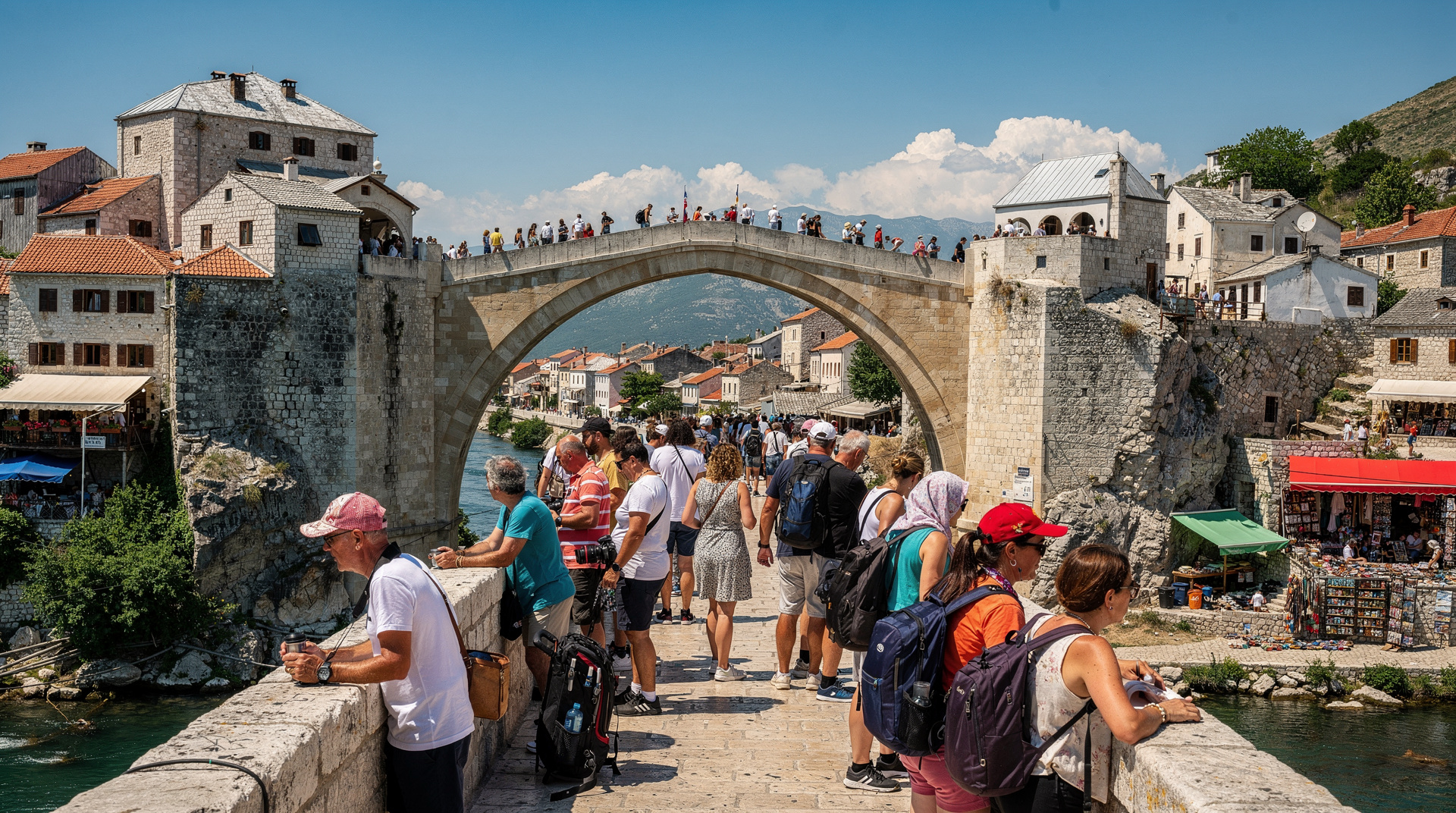
Mostar is a small city — the historic core is about 1 km from one end to the other — but where you sleep significantly affects your experience. The day-trip traffic through the Stari Most area is intense in summer; the same streets at 6:00 in the morning are among the most beautiful in the Balkans. Getting the location right means you can catch both.
The old town east bank — closest to the bridge
Who it suits: Those who want to walk out of their accommodation and be standing on the Ottoman bridge in 2 minutes. Architecture enthusiasts, photographers.
Atmosphere: The east (Bosniak) bank of the Neretva river is the original Ottoman core — winding stone lanes, covered bazaar stalls, copper-smiths, the distinctive Mostar minaret. It is the most photographed part of Bosnia. In season it is also extremely busy during daylight hours.
Accommodation: A mix of family guesthouses, heritage boutique hotels and modern small hotels tucked into the lanes. The most famous is Muslibegović House (a genuine Ottoman mansion, 150–250 BAM/night, must-book months ahead in summer). Pansion Nur, Pansion Most and several small guesthouses cluster here, typically 60–100 BAM/night.
Noise consideration: Rooms facing the main tourist lanes (Kujundžiluk) can be busy until 21:00. Rooms in interior courtyards or a street back are far quieter.
Book a private walking tour of Mostar with a local guide on your first afternoon — the guide will explain which parts of the east bank are genuinely historic and which are reconstructed for tourists, which makes all the difference.
The old town west bank
Who it suits: Travellers who want easy access to both sides of the city, slightly less congestion, a mix of Ottoman and late 19th-century architecture.
Atmosphere: The west bank (historically associated with Croat Mostar) was more severely damaged in the 1990s and has been rebuilt more recently. There are genuine heritage buildings here (the Franciscan church and monastery, some Ottoman-era structures) but also more modern construction. Quieter in the evenings.
Accommodation: More modern small hotels and some pansions. Hotel Kriva Ćuprija (Crooked Bridge area) is a popular mid-range option (100–160 BAM/night). The Crooked Bridge itself is a smaller Ottoman bridge a few minutes from Stari Most, almost always less crowded.
Bulevar area — the main modern boulevard
Who it suits: Travellers who prioritise hotels with parking, larger rooms, air conditioning and standard hotel amenities over location.
Atmosphere: The modern arterial road that runs through Mostar. Less charm, more functionality. A 10–15 minute walk to Stari Most on foot.
Accommodation: Mid-range chain-style hotels (Hotel Mepas, Hotel Ero, Hotel Mostar) in the 120–200 BAM range. These offer what a three-star hotel should offer — reliable wifi, proper bathrooms, breakfast options — in a setting that is convenient but not atmospheric.
Parking: The best option if you arrive by car. Old-town accommodation often has no parking or charges extra.
Residential neighbourhoods — Donja Mahala, Ilići
Who it suits: Long-stay travellers, those wanting to live in Mostar rather than sight-see it, very budget-conscious travellers.
Atmosphere: Real Mostar — a city of 110,000 people going about daily life. Markets, local cafés, school runs, neighbourhood mosques. Pleasant to experience but adds 20–30 minutes of walking to the old bridge.
Accommodation: Mostly Airbnb apartments and local guesthouses. Prices from 40–70 BAM/night.
How many nights in Mostar?
One night: Covers a late afternoon arrival (avoiding the worst of the day-trip crowds), sunset on the bridge, an evening meal, dawn at the bridge (the best time), morning in the old town, and departure.
Two nights: Allows a full day trip to Blagaj Tekija, Počitelj and Kravice Falls from a Mostar base — highly recommended.
Three nights: Adds time for Trebinje to the south-east, or the Ćiro cycling trail, or a half-day rafting on the Neretva.
Honest notes about staying in Mostar
The day-trip problem: On summer days, somewhere between 5,000 and 10,000 day-trippers from Dubrovnik and Split pass through Mostar’s old bridge area. The streets are packed. It is genuinely challenging to have a quiet, reflective experience at the bridge between 11:00 and 18:00. The solution is to be on the bridge at 7:00 when the day-trippers are still eating breakfast in Dubrovnik. Staying overnight makes this possible.
Taxis: Agree a price before getting in. There is no Bolt/Uber coverage in Mostar. Reputable taxi companies are arranged through hotels; unregulated drivers outside the bus station are known to overcharge tourists. For the tourist traps to avoid in Mostar, see that guide.
Bridge divers: The Stari Most bridge divers are a tradition — young men who jump 21 metres into the Neretva for money. They will approach you before jumping and explain that they dive only if they raise their target sum. This is a form of street performance; you can donate or not without obligation. No pressure is appropriate. See Mostar bridge divers — the truth.
Since the quiet hours at Stari Most belong to those who sleep in town, check the walking distance to the bridge and whether the host can arrange a reputable taxi for your arrival, as there is no Bolt or Uber here. Read recent guest comments about noise on summer evenings, then browse Mostar stays on Booking.com with those two points in mind.
Prices at a glance
| Type | Price (BAM) | Price (EUR) |
|---|---|---|
| Budget dorm (hostel) | 22–35 | 11–18 |
| Budget private room | 50–90 | 26–46 |
| Mid-range guesthouse | 90–140 | 46–72 |
| Mid-range hotel | 120–200 | 61–102 |
| Boutique heritage hotel | 150–280 | 77–143 |
Mostar accommodation is typically 15–25 percent more expensive than equivalent Sarajevo accommodation, reflecting the higher international tourism demand relative to supply.
Frequently asked questions about staying in Mostar
Is it better to base in Mostar or Sarajevo?
For a short Bosnia trip (3–5 days), Sarajevo is the better base — more to do within the city, better transport links and accommodation variety. Mostar is better as a 1–2 night addition. For pure Herzegovina focus (wine, coast proximity, Kravice, Trebinje), Mostar as a base makes more sense.
Can I walk from the bus station to the old town?
Yes. The Mostar bus station and train station are about 1 km south-west of the old bridge — roughly 15 minutes on foot. The walk crosses the Bulevar (main road) and enters the old town from the west side.
What is the best time of day to visit the old bridge area?
Dawn (before 7:30) for beauty and quiet. Evening (after 19:00 in summer) for atmosphere without the crowds. Midday in July-August is the worst — crowded, hot, and the light is flat for photography.
Booking timing and what actually sells out
Mostar’s supply of atmospheric old-town rooms is genuinely limited — the historic core is small and much of it is not zoned for accommodation. In July and August, the best-located guesthouses and Muslibegović House sell out weeks, sometimes months, ahead. Mid-range Bulevar hotels and Airbnb apartments in the residential neighbourhoods stay available later, since supply there is larger. If you are building a wider trip, the Bosnia 7-day itinerary and Sarajevo-Mostar 3 days itinerary both assume 1–2 nights in Mostar, which matches what most travellers need.
Day trips that work well from a Mostar base
Once you are settled, Mostar’s location makes it an efficient base for Herzegovina’s best sights. Blagaj Tekke and the Buna spring are 20–25 minutes away; Kravice Falls is roughly 40 minutes and best visited in the morning before tour buses arrive; Počitelj is a scenic 30-minute stop en route to Kravice. Combine two or three of these in a single day rather than trying to do all of Herzegovina at once — see the Herzegovina day trip guide for suggested pairings. If you would rather not organise the logistics yourself, a guided day tour that links Mostar, Počitelj and the Kravice waterfalls is one way to cover several of these stops in a single outing.
Choosing by trip style
First visit, short on time. Stay on the east bank or just back from it. You trade some noise for the ability to see the bridge at both ends of the day, which is the whole point of sleeping here. Read the Stari Most guide before you arrive so you know what you are looking at, and the Mostar destination page for the wider picture of the city.
Arriving by car. Pick a Bulevar hotel and walk in. Roads in the old town are narrow and parking is awkward. If you have not yet sorted the car, the guide to renting a car in Bosnia and the notes on driving in Bosnia explain what to expect on the road. Coming from the coast, the driving guide from Croatia to Bosnia covers the border side of things.
Arriving by bus or train. Almost anywhere in the core is within walking distance of the stations, so you can choose purely on atmosphere. See Sarajevo to Mostar transport and the buses in Bosnia guide for how the connections work.
Travelling on a tight budget. The residential neighbourhoods and the simplest guesthouses give the best value, and a long walk into the old town costs nothing. Our Bosnia on a budget guide shows where else to save, and the money and currency guide explains how to pay without losing out on exchange.
Travelling as a couple. A heritage room with a view or a quiet courtyard is worth the extra spend here more than almost anywhere else in the country. A slow evening on the east bank, then a late dinner, is the sort of night people remember.
What to look for in a room
Whatever area you choose, a few practical checks save trouble later. Ask which way the window faces and whether the room is above a café terrace. Check whether air conditioning is included if you travel in the hot months, because the Herzegovina summer is hard on rooms without it. Ask whether breakfast is served on site, and whether the host can arrange a taxi or a lift to the station. Small family guesthouses often answer these questions generously, and a host who knows the town will tell you honestly when a lane gets loud.
Read recent reviews for mentions of noise, hot rooms and stairs. Many old-town buildings are steep and narrow, so if you carry heavy luggage or have limited mobility, say so when booking and ask about the ground floor.
Evenings, food and the rhythm of the day
Staying overnight changes the rhythm of the whole visit. After the day-trippers leave, the east bank softens: terraces fill with locals and visitors, the stone lanes cool down, and the bridge is lit. Eat early if you want a table with a view, or later if you prefer a quieter room. The best restaurants in Mostar guide gives specific places to try, and the Bosnian food guide explains the dishes you will see on menus. If you want to understand the coffee that will fill your morning, read about Bosnian coffee culture.
If you prefer to see the old town with someone who knows its stories, a guided walk through the old town and across the Old Bridge fits neatly into the quiet hours of an overnight stay.
Mornings reward a little discipline. Walk out early, cross the bridge before the first groups arrive, and then return for breakfast. By the time you sit down, the lanes have started to fill, and you have already seen the best of them.
Understanding the city you are sleeping in
Mostar carries its history openly. The two banks were divided during the 1990s, and traces of that period are still visible in some streets and buildings. If you choose to stay on one side or the other, take time to see both. The Mostar war history guide is a respectful introduction, and the blog post on the story of the old bridge adds a more personal account. Neither bank is better or worse as a place to sleep; they simply feel different, and the contrast is part of what makes the city worth the overnight stop.
Combining Mostar with the rest of your trip
Mostar fits into many routes. From the coast, compare the options in Mostar from Dubrovnik, Mostar from Split and the side-by-side Mostar from Split vs Dubrovnik. From Sarajevo, the Mostar day trip from Sarajevo works, but sleeping in Mostar gives a far better experience, and the Sarajevo vs Mostar comparison helps you decide how to split your nights. If you also need a bed in the capital, see where to stay in Sarajevo.
Once you are based here, the best day trips from Mostar list gives you plenty of ideas. Active travellers may like the Neretva rafting guide or the Mostar zipline over the glass bridge, and those who prefer to taste their way through the region will enjoy the Herzegovina wine guide.
Timing your stay and avoiding crowds
The season matters as much as the neighbourhood. The best time to visit Bosnia page explains the shoulder months, and Bosnia in summer describes what the heat and the crowds are really like. For general tactics, the guide to avoiding crowds in Bosnia applies very well to Mostar: go early, stay late, and sleep close enough to do both.
Booking safely
Use well-reviewed properties and confirm the details of your reservation in writing, including the name of the street and how to find the entrance, because some lanes are hard to locate with a suitcase. Be wary of anyone who approaches you at the station with an offer of a room, and agree any transfer price in advance. For a wider view of the pitfalls, see the Bosnia scams to avoid guide.
Top experiences
Bookable activities with verified prices and instant confirmation on GetYourGuide.