Stari Most — Mostar's Old Bridge guide
Mostar: Old Town Walking Tour with Stari Most & Mosque
What is Stari Most?
Stari Most (Old Bridge) is a 16th-century Ottoman stone arch bridge over the Neretva river in Mostar, built in 1566 under Suleiman the Magnificent, destroyed by Croatian forces in 1993 and rebuilt in 2004. It is a UNESCO World Heritage Site and the most recognisable symbol of Bosnia & Herzegovina.
Stari Most — literally “Old Bridge” in Bosnian — is the most photographed structure in Bosnia & Herzegovina and one of the most compelling stories in European architecture. It is simultaneously a masterpiece of Ottoman engineering, a war-crime victim and a symbol of post-conflict reconstruction. Understanding all three dimensions makes visiting the bridge a richer experience than simply crossing it.
| Where | Old town Mostar, over the Neretva river, Herzegovina |
| Cost | Walking the bridge is free; Tara Tower around 3-4 BAM; Koski Mehmed Pasha Mosque terrace around 5 BAM |
| Time needed | 30-45 minutes to see the bridge properly; half a day to explore the surrounding old town |
| Getting there | Around 2h30 from Sarajevo by bus or car; walkable from Mostar bus station in about 15 minutes |
| Best time | Early morning (07:00-09:00) or early evening, avoiding the 10:00-16:00 day-tripper crush in July-August |
The original bridge: 1566
Before 1566, the Neretva was crossed at this point by a wooden suspension bridge. When the Ottoman governor decided the city needed something more permanent, he commissioned the young architect Mimar Hayruddin — a student of the great Sinan — to design a stone arch bridge. The project took nine years and the involvement of hundreds of craftsmen. When the keystone was finally placed and the wooden scaffolding removed, witnesses reportedly feared the arch would collapse. It held.
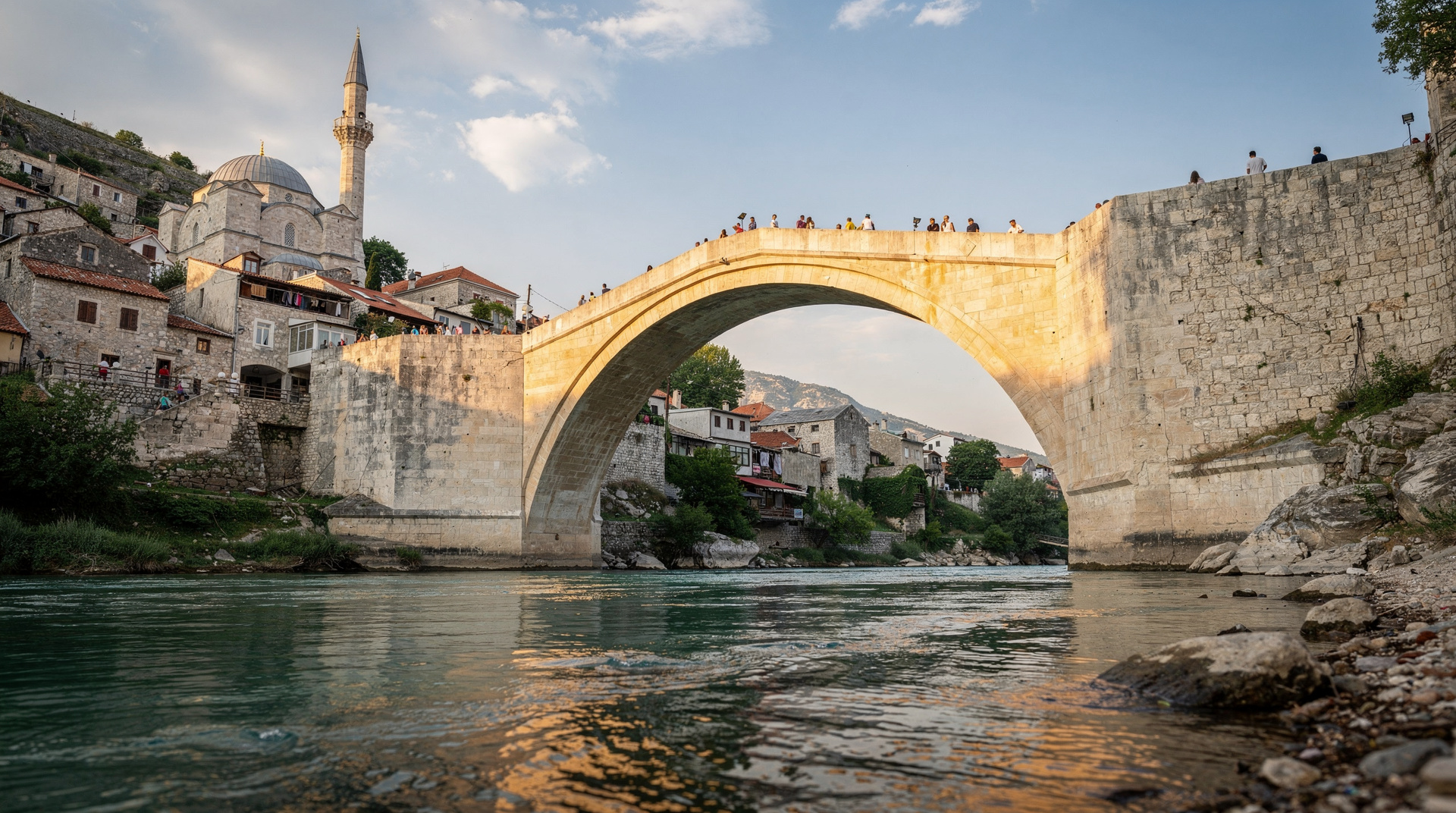
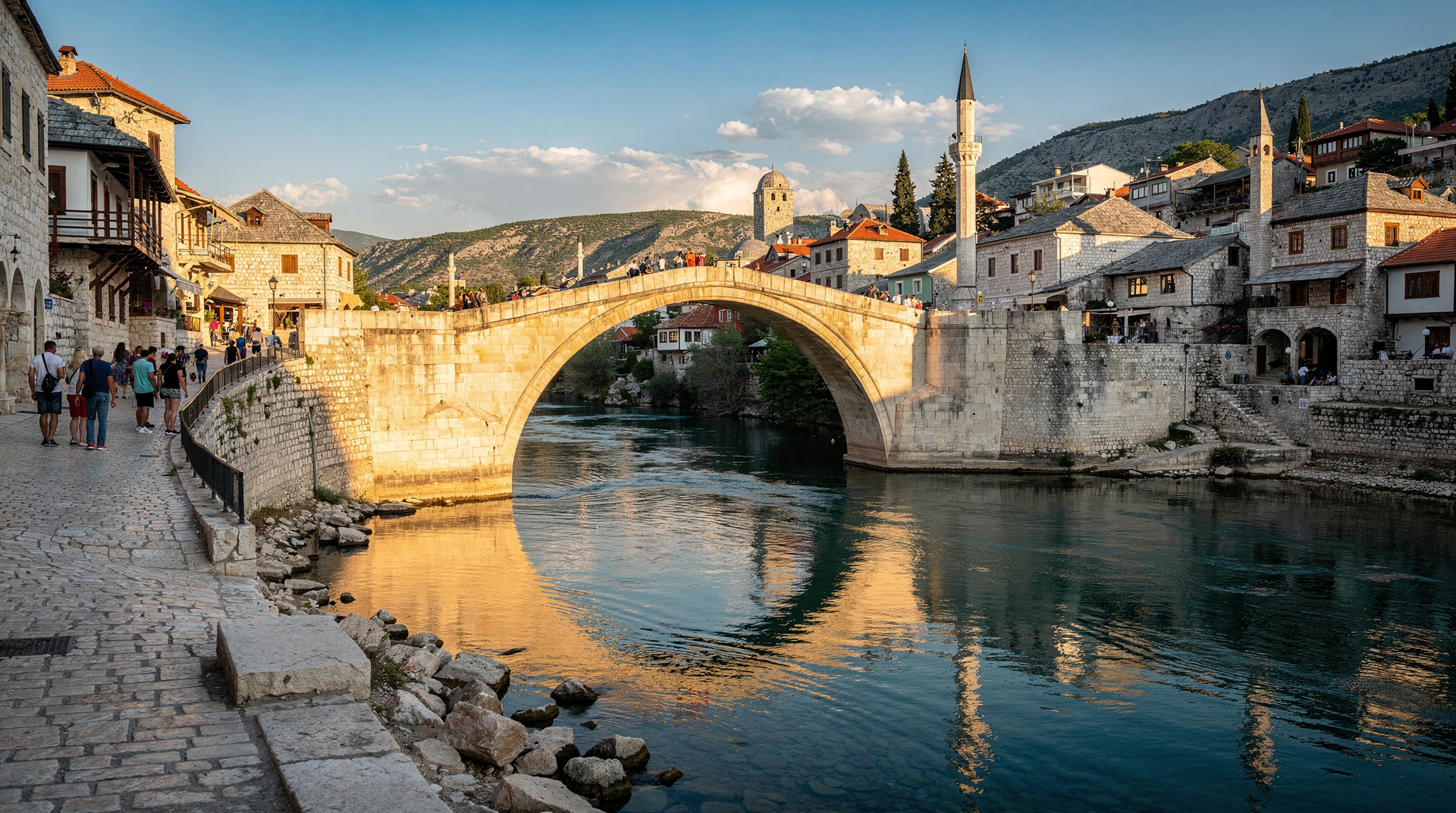
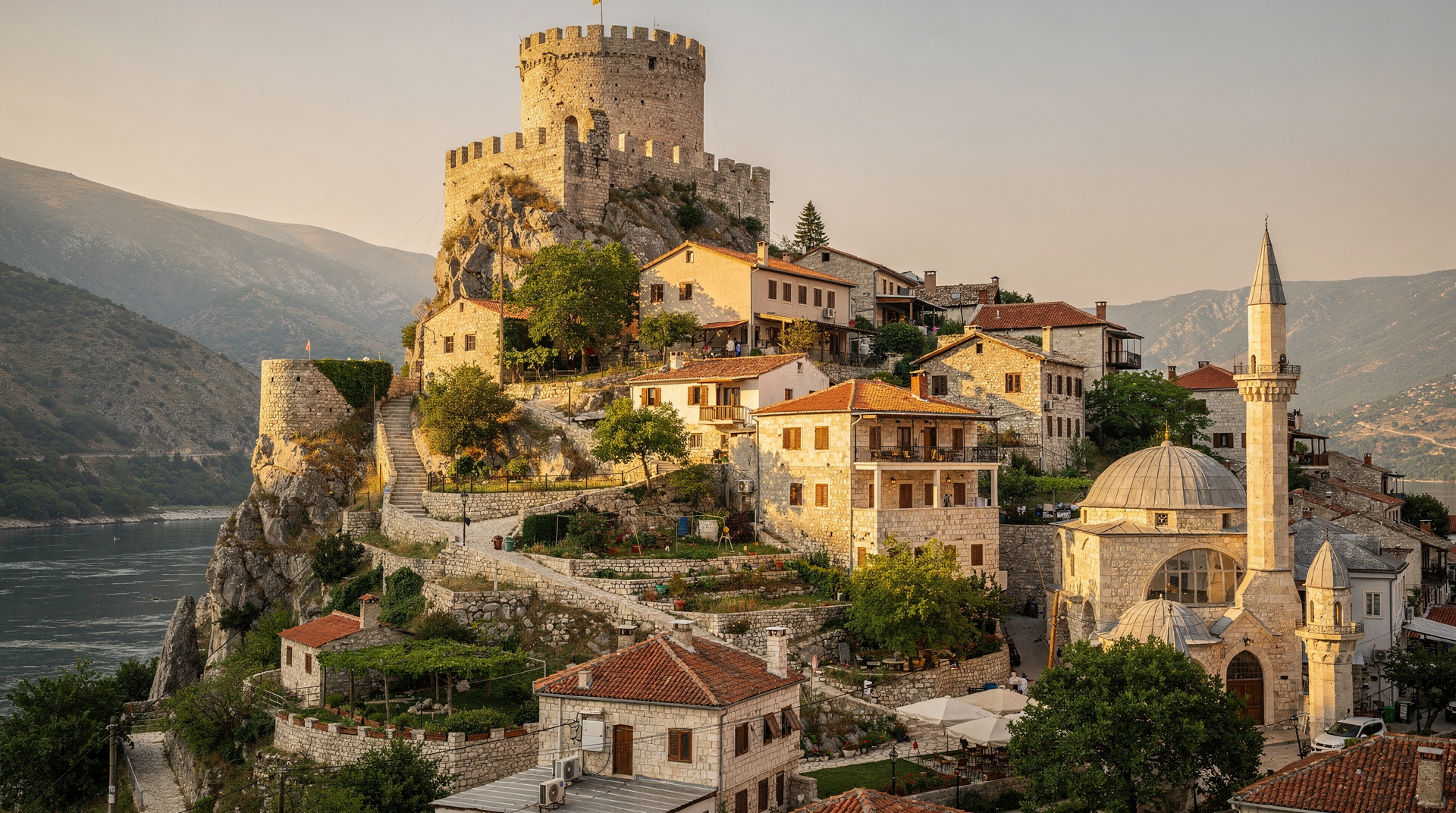
The resulting structure is a single elegant arch of tenelija limestone, a local stone quarried upstream that is soft enough to cut but hardens and strengthens with exposure to air and water. The span is 29 metres; the arch rises 21 metres above the summer water level. The roadway is paved with irregular river stones, polished smooth by centuries of feet into a slippery, bone-white surface. On each bank, Ottoman towers guard the bridge — the Tara Tower (west) and Helebija Tower (east).
The bridge stood for 427 years. Successive rulers — Habsburgs, Kingdom of Yugoslavia, Communists — left it alone. By the late 20th century it had become the symbol of Mostar and of Herzegovinian identity more broadly.
9 November 1993
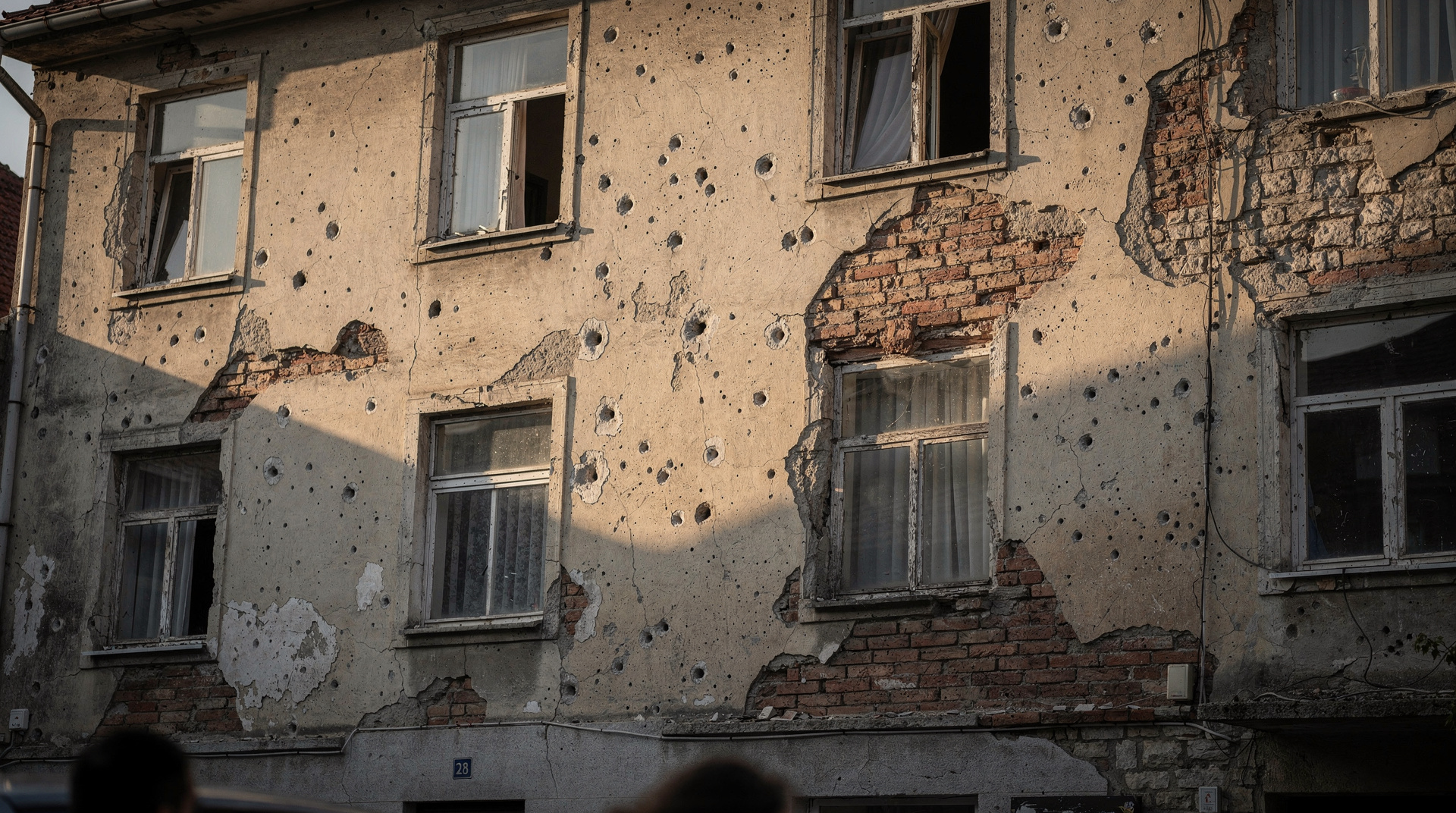
On 9 November 1993, at approximately 10:15, Croatian Army tank and anti-tank fire focused on the arch’s eastern haunch. The bridge had been repeatedly struck in previous months, and protective tyre barriers had been placed on it. Under sustained fire, the arch collapsed into the Neretva. Local residents reportedly wept in the streets.
The destruction was deliberate — Croatian commanders later acknowledged targeting the bridge as a symbol. The International Criminal Tribunal for the former Yugoslavia in The Hague classified the act as unlawful attack on civilian objects and a war crime. General Slobodan Praljak, who was convicted for the campaign, later died in 2017 after drinking poison in the courtroom when his appeal was rejected.
The war in Mostar is covered in more depth in the Mostar war history guide.
Reconstruction and UNESCO inscription
After the Dayton Peace Agreement ended the wars, the international community turned to rebuilding Mostar’s bridge. The World Bank, UNESCO, the Aga Khan Trust for Culture and several governments funded the project. The brief was exacting: rebuild the bridge using the original Ottoman technique, the original stone type and as much of the original material as possible.
Divers recovered some 1,088 original stones from the riverbed. Stonemasons were trained in traditional tenelija cutting. The original arch geometry was reconstructed from historical surveys and photographs. The temporary works to support the arch during construction repeated, almost exactly, the problem Hayruddin had solved in the 1550s.
The Old Town and Old Bridge highlights tour covers both the history of the reconstruction and the best vantage points around the bridge with a local guide who can answer questions about the 1993 destruction and the post-war period.
The rebuilt bridge opened on 23 July 2004 before a crowd of tens of thousands. UNESCO inscribed the Old Bridge Zone of the Historic City of Mostar on the World Heritage List in 2005 — not just for the bridge itself but for the ensemble of Ottoman houses, mosques and bazaar lanes that surround it.
Walking the bridge
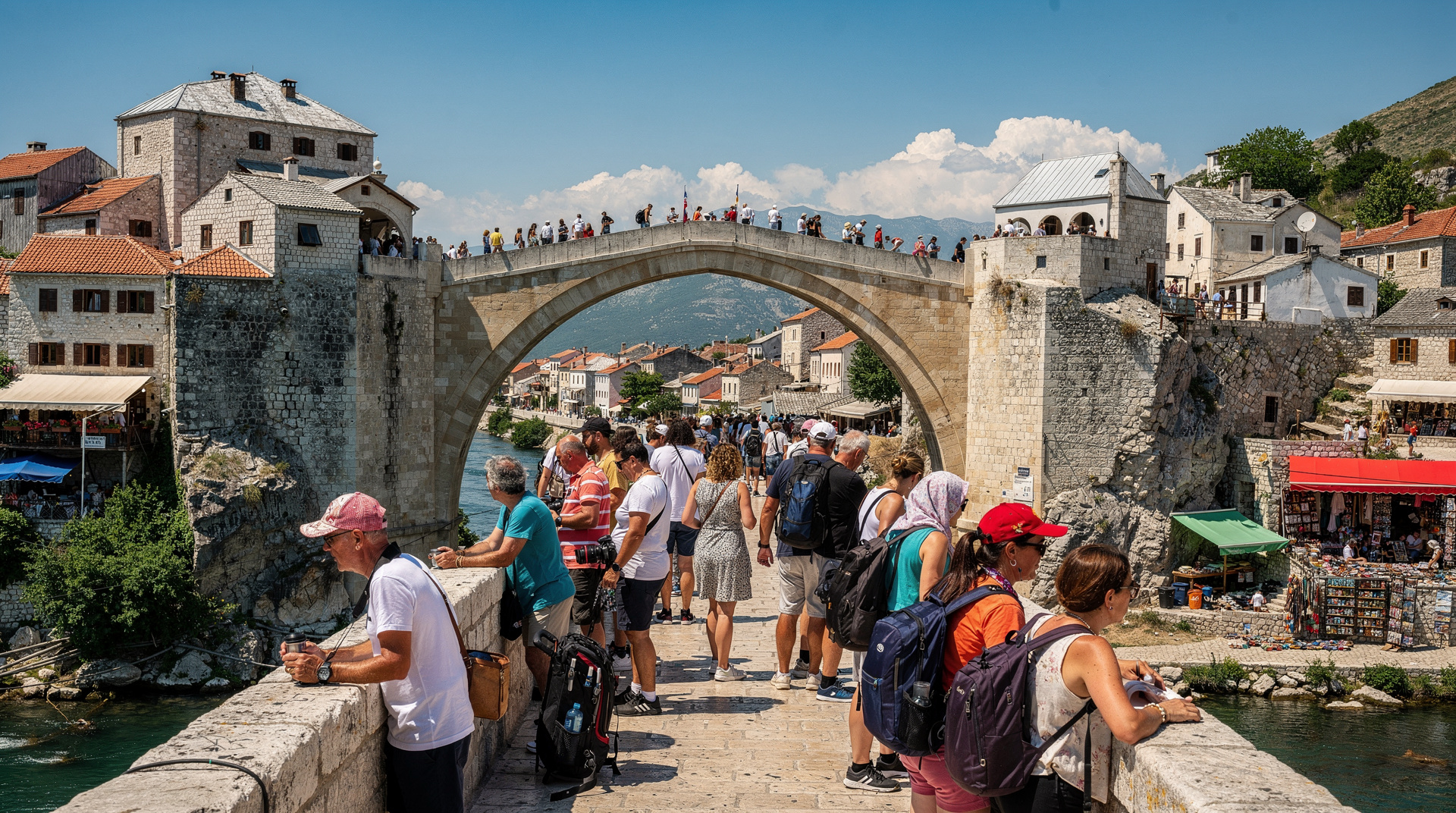
The bridge surface is much steeper than it appears in photographs. The cobblestones are polished smooth; in wet weather they are genuinely slippery. Many visitors bring or rent cloth overboots (available at the bridge ends for around 2 BAM) to improve grip. The walk across takes about 45 seconds but most visitors stop in the middle for photographs — longer on busy summer days.
The views from the bridge are excellent: upstream you see the Neretva curving away between forested banks; downstream the old town’s Ottoman rooftops and minarets frame the river. Early morning gives the best quality light and fewest people.
Bridge divers
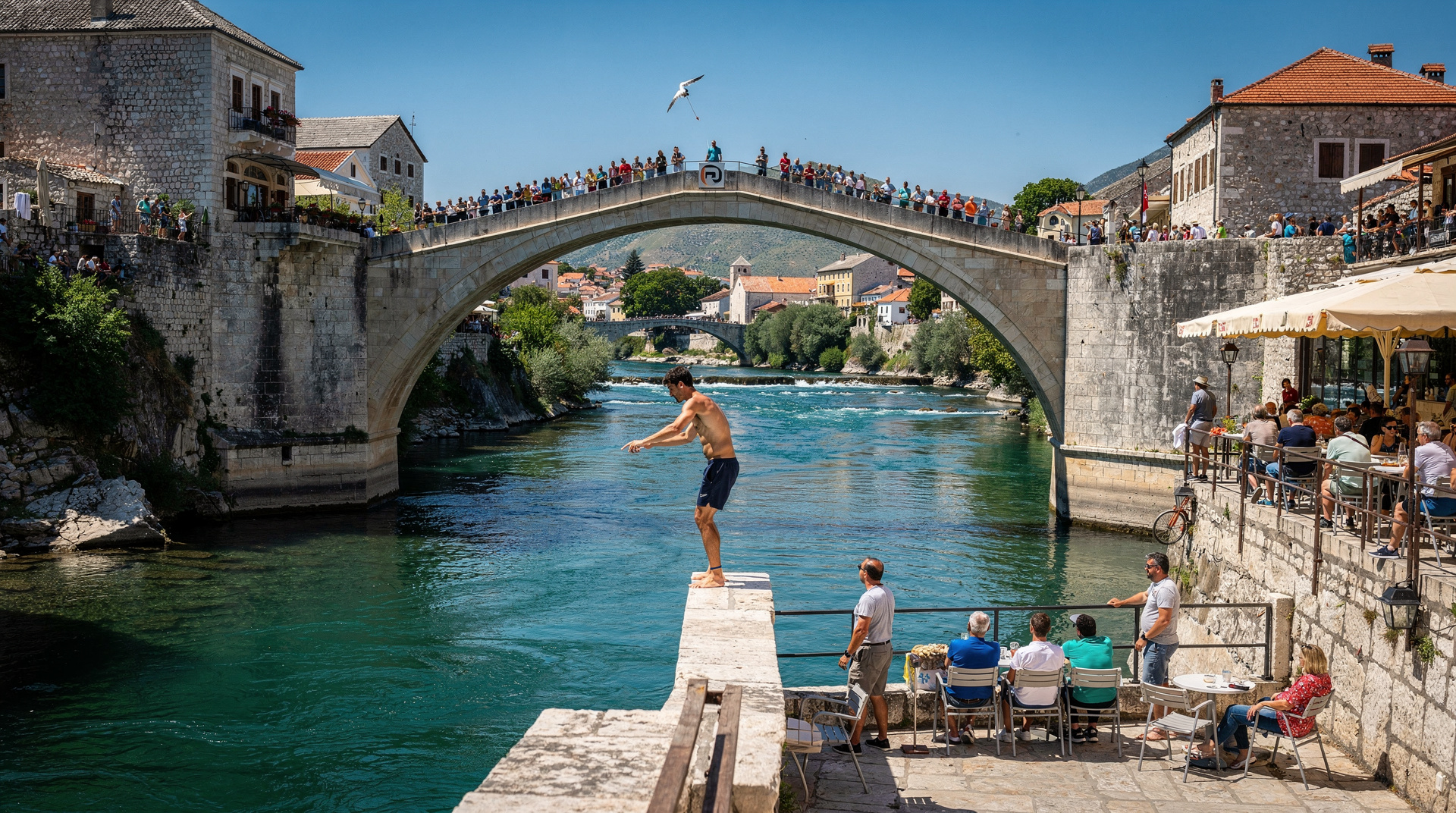
The Ikari diving club has been jumping from Stari Most since 1968 — a tradition that predates the bridge’s destruction and resumed after the 2004 reopening. The jump is approximately 21 metres above the river. Water temperature in the Neretva can be 8-12°C even in summer because it drains from Bosnian mountains. Jumpers typically spend 20-30 minutes psyching up on the bridge before committing.
The tradition of collecting tips from spectators before jumping is well established but can feel pressured if you are watching for a while. The honest guide to bridge divers explains the etiquette in detail. If you want to see a jump, stand near the bridge from around 11:00-13:00 or 16:00-18:00 when divers typically perform. The official club charges a fee for those who want to make a supervised jump themselves.
Viewpoints and photography
Tara Tower terrace (west bank): A staircase inside the Tara Tower leads to a terrace directly above the bridge approach. The classic postcard composition — arch, river, east bank — is shot from here. Admission approximately 3-4 BAM.
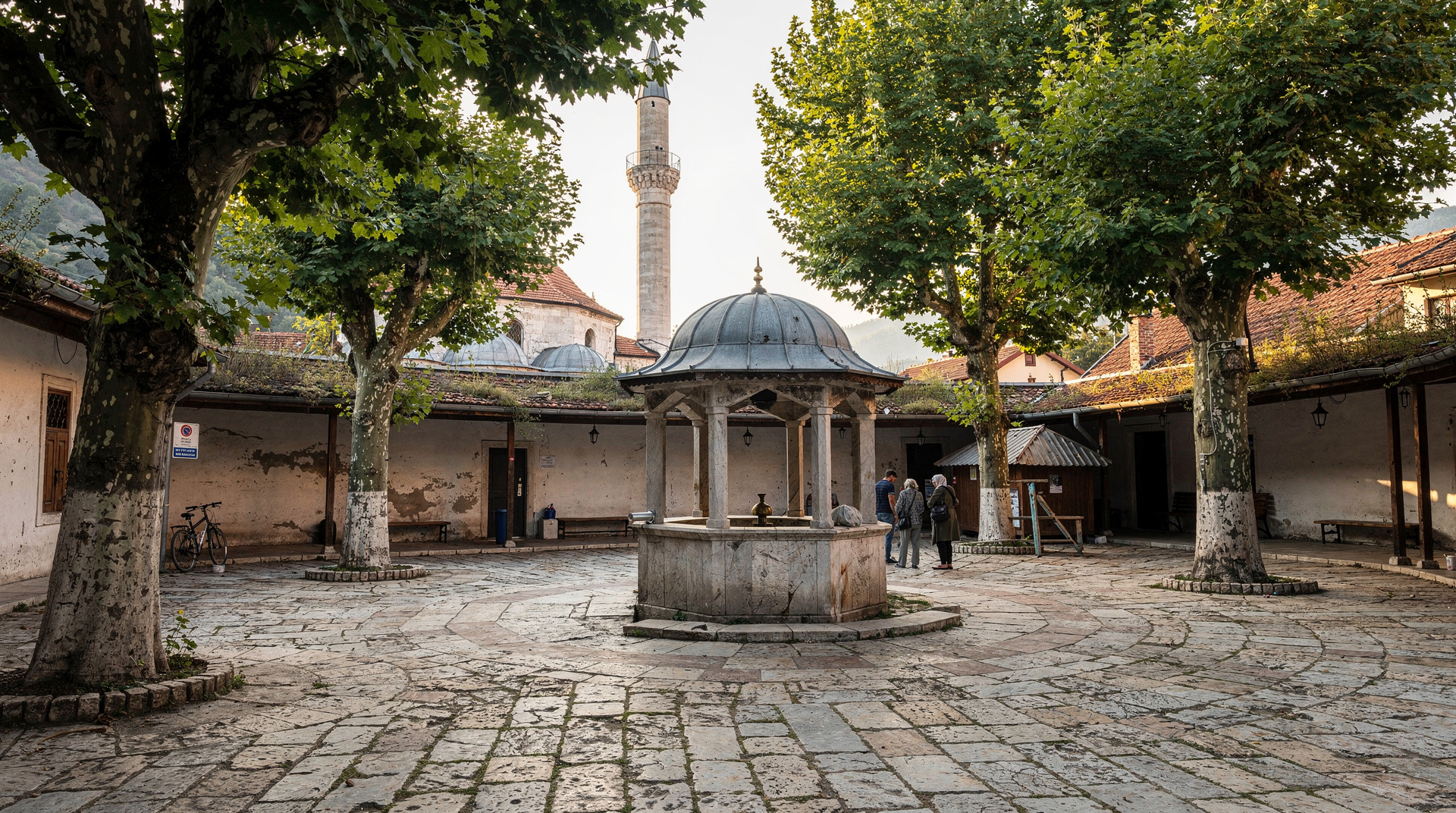
Koski Mehmed Pasha Mosque terrace: Located 150 metres north-east of the bridge on the east bank, the mosque’s elevated terrace gives a slightly elevated south-facing view of the bridge. Admission to terrace included in mosque entry (about 5 BAM).
Lučki Most (the modern footbridge): 200 metres downstream, the low suspension bridge gives a long-lens view looking upstream with the arch framed against the old town hillside.
Opposite bank cafes: Several cafes on the east bank have terraces positioned to face the bridge. The angle is less dramatic than the Tara Tower but you can drink coffee while watching.
The surrounding old town
The bridge is the centrepiece of a larger UNESCO-listed ensemble. The Kujundžiluk (Silversmiths’ Street) runs south from the east bridge approach — it is Mostar’s answer to Sarajevo’s Kazandžiluk, with jewellery and silverwork workshops. The lanes north of the bridge lead to the Kriva Cuprija (Crooked Bridge), a smaller Ottoman stone bridge from around 1558 on the Radobolja stream — actually the older of the two surviving bridges. Entry is free and it receives far fewer visitors.
A private walking tour with a local Mostar guide gives the most honest and personal account of the bridge’s destruction and reconstruction — many guides have direct family memories of 1993.
For context on the broader Ottoman heritage of Herzegovina, the Ottoman heritage guide covers the network of monuments from Sarajevo south to Počitelj and Blagaj.
Practical information
Location: Centre of old-town Mostar, on the Neretva river. GPS: approximately 43.337°N, 17.815°E.
Getting there: Old-town Mostar is walkable from the bus station (about 15 minutes) or reachable by taxi (5-7 BAM). From Sarajevo, the bus or car ride takes about 2h30. See the Sarajevo to Mostar transport guide for bus and train options.
Best time to visit the bridge: Early morning (07:00-09:00) or late afternoon (17:00-19:00) in summer. The bridge is packed between 10:00-16:00 in July-August when day-trippers from Dubrovnik and Split arrive en masse.
Entry costs: Walking the bridge is free. Tara Tower approximately 3-4 BAM; Koski Mehmed Pasha Mosque plus terrace approximately 5 BAM.
Avoid: the common Mostar tourist traps — unmetered taxis, overpriced riverside restaurants directly below the bridge and the pressure to buy from street vendors on the bridge itself.
Why the reconstruction matters beyond Mostar
The rebuilding of Stari Most became a template for how post-conflict Bosnia approached its damaged heritage more broadly. The insistence on original technique, original stone type and, where possible, original material set a standard later referenced in the restoration of mosques, bridges and historic buildings across the country, including work at Počitelj and other Ottoman-era sites.
In that sense, the bridge is not only a monument to what was lost in 1993 but to a specific, deliberate choice about how Bosnia would rebuild — favouring authenticity over speed. Understanding this makes the bridge read differently: every stone underfoot was either salvaged from the riverbed or cut by hand using nine-year-old techniques revived specifically for this project.
Best time of day and season
Stari Most changes character dramatically depending on when you visit. At dawn, before the first tour buses arrive from the coast, the bridge and Kujundžiluk are quiet enough to hear the river. By mid-morning, day-trip groups from Dubrovnik and Split fill the bridge and surrounding lanes, and diver tips are actively solicited. Late April to early June and September offer warm weather with noticeably thinner crowds than peak July-August; winter is quiet but some tower and terrace viewpoints may have reduced hours.
Frequently asked questions about Stari Most
A few more questions travellers ask:
Can I swim near Stari Most? Yes — there is a small rocky bathing area on the east bank below the bridge, used by locals. The water is cold and currents can be strong; observe caution.
Are day trips to Mostar from Dubrovnik worth it? They are the most popular GYG tours in the region. See the Mostar from Dubrovnik guide for an honest assessment.
How does Stari Most compare with the Mehmed Paša Sokolović Bridge at Višegrad? Both are UNESCO-listed Ottoman bridges, but they are very different: Stari Most is a single high arch in an urban setting; the Višegrad bridge is a longer multi-arched structure crossing a wider river in a quieter town. See the Višegrad bridge guide for comparison.
Should I stay overnight in Mostar or visit as a day trip? Staying overnight lets you see the bridge at dawn and dusk without crowds — a meaningfully different experience from a midday day trip. See the Mostar where to stay guide for options.
Top experiences
Bookable activities with verified prices and instant confirmation on GetYourGuide.