Srebrenica genocide memorial — visiting Potočari
From Sarajevo: Srebrenica Genocide Memorial Study Tour
How do you visit the Srebrenica genocide memorial?
The Srebrenica-Potočari Memorial and Cemetery is located 5 km north of Srebrenica town, a 3-hour drive from Sarajevo. Most visitors join a guided day tour from Sarajevo that includes the memorial, the Srebrenica Genocide Memorial Gallery, and a documentary screening.
There are places that demand to be visited not for beauty, spectacle or adventure, but for the simple duty of bearing witness. Srebrenica is one of those places. What happened in a small valley in eastern Bosnia over ten days in July 1995 — the systematic killing of approximately 8,000 Bosniak Muslim men and boys — has been adjudicated as genocide by the International Court of Justice and the International Criminal Tribunal for the former Yugoslavia. No honest account of Bosnia omits it.
This guide is written in the spirit of the memorial foundation’s own mission: honest, factual and respectful. It covers what happened, what you will see at the memorial, how to get there, and how to choose a guided tour.
| Where | Potočari, 5 km north of Srebrenica town, eastern Bosnia near the Drina valley |
| Cost | Free entry to the cemetery and Memorial Gallery; guided day tours from Sarajevo typically run around 60-90 EUR per person |
| Time needed | Around 1-2 hours at the memorial itself; a full day if travelling from Sarajevo |
| Getting there | Around 2.5-3 hours by car from Sarajevo via Rogatica and Žepa; no practical direct public transport, so most visitors join a guided tour |
| Best time | Any time of year; 11 July draws large crowds for the annual commemoration and is not ideal for a quiet visit |
What happened at Srebrenica in July 1995
The safe area
In April 1993, the UN Security Council declared Srebrenica a “safe area” — a designation that was supposed to protect the tens of thousands of Bosniak refugees who had fled there from villages across eastern Bosnia during the preceding months. A small contingent of Dutch UN peacekeepers (Dutchbat) was stationed in the area to observe the ceasefire.
By 1995 the situation in the enclave had become desperate: the population had swollen to perhaps 40,000 in a town built for a few thousand, supplies were limited, and Bosnian Serb forces kept the area under steady military pressure.
The fall of the enclave and the massacre
On 6 July 1995, Bosnian Serb Army (VRS) forces began their final assault on the enclave. By 11 July, General Ratko Mladić entered Srebrenica town. The Dutch UN battalion did not intervene. Approximately 20,000–25,000 Bosniaks — mostly women, children and elderly — sought refuge at the UN base at Potočari, 5 km to the north.
Over the following days, men and boys aged roughly 12 to 77 were separated from the women and taken away. Many were executed at sites in the surrounding countryside, their bodies buried in mass graves and then — when the scale of the killings became apparent — reburied in secondary mass graves in an attempt to conceal evidence. Approximately 8,000 individuals have been identified as victims; identification continues today using DNA analysis.
The women and children who survived were transported by bus into Bosniak-controlled territory. General Mladić was convicted by the ICTY in 2017 and sentenced to life imprisonment. Radovan Karadžić, the political leader of the Republika Srpska, was also convicted and sentenced to life imprisonment on appeal in 2019.
The legal designation as genocide
The International Court of Justice, in its 2007 ruling in Bosnia and Herzegovina v. Serbia and Montenegro, found that the Srebrenica massacre constituted genocide as defined in the 1948 Genocide Convention. The ICTY reached the same conclusion across multiple proceedings. The findings are legally established and are not subject to legitimate historical dispute; visitors should be aware that denial of the genocide is still encountered in parts of Bosnia and the region.
The Srebrenica-Potočari Memorial and Cemetery
The memorial complex is built on and around the site of the former UN base at Potočari. It has two main components:
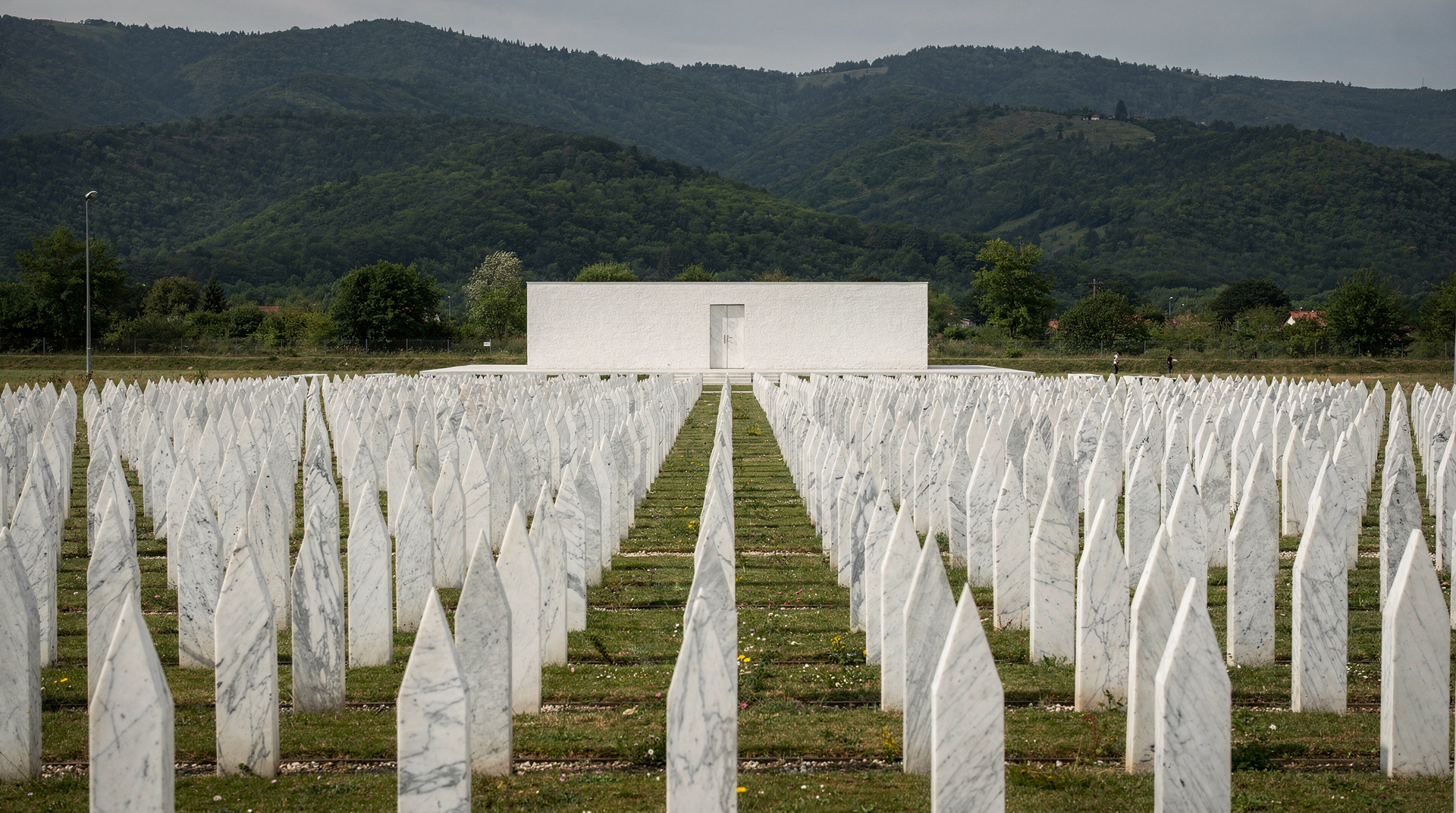
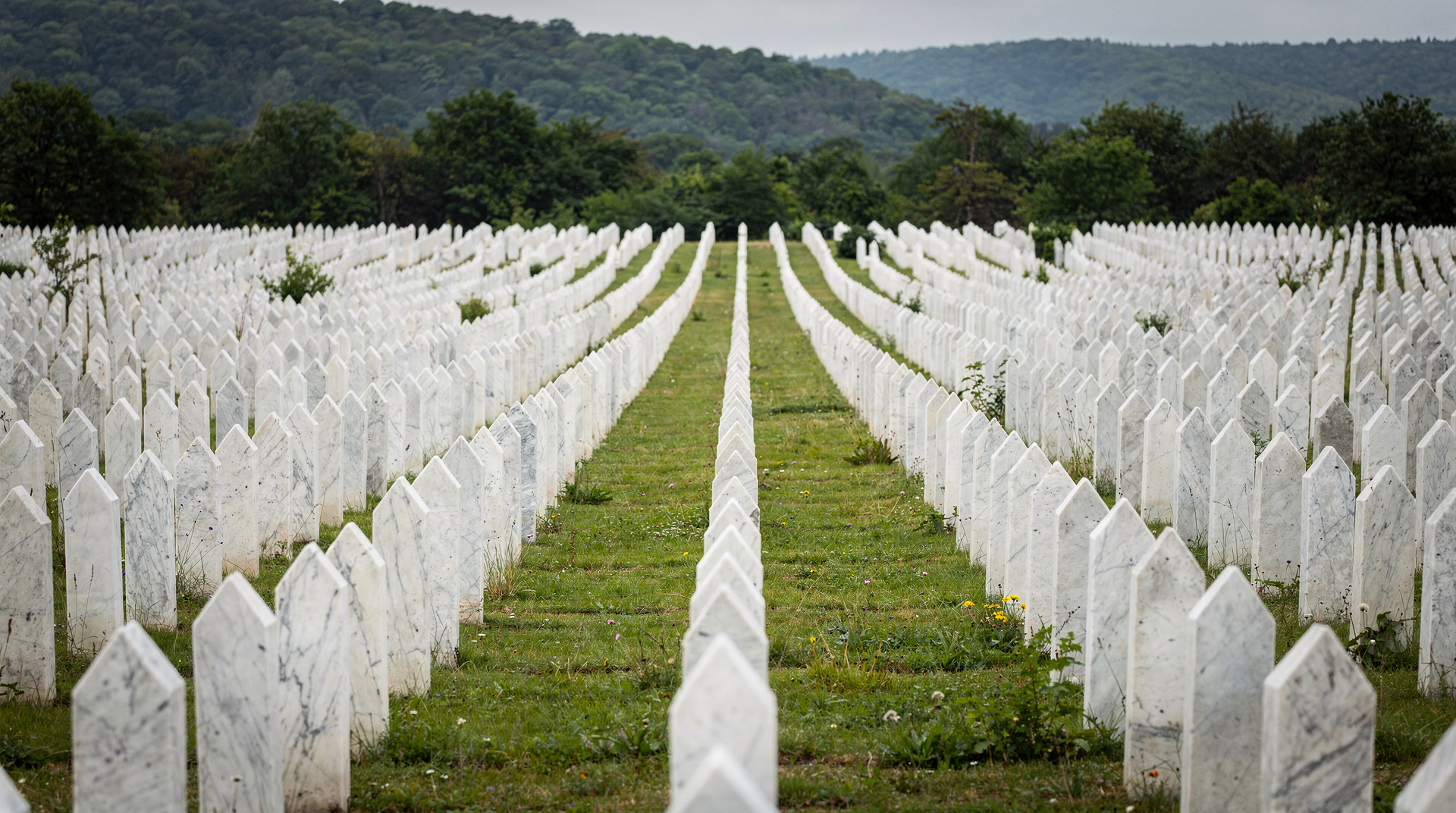
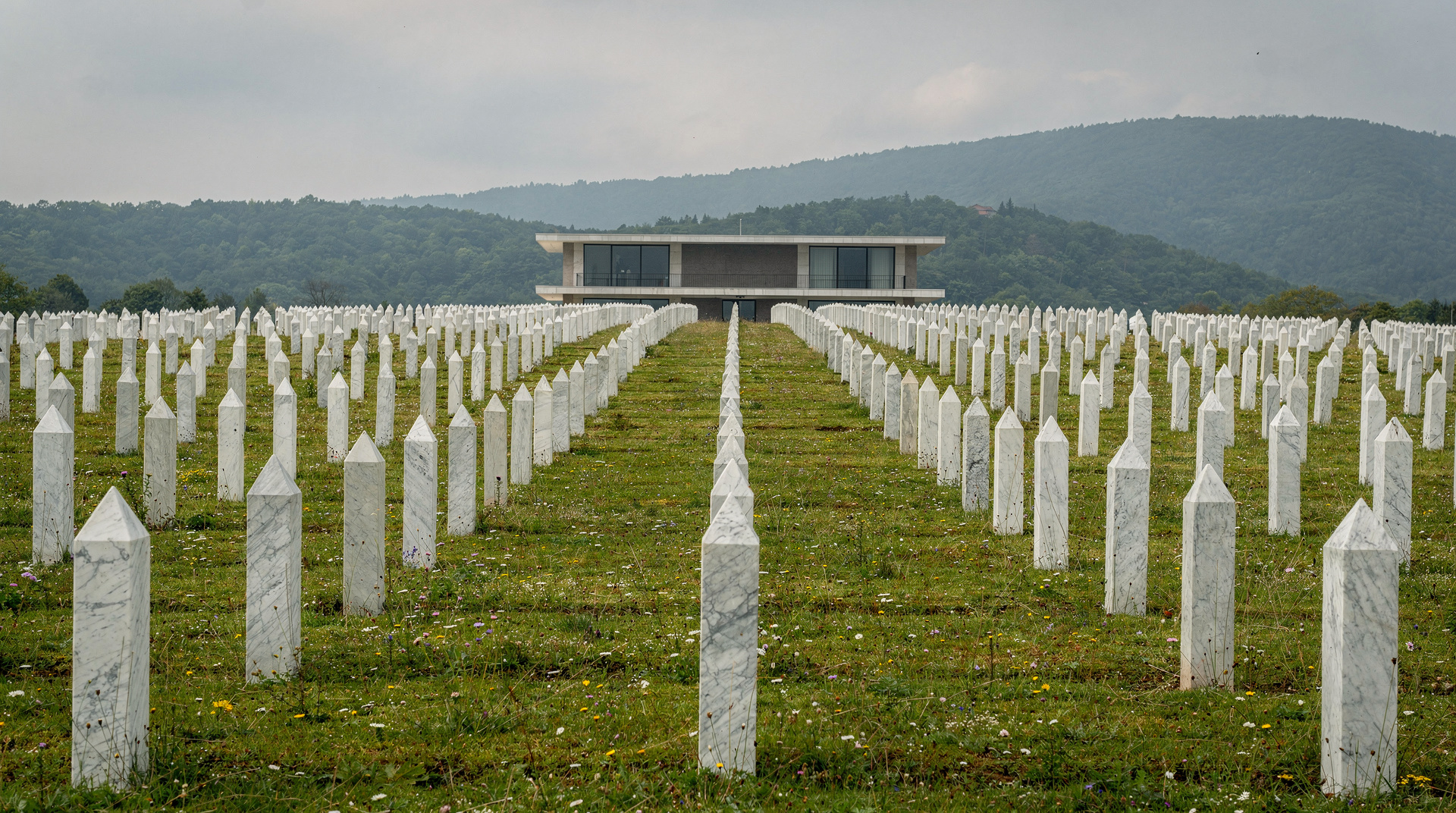
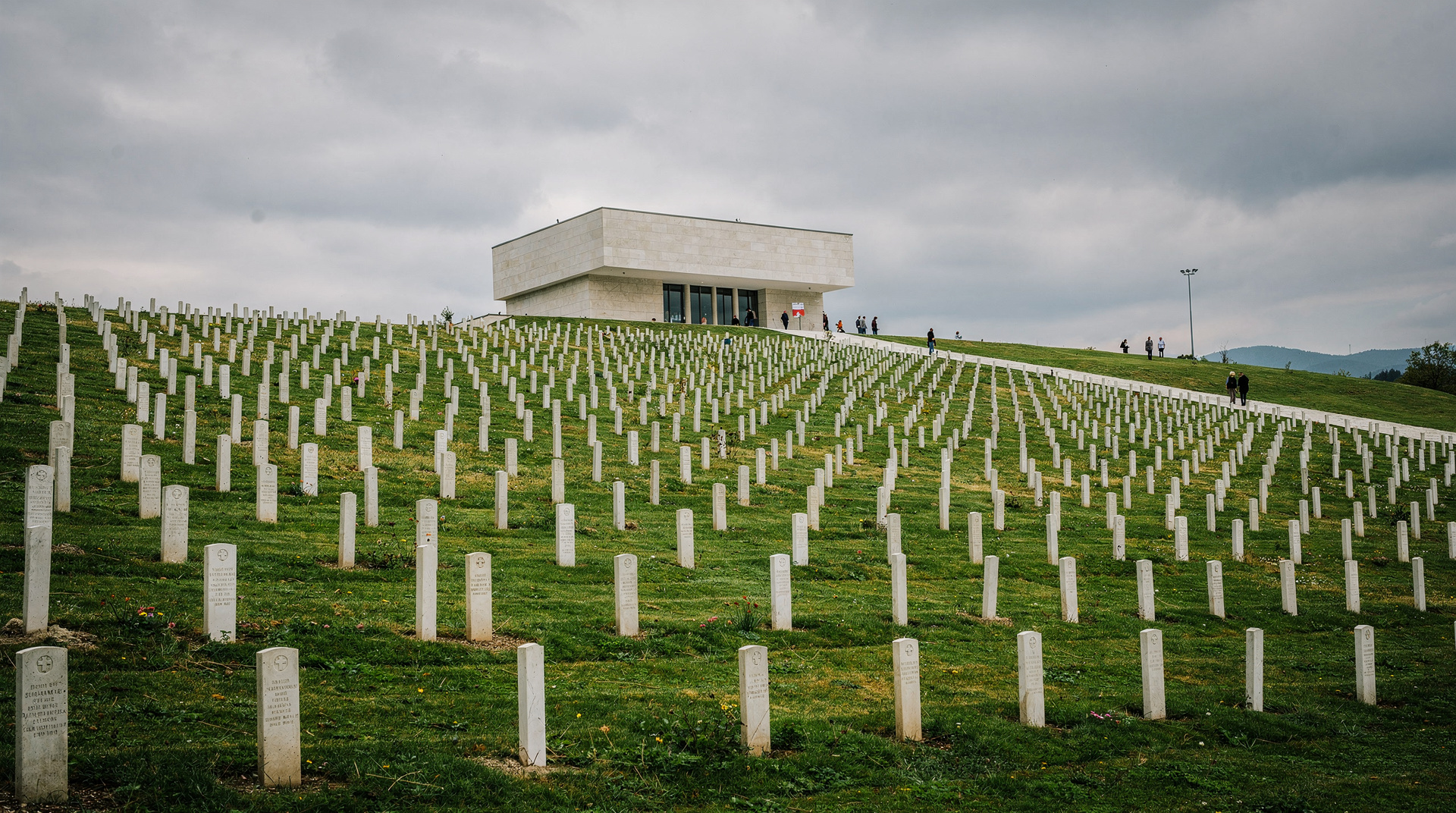
The cemetery occupies a broad green hillside adjacent to the road. Thousands of identical white headstones mark the graves of identified victims. The graves are arranged by year of burial — new interments take place every 11 July as more victims are identified from mass graves. The scale of the cemetery — row after row of stones on a quiet hill — is the most powerful element of the visit.
The Memorial Gallery (Memorijalni Centar Srebrenica) is inside the former battery factory building that served as the UN base in July 1995. The permanent exhibition uses photographs, documentary footage, survivor testimony and original objects to document the events of July 1995. The exhibition is sober, carefully sourced and suitable for visitors with no prior knowledge of the events. Guided tours inside the gallery are led by trained educators.
Admission to both the cemetery and the gallery is free. The memorial is open daily, generally 08:00–16:00 (hours may extend during the summer season and 11 July commemoration period).
From Sarajevo: Srebrenica Genocide Memorial Study TourGetting to Srebrenica from Sarajevo
Srebrenica is approximately 130 km from Sarajevo, but the route crosses mountain terrain and the journey takes around 2.5 to 3 hours by car. There is no direct public bus service that suits day-trip timing for most visitors.
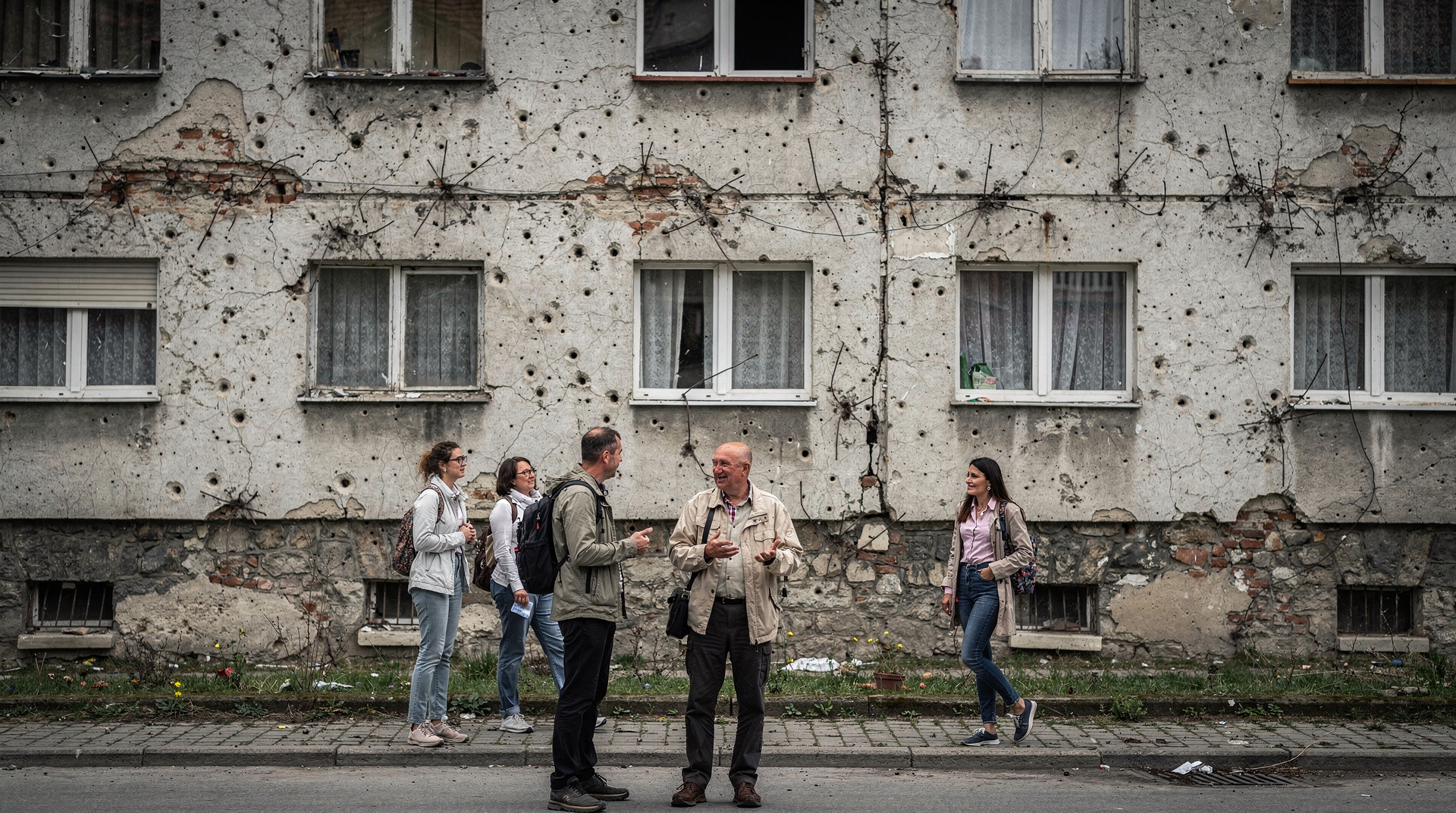
The most practical option for visitors based in Sarajevo is to join a guided day tour. These depart in the morning, allow approximately four to five hours at the memorial complex and surrounding area, and return in the evening.
Understanding Srebrenica Genocide plus lunch with local familySome tours include lunch with a local family in the Srebrenica or Potočari area — a meaningful way to connect with the present-day community and hear personal perspectives from people whose families were directly affected.
For independent visitors with a rental car, the route from Sarajevo runs east via Rogatica and Žepa before descending into the Drina valley. Note that road conditions on some sections can be slow — plan for at least three hours each way. The driving in Bosnia guide covers road conditions and what to expect on mountain routes.
11 July: the annual commemoration
Every year on 11 July, the anniversary of the fall of Srebrenica, a commemoration ceremony is held at Potočari. New victims whose identities have been confirmed in the preceding year are buried. Attendance often reaches tens of thousands of people — survivors, relatives, dignitaries and visitors from around the world. The ceremony is deeply moving and open to all. If you plan to visit on 11 July, arrange accommodation well in advance as places in Srebrenica and the surrounding area fill up.
How to approach the visit
The Srebrenica memorial is not a tourist attraction in the usual sense. It is a working cemetery, an active educational institution and a place of grief for thousands of families. Visitors are asked to:
- Dress modestly (cover shoulders and knees; bring a scarf)
- Speak quietly throughout the memorial complex
- Be thoughtful about photography — in particular, avoid photographing individual graves in ways that feel intrusive
- Engage with the exhibition honestly and avoid minimising language
The memorial foundation actively encourages visits as part of its commitment to education and prevention. Coming here as a traveller is not voyeuristic — it is part of the broader project of ensuring that what happened is documented, understood and not repeated.
After Srebrenica: returning to Sarajevo
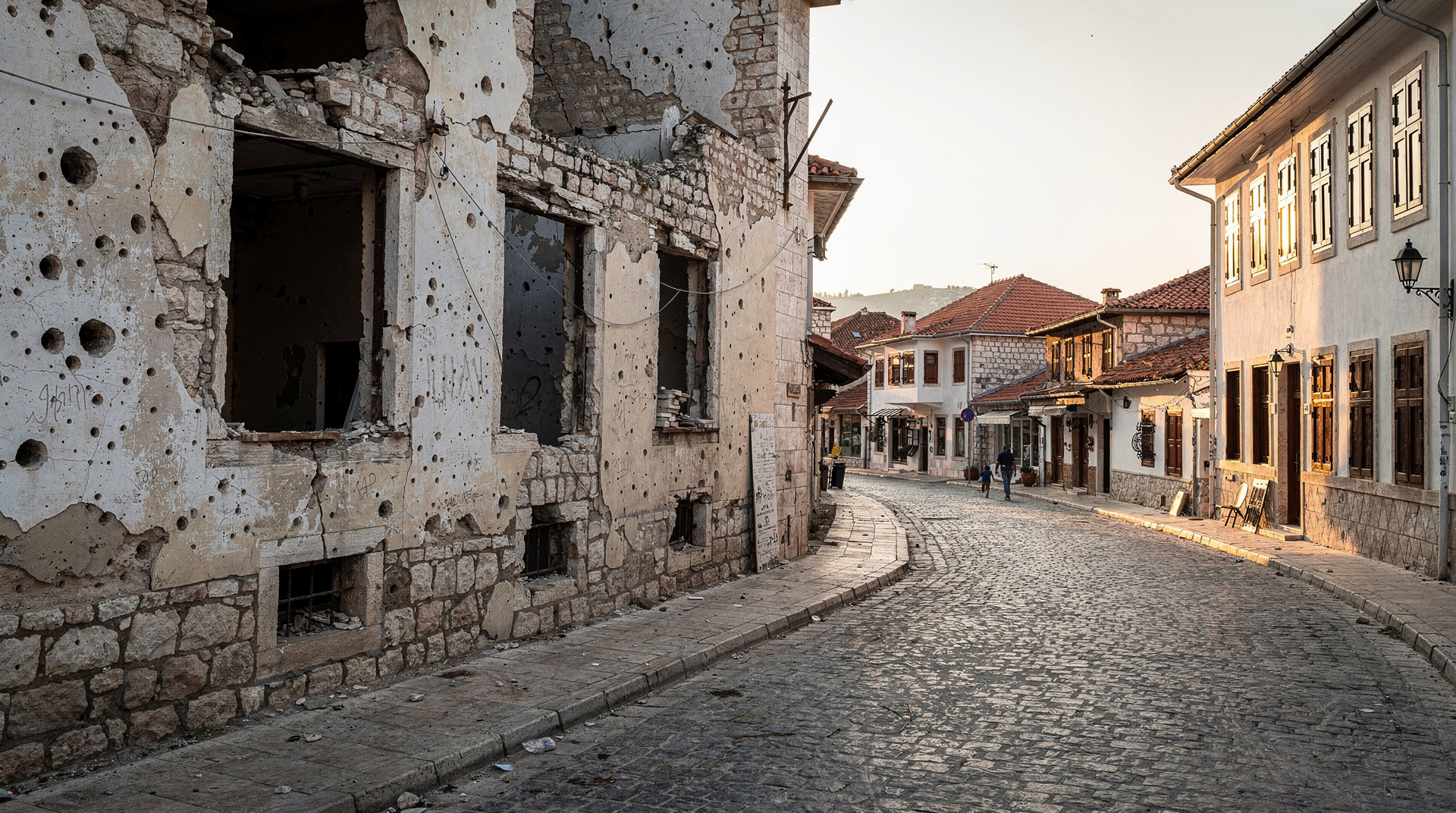
The drive back to Sarajevo through the Drina valley and across the central Bosnian mountains is among the most beautiful in the country — a reminder that Bosnia’s physical landscape is extraordinary, and that the people who live in it carry an extraordinary weight of recent history.
Visitors who wish to understand the broader context of the Yugoslav wars before or after the visit will find our Yugoslav wars explained guide useful. For a longer multi-day itinerary that connects Srebrenica with Sarajevo, Konjic and Mostar, see the Bosnia war history itinerary.
From Sarajevo: day trip to SrebrenicaThe Srebrenica destination guide covers practical details on the town itself — where to eat, the context of the post-war economy, and how Srebrenica fits into the region today.
Why the identification process still matters
The scale of Srebrenica’s crime is bound up with an unusually long forensic effort. Many bodies were moved from primary mass graves to secondary and even tertiary sites using heavy machinery, deliberately mixing remains to obstruct identification. As a result, DNA analysis by the International Commission on Missing Persons has, in many cases, matched a single individual’s remains to fragments recovered from two or three separate grave sites years apart. This is part of why burials at Potočari continue every 11 July more than three decades after the massacre — identification work is genuinely ongoing, not symbolic. Visitors sometimes ask why the cemetery keeps growing; this is the answer.
Combining the visit with wider war history
Many travellers pair Srebrenica with Sarajevo’s own siege history to understand the war’s arc from beginning to end. The War Childhood Museum and the Sarajevo Siege Tunnel of Hope both address the 1992-95 conflict from the perspective of the besieged capital, which fell under different circumstances than Srebrenica but over the same years. Together, a Sarajevo war-history day and a Srebrenica day trip give a far more complete picture than either alone — see the Sarajevo war tour guide for how to structure it.
Preparing yourself before you go
A visit to Potočari lands harder if you arrive with some background. Reading the Bosnia history for travelers guide gives the long view, while the Sarajevo siege remembered blog post offers a more personal account of the same years. If you are building a longer trip, the Sarajevo 4-day deep dive leaves room to absorb the capital’s wartime story first and travel east afterwards, rather than cramming everything into one rushed day.
It is worth deciding in advance how you want to spend the time at the memorial. Some visitors prefer to walk the cemetery alone in silence before entering the gallery; others want the framing of the exhibition first and the hillside second. Neither order is wrong. What matters is that you leave yourself enough unhurried time that you are not watching the clock while standing among the graves.
Practical points for a respectful day
Plan the rest of the day around the memorial rather than the other way round. Eat before you arrive or after you leave, keep your phone on silent, and avoid scheduling anything demanding straight afterwards. Many people find they want a quiet hour on the drive back, which is one more reason the guided option works well: nobody has to concentrate on the mountain road while processing what they have seen.
If you travel independently, read the renting a car in Bosnia guide before you book, and check the getting around Bosnia overview for the realities of public transport in the east. Stay on marked roads and paths throughout the region; the landmine safety in Bosnia guide explains why this matters, even though the memorial complex itself is a maintained, safe site. Travellers with general concerns about the country can consult is Bosnia safe for a sober assessment.
Talking about what you saw
Visitors often ask how to speak about Srebrenica with the people they meet afterwards. The simplest approach is to listen first. Bosnians have lived through very different experiences of the 1990s, and many are willing to share them when asked with sincerity rather than curiosity for its own sake. Use the established terminology — genocide, victims, survivors — and avoid false balance. If a conversation turns to denial, you are under no obligation to argue; you can simply state that the facts are established in court and move on.
Back in Sarajevo, plan something gentle for the evening. A walk through the old town, covered in the Baščaršija guide, or a quiet coffee following the customs described in Bosnian coffee culture, can help you decompress without turning the day into entertainment. If you need somewhere to stay that makes the return easy, the where to stay in Sarajevo guide compares neighbourhoods.
Other places that explain the war
Srebrenica is one chapter in a wider story. In the capital, Sniper Alley and the Sarajevo Roses memorials show how the siege is remembered in the streets themselves. In Herzegovina, the Mostar war history guide covers a different front and a divided city. For the bigger picture of how these places connect, the Bosnia travel guide and the how many days in Bosnia planner help you decide how much time to give to this side of the country.
Frequently asked questions about Srebrenica genocide memorial — visiting Potočari
What happened at Srebrenica in July 1995?
Is the Srebrenica memorial open to visitors year-round?
How far is Srebrenica from Sarajevo?
What is the Srebrenica-Potočari Memorial Cemetery?
Is it respectful to visit Srebrenica as a tourist?
What guided tours go to Srebrenica from Sarajevo?
Can I combine Srebrenica with other war-history sites in one trip?
Why are new burials still happening at Potočari decades later?
Top experiences
Bookable activities with verified prices and instant confirmation on GetYourGuide.