The story of Mostar's Old Bridge
In November 1993, a Croatian artillery unit spent two days shelling a limestone arch bridge across the Neretva River in Mostar. The bridge was not a military target. It had no strategic value. It was 427 years old.
The destruction of Stari Most — the Old Bridge — was one of the most widely condemned acts of cultural vandalism in modern European history. When the bridge finally fell into the green water of the Neretva, it took with it something that had stood through Ottoman rule, Austro-Hungarian annexation, two world wars, and four decades of Yugoslav communism.
This is the story of what that bridge meant, why it was built, and how it came back.
| At a glance | |
|---|---|
| Where | Mostar old town, spanning the Neretva River |
| Cost | Free to walk across; nearby museums and the diving club collection are separate |
| Time needed | 30-60 minutes at the bridge itself; half a day for the surrounding old town |
| Getting there | Day trip from Sarajevo, Split or Dubrovnik |
| Best time | Early morning or evening, to see it before or after the day-tripper coaches |
The Ottoman commission
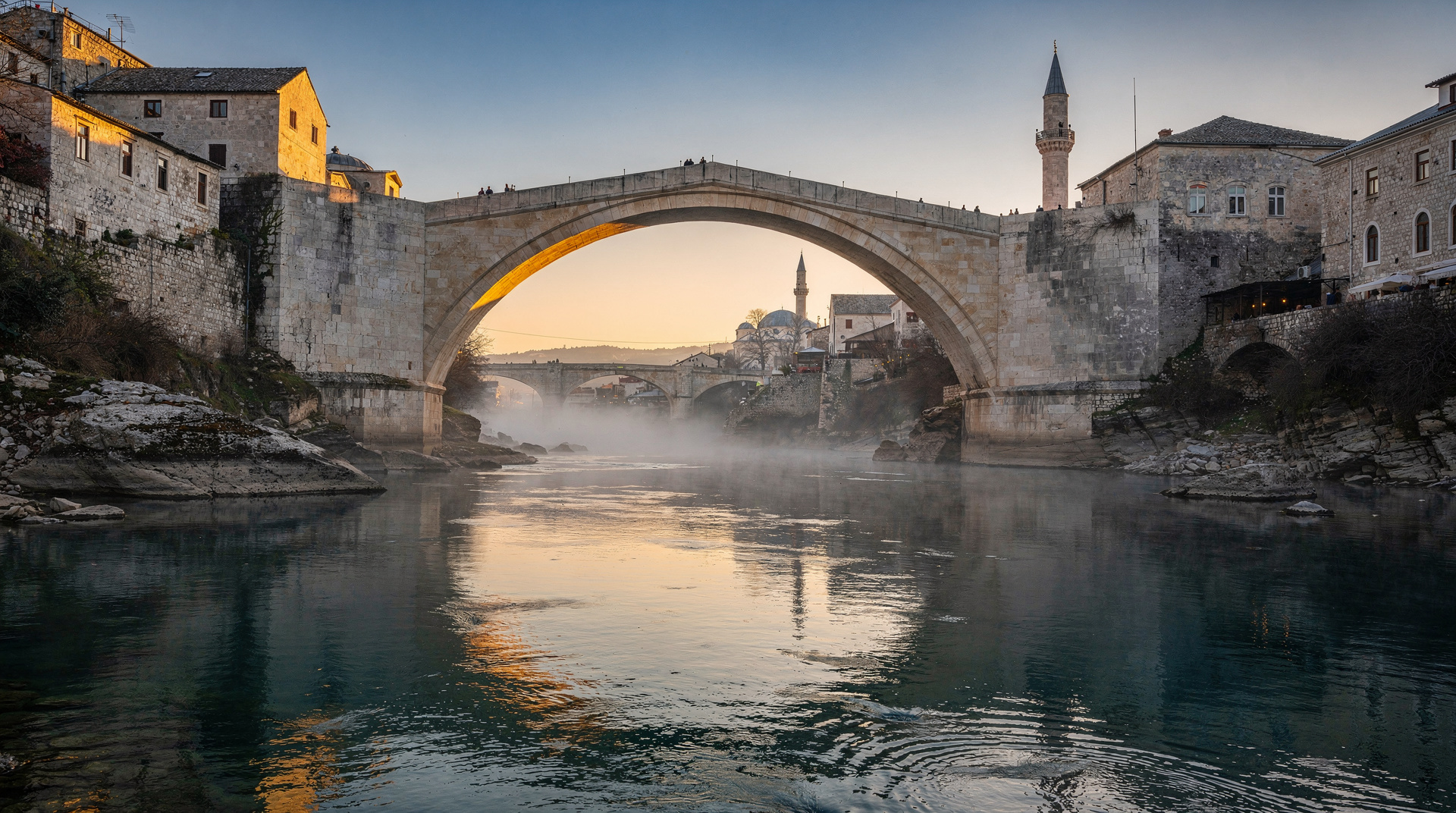
In 1557, the Ottoman Sultan Suleiman the Magnificent commissioned a bridge to replace an older wooden structure at the crossing point of the Neretva in the city of Mostar. The work fell to a young architect named Mimar Hayruddin, a student of the legendary Sinan who had designed the Süleymaniye Mosque in Istanbul.
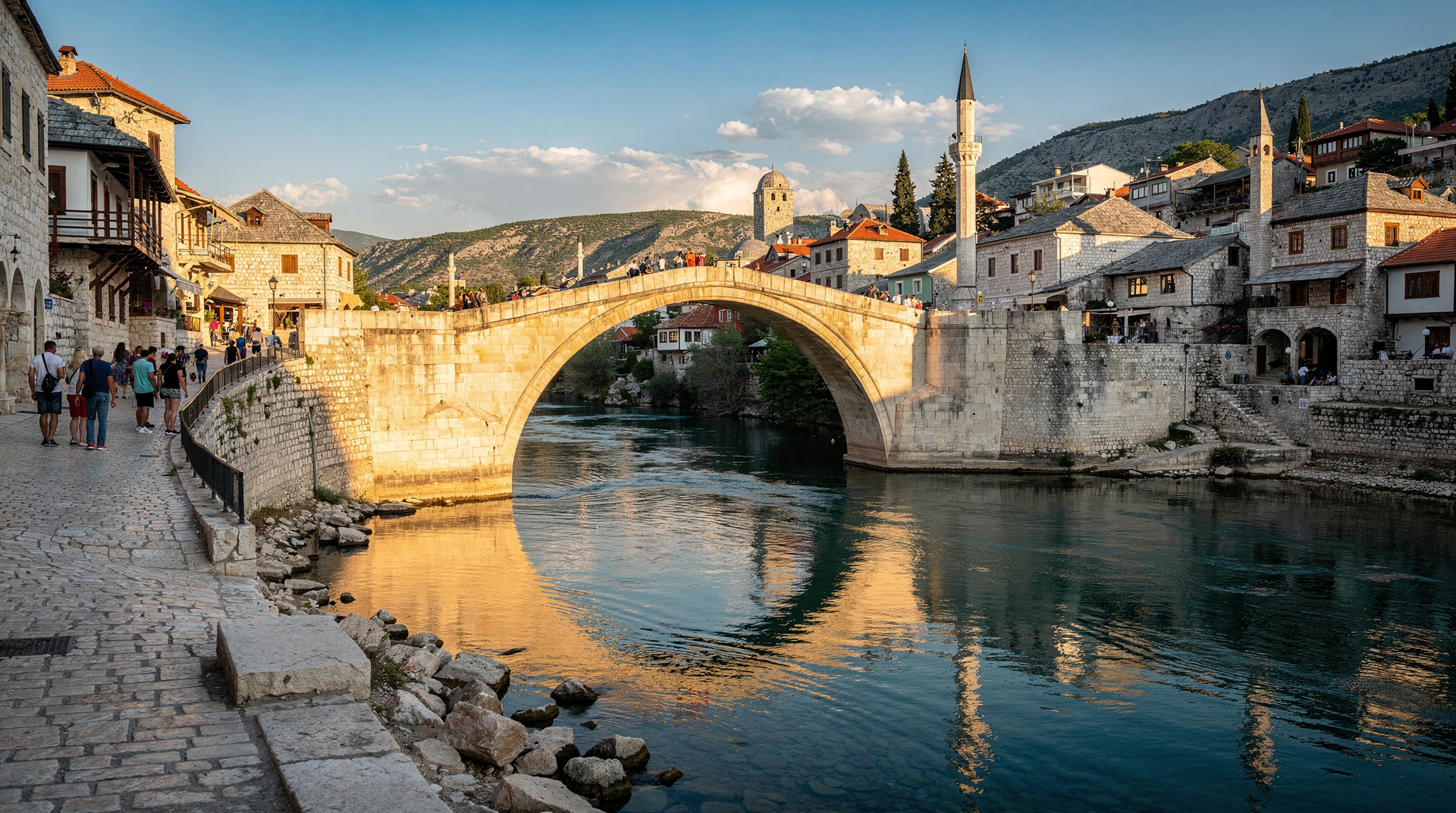
The challenge was considerable. The Neretva here was too wide and too fast for conventional masonry bridges of the era. Hayruddin designed a single span: one continuous arch of limestone, 21 metres across, rising 21 metres above the river at its highest point. The bridge used a stone called tenelija — a local limestone that was soft when freshly quarried and hardened over time with exposure to air and water.
Construction lasted nine years. The bridge was completed in 1566. According to legend, the scaffolding was removed on a Friday at prayer time — Hayruddin, convinced the arch would collapse, reportedly fled the city. It did not collapse. It stood, in one form or another, for 427 years.
Why it mattered to the city
The name “Mostar” derives from the Bosnian word mostari — bridge keepers, the men appointed to maintain and guard the crossing. The bridge was not merely infrastructure; it was the city’s identity. Divided by the Neretva into eastern (predominantly Bosniak) and western (predominantly Croat) halves, Mostar was a city whose two parts had always been physically joined by this single span of white limestone.
The Stari Most guide covers the bridge’s architecture and symbolism in detail. What matters here is the emotional geography: this bridge was where people met, where lovers arranged to see one another, where young men tested their courage by jumping into the cold Neretva below, where the smell of grilled meat from the bazaar mixed with the sound of the river.
When it fell, the city fell in half.
The destruction of 1993
The Bosnian War began in April 1992. Mostar’s situation was complicated from the start: first besieged by Serbian and Yugoslav People’s Army forces, then fractured internally when Bosnian Croat forces (HVO) turned on the Bosniak population in 1993.
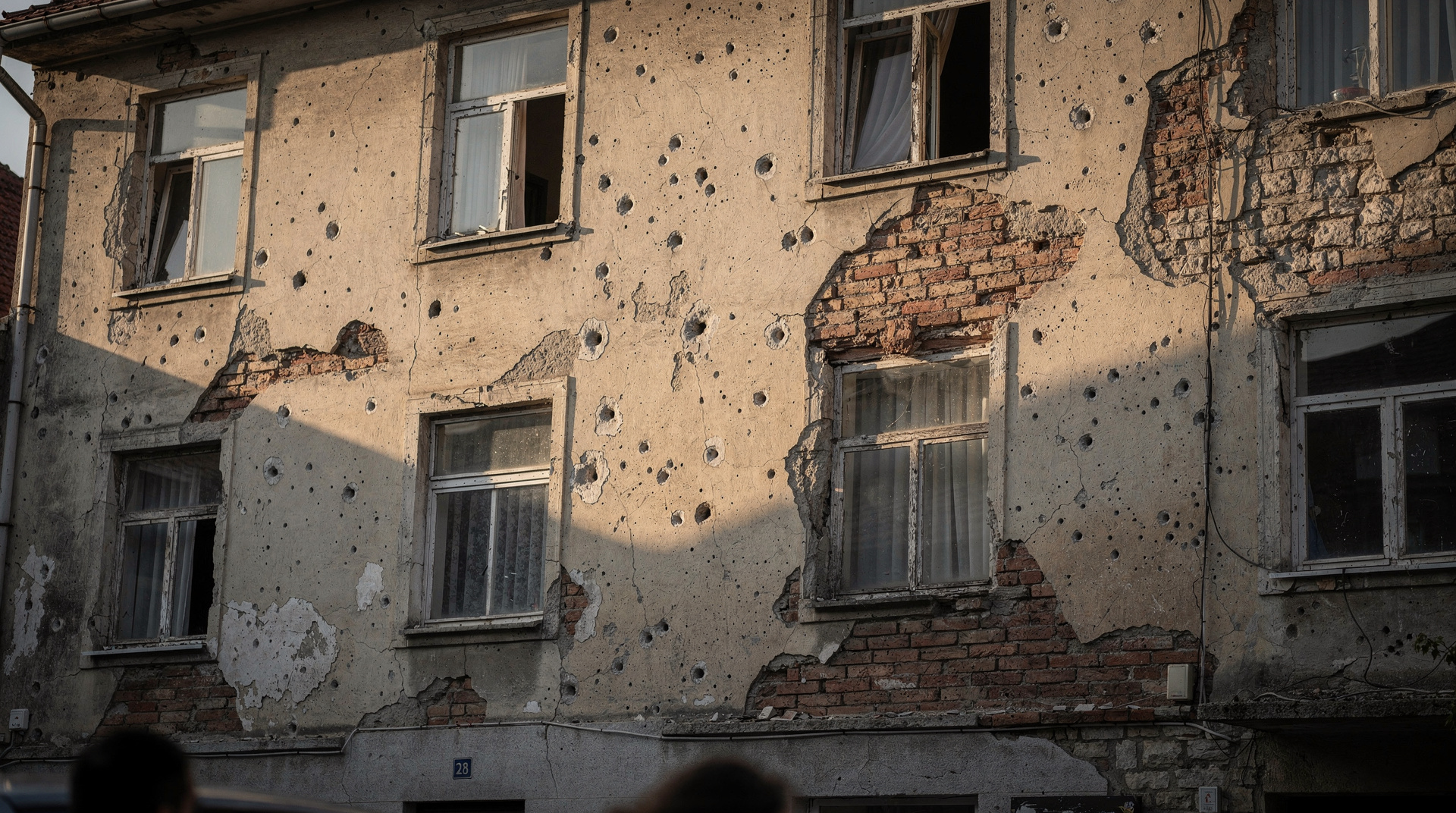
The eastern half of the city — the older Ottoman quarter, including Stari Most — was subjected to a siege within a siege. Bosniak residents were trapped. Supplies were cut off. Snipers made the streets lethal.
On 9 November 1993, after repeated earlier shellings that had damaged the bridge, Croatian forces concentrated artillery fire on the arch itself. It took two days. The bridge, weakened by earlier hits, cracked and fell into the river on 9 November. Eyewitnesses on the eastern bank said it made a sound like a groan.
The destruction was widely seen as an attempt to erase the cultural and historical fabric of Bosniak Mostar — to make reunification physically as well as psychologically harder.
The rebuilding
The idea of rebuilding Stari Most was proposed almost immediately after the Dayton peace agreement in 1995. The project became an international symbol of postwar reconstruction — not just of buildings, but of coexistence.
The engineering challenge was formidable. The original construction methods were partially known, but the exact techniques for cutting and placing tenelija limestone were not fully documented. Artisans were found and trained. Old photographs and surveys were studied. The stones salvaged from the riverbed (most of the original bridge was retrieved by divers) were found to be too damaged by the fall and subsequent immersion to reuse structurally.
New tenelija was quarried from the same source as the original. The reconstruction used traditional hand tools as far as possible alongside modern surveying technology. The rebuilt bridge is technically a replica, but the materials, proportions and profile are as close to the original as research and craft could achieve.
Stari Most was reopened on 23 July 2004 — nearly eleven years after its destruction. The ceremony was attended by dignitaries from across the region. Local divers leaped from the parapet into the Neretva, as they had for centuries before.
In 2005, Stari Most and the historic centre of Mostar were inscribed as a UNESCO World Heritage Site.
The architecture, briefly
The single arch is the defining engineering feat: no central pier interrupting the river, just one continuous span of tenelija limestone rising to its 21-metre peak. The stone blocks were fitted together with iron clamps set in lead, a technique that let the structure flex slightly rather than crack under load — part of why the original survived nearly 430 years of use, floods, and the wear of centuries of foot traffic across its worn, sloped surface. The bridge’s two guard towers, Halebija on the east bank and Tara on the west, originally served defensive and toll-collection purposes and now house small exhibits related to the bridge’s history.
What else to see nearby
The bridge sits at the heart of Mostar’s old town, and a visit rewards lingering rather than a quick photo stop. The Kujundžiluk bazaar streets running off both ends of the bridge are lined with copper and silver workshops, a trade that has continued in Mostar for centuries. For a broader sense of what else the town and surrounding area offer, the best day trips from Mostar guide and the Mostar where to stay guide cover logistics beyond the bridge itself.
Where the bridge fits in the wider region
Mostar rarely stands alone on a trip. Many travellers pair it with the Herzegovina countryside, and the Herzegovina day trip guide shows how the bridge connects to the villages and valleys around it. Blagaj and its tekke by the spring, Počitelj and its Ottoman village, and the Kravice waterfalls all belong to the same Ottoman-era and natural landscape that the bridge once served as a gateway to.
If the bridge’s story pulls you further into the Ottoman past, the Ottoman heritage guide places Hayruddin’s arch among the mosques, bazaars and bridges built across the country, and the Višegrad bridge on the Drina offers another famous crossing with its own, very different history. For the wider backdrop to 1993, Bosnia history for travellers and the Yugoslav wars explained give the context that a single page on one bridge cannot.
Visitors who want to see the city before choosing how long to stay can compare it with the capital in Sarajevo vs Mostar, or read the Mostar tourist traps guide and the best restaurants in Mostar to plan a more comfortable day around the bridge. Those following the route from the capital can use the Sarajevo to Mostar transport guide, and the Sarajevo and Mostar in three days itinerary puts both cities into one trip. The Herzegovina weekend itinerary is a good fit if the bridge is only one stop among several.
Visiting Stari Most today
The bridge is the centre of Mostar’s tourist life. In summer it is crowded from mid-morning — the narrow cobblestoned approaches fill up quickly with day-trippers arriving on coaches from Dubrovnik, Split, and Sarajevo.
The divers you will see on the parapet are real — young men from the Ikari diving club have been jumping from the bridge since before the war, and they have resumed the tradition since reconstruction. If they approach you before jumping, it is to collect a contribution. You are not obliged to give, but it is customary if you have been watching and waiting for the jump. The full story is in our bridge divers honest guide.
For a walking context of Mostar’s war history and recovery, a local guide tour makes the layers of the city legible in a way that independent exploration cannot fully replicate.
If you would rather have the story told as you walk, a private guided walk through the old town and across the bridge lets you ask questions about 1993 on the spot, while a shorter highlights tour of the old town suits a tight schedule. Travellers based on the coast can also join a full-day trip to Mostar from Dubrovnik, though the early or late hours at the bridge are usually only possible if you stay overnight. Whichever you choose, the Stari Most guide and the Neum corridor crossing guide help you plan around the border and the crowds.
What remains unresolved
Mostar is still a divided city in ways that are uncomfortable and important to acknowledge. The physical bridge is rebuilt. The social bridges are not fully reconnected. The city’s political system remains structured around ethnic division — it did not hold a unified city election for over a decade.
The east bank remains predominantly Bosniak; the west predominantly Croat. The cemeteries on the hillsides above both halves are full of graves dated 1993 and 1994. The war history of Mostar is something a thoughtful visitor owes it to themselves to understand before arriving.
And yet the bridge stands. Hundreds of thousands of people cross it every year. The Neretva flows green below, as it always has. Whatever it cannot fix in the city’s politics, the bridge does something quieter: it proves that the impulse to rebuild, to restore, to refuse erasure, is stronger than the impulse to destroy.
That is worth walking across to consider.
Frequently asked questions about story of Mostar’s Old Bridge
Is the Stari Most in Mostar the original bridge? No — the current bridge is a faithful reconstruction completed in 2004, using new tenelija limestone from the original quarry and traditional building techniques, after the 1993 destruction during the Bosnian War.
Can you still see divers jump from the bridge? Yes — members of the Ikari diving club jump from the parapet regularly in season, a tradition that predates the war and has continued since reconstruction; they typically collect contributions from onlookers before jumping.
Top experiences
Bookable activities with verified prices and instant confirmation on GetYourGuide.